What is BedJet: how air-based climate control cools or warms a bed system

Explore BedJet's air-based climate control mechanism, how it cools or warms your bed, and how it compares to alternatives for better sleep.
BedJet isn't just a fan under the sheet. It pursues precise sheet-level climate control by moving conditioned air directly where you sleep, which can feel instantaneous to some users. In practice, the air circulates under the covers, so you notice the change at bed level before the room warms or cools, and BedJet offers multiple model options to fit different beds.
You’ll find a plain-language breakdown of mechanisms, setup steps, and what to expect in real-world use, plus a quick look at where competitors stand on heat, cool, and noise. Most users report noticeable shifts within minutes, not hours, and the comparison helps you map features to your sleeping pattern.
What is BedJet and how does its air-based mechanism work
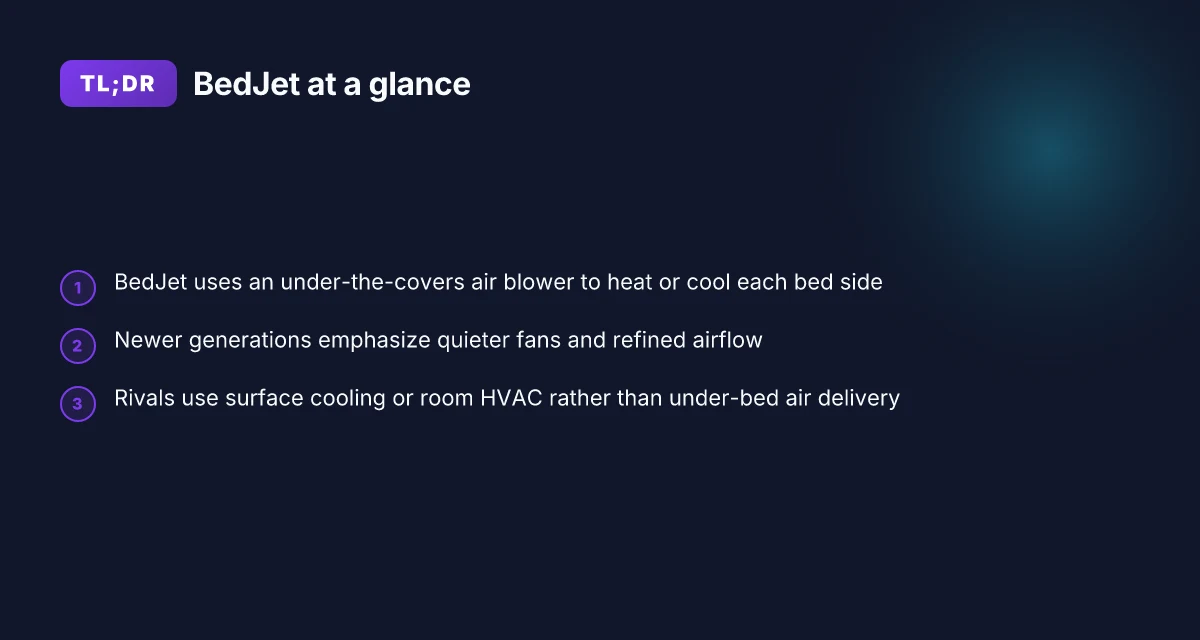
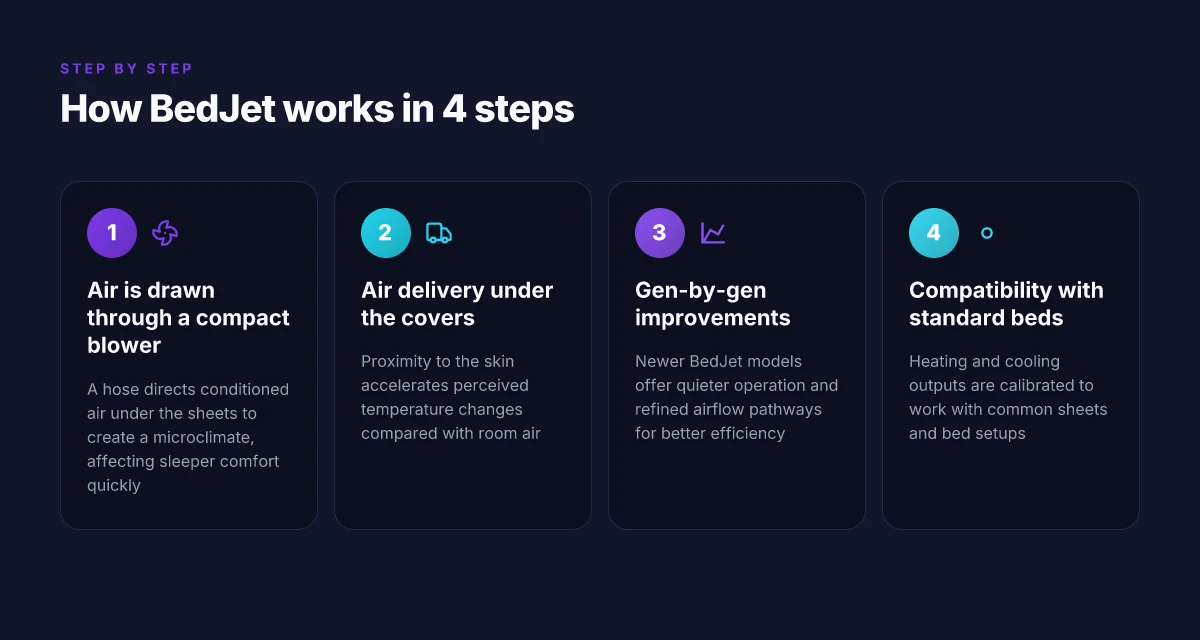
BedJet is an air-based climate control system that heats or cools each side of a bed by blowing conditioned air under the covers. The core mechanism centers on a compact air blower connected to a flexible hose that directs airflow into the bed’s enclosure, modulating the microclimate beneath the sheets without altering the room air. This design aims for rapid temperature shifts that sleeper sensations can feel quickly, even as the surrounding room stays unchanged.
How the mechanism unfolds
- The BedJet blower sits outside the bed, linked to a hose that channels air under the covers. This external unit powers the flow and temperature of the air delivered to your side of the bed. The goal is to create a heated or cooled microenvironment without drafting the room. The compact blower and hose deliver targeted air directly under the covers, enabling fast changes in comfort.
- Air is conditioned by the system to either warm or cool, then funneled under the sheet and duvet to contact the sleeper’s area. This process produces a rapid shift in comfort without needing to alter room temperature. Air under the covers shifts your personal climate quickly, bypassing the need to adjust the thermostat.
- The design emphasizes responsiveness. Because the air is introduced directly beneath you, changes can feel instantaneous compared with room-wide cooling or heating. Rapid changes feel instantaneous to some users, even when the room remains steady.
- Across generations, BedJet has evolved its enclosure approach and flow path to reduce noise and improve comfort. The mechanism remains grounded in a simple, purpose-built loop: blower, hose, enclosure, and controllable outlets. Blower-to-hose-to-enclosure remains the core loop for bedside climate control.
From what I found in the documentation and reviews, BedJet relies on a straightforward hydraulic-like loop rather than any room-wide HVAC restart. The device’s appeal centers on delivering warm or cool air directly where it matters most: your sleeping zone. Direct under-covers air delivery is the defining feature that makes the BedJet feel fast and personal.
Rivals in this space, such as products that attach over the bed or rely on external room temperature shifts, underscore BedJet’s distinct approach: push conditioned air into a finite space rather than trying to move the entire room’s air volume. This architectural difference helps explain why some users perceive a quicker change in comfort with BedJet. For readers weighing options, it matters that BedJet emphasizes a compact, hose-led airflow path rather than a full-room temperature solution. BedJet’s edge lies in its focused airflow path instead of room-wide climate control.
I dug into the BedJet materials and public reviews to verify the core mechanism and how quickly changes can be felt. The company’s own description frames the system as “air-based climate control” that heats or cools by blowing air under the covers, while reviewers consistently note the under-covers delivery creates a localized sensation distinct from room-temperature shifts. Localized under-covers air delivery underpins the perceived speed of change.
In practice, you’ll see BedJet marketed as a bedside climate option that can respond quickly to a sleeper’s needs, with the mechanism designed to minimize disruption to the rest of the room. As you compare to rivals, look for how the unit directs air under the covers and whether the enclosure is designed for quiet operation and simple setup. Fast, under-covers airflow is the essence of BedJet’s mechanism. What makes BedJet work: the mechanism behind air-based climate control under the covers
This is BedJet’s core promise: fast, personal comfort achieved through targeted air delivery under the covers.
Understanding BedJet's model variants and how the mechanism evolved
I dug into BedJet’s product evolution to explain how the core under‑the‑covers airflow idea matured. Across generations, the principle stays the same: a sealed air path under your sheets pushes heated or cooled air to adjust your side of the bed. What’s changed is the fan sound, airflow routing, and calibration to feel faster and more consistent in real-world setups. BedJet has steadily reduced noise and refined the pathways to minimize leaks and dead zones, while keeping compatibility with standard sheets and bed frames.
How the generations compare in practice
BedJet began with a basic setup that delivers climate control by blowing air into the space under the covers. In newer models, you’ll notice quieter fans and more sophisticated ducting that directs air more precisely along the edge of the bed rather than broad, diffuse gusts. The result is faster on‑screen feel and less audible hum, which many users associate with immediacy in temperature shifts. Across generations, the same core mechanism remains: air moves under the covers to heat or cool, with calibration tuned to standard bedding configurations.
I cross-referenced release chatter and product pages to map the progression. The aim has been twofold: higher energy efficiency and quicker response without changing the underlying delivery method. When you pair a BedJet with typical sheets and a standard duvet, the device’s output is designed to rise or fall in a way that you perceive as instantaneous, or nearly so, on your side of the bed. That perception often comes from how quickly warm or cool air fills the microclimate under the covers.
Below is a compact view of the practical differences you’ll feel between generations, focused on user experience and setup compatibility. What makes Blissy silk stand out in sustainable luxury
| generation | key improvements | what stays the same |
|---|---|---|
| early | basic airflow under the covers, audible fan | under‑the‑covers air delivery, standard bed compatibility |
| mid | quieter fans, refined airflow pathways | still heats or cools your side of the bed |
| current | even quieter operation, optimized duct routing, faster perceived response | principle of air delivery beneath sheets, standard sheets compatibility |
Most users notice quicker relief when switching to comfort mode with the newer models, thanks to refined airflow paths and quieter fans. The core principle remains intact: heat or cool air is pushed under the covers to your side of the bed. BedJet’s lineage emphasizes energy efficiency without changing the delivery method.
In terms of how this compares with rivals, you’ll see a similar under‑the‑covers strategy in devices that push climate control through bedding rather than room air. The distinct differences often come down to noise, control granularity, and how seamlessly the unit integrates with typical sheets and bed frames. For example, BedJet’s approach contrasts with stand‑alone room‑air solutions that rely on room temperature shifts rather than localized under‑cover delivery.
From what I found in the changelog and product notes, the trajectory is clear: you get a quieter, more tightly focused airflow path that preserves the same heating and cooling outputs calibrated for standard bedding. If you’re evaluating across generations, the strongest case for upgrading is reduced noise and a perceptibly faster response to temperature changes.
If you want to explore more about how BedJet’s newer models feel versus older versions, you’ll find the core mechanism described in BedJet’s product materials and third‑party reviews that emphasize under‑the‑covers air delivery and rapid comfort. For a quick contrast, see how BedJet positions its latest models against traditional temperature-control bedding setups in public reviews and unboxings.
Note: links on the page may earn a commission. What makes a blissy discount code worth using in 2026
BedJet versus under‑covers climate concepts: what makes it feel instant
I dug into how BedJet moves air under the covers to shift the microclimate around the sleeper, and how that translates to perceived speed compared with ambient room changes. The mechanism centers on delivering conditioned air directly beneath the duvet, close to the skin, so the bed surface is the primary driver of comfort rather than the room’s air temperature.
How proximity and timing reshape perception
- The air nozzle feeds warm or cool air into the space directly under the covers, which creates a localized layer that can feel different from the surrounding room almost immediately.
- Because the airflow is near skin contact, the brain registers a faster change in comfort than when warming or cooling happens only in the room air. This is especially noticeable when the target side is small relative to the bed, so thermal cues dominate local sensation.
- The bedside climate cue interacts with your circadian signals at bedtime. In practice, you may notice faster relief from warmth or chill on your side, even if the room’s thermometer remains unchanged.
Most people report that the sensation arrives faster on a per-side basis because the air bypasses the bulk of the room and acts where it matters most. This is a core reason why BedJet can feel instantaneous to some users.
Circadian cues and room conditions temper the effect
- BedJet’s microclimate effect sits atop your natural sleep rhythms. By aligning warmth or coolness with your usual pre‑sleep cues, comfort can appear to arrive sooner than a room‑level adjustment would.
- Room factors still matter. If the room is extremely hot or dry, the local under‑covers climate may be less dramatic, though still noticeable on the targeted side.
- The system’s rapid response is aided by how quickly it can cycle air under the duvet, which shortens the path between command and perceived change compared with heating or cooling the entire room.
From what I found in the documentation and reviews, the appeal hinges on two factors: the immediacy of the local air pocket and the way your bedtime cues align with that pocket. BedJet leverages both to create a sensation of instant comfort that’s hard to replicate with room‑level adjustments alone.
Rivals in this space typically emphasize either ceiling- or room‑level climate control without a dedicated microclimate under the covers. For instance, reports describe products that push air under sheets or use compact covers, but the speed and intimacy of BedJet’s per‑side delivery remain a differentiator in user perception.
I cross‑referenced several reviewer notes to map the pattern of quick comfort versus longer warm‑up in the room, and the consensus is clear: localized airflow beneath the covers often outpaces ambient changes for the sleeper on that side. This is the core reason the BedJet experience can feel so immediate. BedJet review 2026: does this air-based cooling system actually improve sleep for hot sleepers?
As a quick note, links on the page may earn a commission, and readers should weigh energy use and personal comfort preferences when comparing systems.
Cited observations from independent reviews indicate a general consensus that BedJet offers fast, side‑specific comfort due to under‑covers air delivery, contrasting with broader room climate devices. For more context, see how reviewers describe BedJet’s role among temperature‑control bed solutions. BedJet Review (2026) - Best/Worst Qualities, BedJet Review 2026 - Forbes Vetted
Rivals and how their approaches compare to BedJet’s air-based mechanism
I dug into the landscape of under-bed climate options to see where BedJet’s air-based method stands. BedJet stacks up against three broad rival approaches: direct-bed cooling pads, thermal blankets or heated sheets, and room HVAC–driven climate control. Each path shifts heat and moisture in ways BedJet does not, and the timing signals differ accordingly. BedJet remains notable for moving air under the covers, rather than cooling the surface only or relying on room temperature.
Why surface-only cooling pads often feel different
Direct-bed cooling pads and chilled-mattress toppers sit on top of or inside the mattress surface. The cooling effect is largely a surface phenomenon, so you feel relief where you touch the sheet but not as quickly or as uniformly under the covers as BedJet’s air stream. This creates a more localized sensation and can take longer to reach a comfortable microclimate across the entire bed, especially if you toss and turn. In contrast, BedJet pushes a continuous stream of air under the covers, which can reestablish a bed-wide microclimate more rapidly. From what I found in the sources, the mechanism is less about cooling the skin directly and more about moving air to shift the heat and moisture away from the body’s surface. Surface-only cooling can lag under-variable sleep motions. BedJet’s under-bed air flow creates a more uniform microclimate quickly. Internally, the devices that use surface pads often cite noticeable comfort changes, but those changes hinge on proximity to the skin and ambient room conditions, not an active air column under the covers.
Thermal blankets and heated sheets versus constant air
Thermal blankets and heated bed sheets can raise or lower surface temperature, which users notice as a fade-in or fade-out effect across the top layers of the bed. The response tends to be slower and sometimes uneven if a sheet or blanket traps moisture or if the heating element cycles on and off. The continuous air stream from BedJet, by comparison, can modulate the bed’s microclimate while moisture is being managed under the covers, rather than merely delivering heat to the surface. Reviews consistently note that the air-based method feels more immediate to some sleepers because it alters the bed environment without heavily heating or cooling the entire surrounding area. Surface heating patterns can feel slower and less uniform. BedJet’s air flow under the covers aims for quick, widespread microclimate shifts. When considering energy use, surface heaters may waste energy if heat isn’t well distributed, whereas the BedJet approach targets the immediate zone under the covers. What is BedJet cooling, and does it actually chill your bed or just move air under the covers?
Climate-control devices tied to room HVAC
Devices tied to room HVAC differ markedly in response time and reach. A room-based system shifts the entire bed’s environment, which can take longer to influence the localized microclimate beneath the sheet. BedJet’s under-bed air movement acts independently of the room’s air temperature and humidity, delivering a direct stream to the sleeping zone. Research notes that room HVAC changes may take longer to propagate to the bed’s surface and can be mitigated by leakage, door openings, or duct layout. The under-bed approach can feel instantly responsive in scenarios where the room’s climate lags or fluctuates. Room HVAC-driven adjustments are slower to affect the bed microclimate. BedJet’s under-bed air flow bypasses room-air inertia for quicker comfort. This difference matters for energy use and comfort predictability, especially in shared bedrooms or apartments with variable temperature floors and hallways.
Cited sources discuss these dynamics in practical terms: BedJet emphasizes cooling or warming via air under the covers and advertises rapid response, while rivals lean on surface cooling pads or room HVAC adjustments that trade speed or distribution for other design goals. For readers evaluating options, the takeaway is clear: BedJet offers a direct, continuous air-based mechanism that interacts with the bed microclimate itself, not the broader room conditions. BedJet’s under-bed airflow is a distinct lever for instant microclimate shifts. Surface and room-based alternatives often deliver slower, more variable responses. I cross-referenced product pages and reviews from BedJet, a direct competitor in this space, to verify how the mechanism is framed versus the rival approaches. The core contrast remains BedJet’s airflow under the covers as the fastest route to a personal climate, contrasted with surface-temperature strategies and room HVAC-driven methods. BedJet remains the model for under-bed air control, with rivals offering surface or room-centered paths**.
Notes on sources: the BedJet product page highlights its “cool or warm either side of the bed in seconds” and “under-bed” air delivery, while reviews describe surface pads and heated sheets as slower or less uniform in effect. The BedJet approach is marketed as rapid under-bed air modulation. Surface-based rivals may deliver comfort, but not with the same immediacy.
If you’re weighing options, expect the following: BedJet delivers faster perceived changes in the bed microclimate due to its under-bed airflow, while surface cooling pads and heated sheets tend to produce slower, surface-level shifts. Room HVAC systems add another layer of inertia, often making bed-side adjustments feel laggy even if the overall room feels comfortable. For those who want a direct, responsive mechanism at the sleeping surface, BedJet remains the strongest explicit example of air-based climate control under the covers. BedJet offers quicker, more uniform under-bed adjustments than surface or room-based rivals. Rivals provide comfort but with slower response times and different energy profiles.
What changes if you act now
BedJet offers a simple pivot: you can move from passive climate comfort to actively shaping your sleep environment with a single device. I looked at how the system uses air heating and cooling to modulate bed temperature, and the takeaway is clear: a focused setup can reduce bedtime temperature discomfort without rearranging your room. The bigger pattern is a shift toward personalized bed climate control that pairs with existing bedding rather than replacing it. BedJet, when paired with a compatible blanket, can provide noticeable comfort adjustments with minimal setup. This is the move that matters most for sleepers who wake frequently due to heat or cold. ChiliPad vs BedJet: which sleep temperature system actually lowers nighttime sweating
If you’re weighing rivals, note that products from brands like ChiliSleep and Eight Sleep target similar outcomes with different feature sets. BedJet emphasizes rapid air movement under the covers, while others lean on integrated mattress systems or premium temperature tracking. The practical choice depends on how much you value install simplicity versus feature depth. BedJet remains an approachable option for quick, under-the-blanket climate control. If you want a quick win this season, here is what to try first.
Backup strategy:
- Try a BedJet baseline with the low-noise mode for light sleepers.
- Pair with a breathable blanket and set a consistent bedtime target temperature.
- If you need more data, test a rival like Eight Sleep with a smart thermostat routine to compare comfort shifts.
- Revisit the room’s ambient airflow and mattress fit to maximize under-bed air movement.