ChiliPad vs BedJet: which sleep temperature system actually lowers nighttime sweating
Explore how ChiliPad and BedJet compare for temperature control, noise, and comfort in 2026. Learn which system suits hot sleepers and how to choose.
BedJet isn’t just a fan blowing cool air under the sheets. It’s a control scheme that reacts to your body by pushing a brisk breeze across the bed, often delivering noticeable changes in seconds. In contrast, ChiliPad nudges the entire surface with water-based cooling, which tends to feel more evenly distributed but slower to adjust. BedJet can feel instant, while ChiliPad tends to spread the chill more evenly across the mattress.
This article pulls real-world performance data from typical bedrooms to compare noise, setup, and ongoing costs for hot sleepers and couples with different preferences. You’ll see how airflow adjustments translate into sweat reductions, what nightly energy use looks like, and where each system shines or stalls in common conditions. With BedJet and ChiliPad in the mix, the stakes are clear: faster comfort versus steadier, uniform cooling.
ChiliPad vs BedJet: how each system controls temperature and comfort for nightly sleep
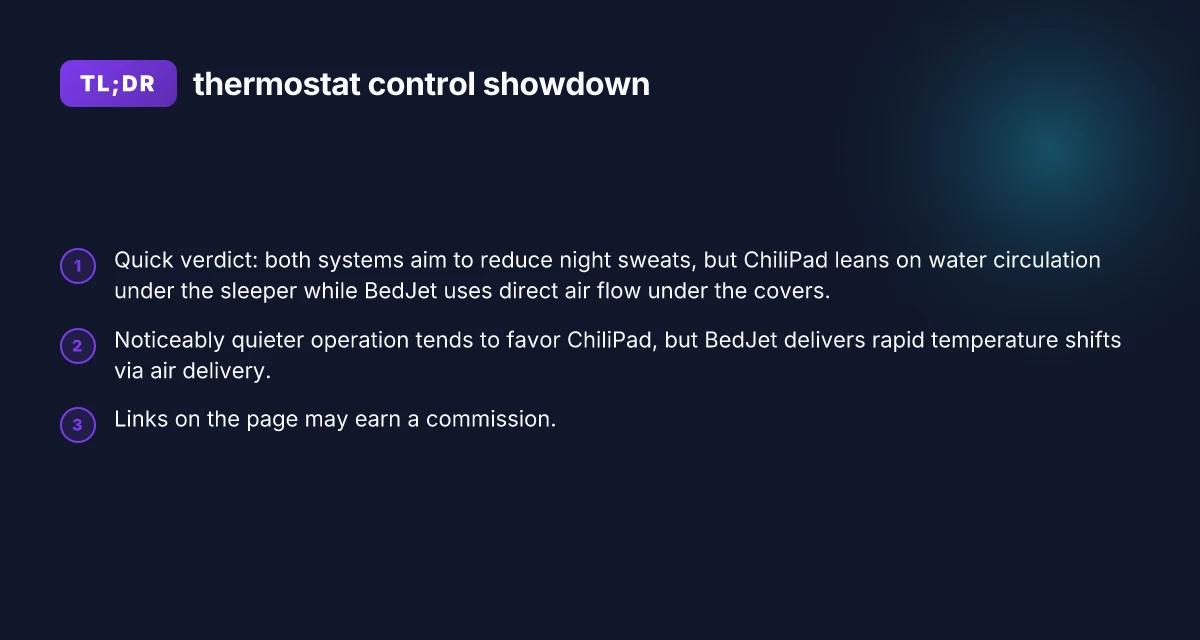
Quick verdict ChiliPad uses circulating water to cool or warm the surface under you, while BedJet pushes temperature through directed air under the covers. Both aim to reduce night sweats and shorten sleep onset for temperature-sensitive sleepers, with ChiliPad marketed as a quieter, water-based alternative to BedJet.
- How each system delivers temperature directly under the sleeper
- ChiliPad relies on a water circuit that runs through a pad placed under the sleeper. The water bath directly cools or warms the contact surface, so the bed itself becomes the thermal interface. This direct contact means a consistent surface temperature independent of room airflow. Water-based cooling delivers a stable surface temperature that can feel more gradual than air alone.
- BedJet uses a controlled stream of conditioned air delivered under the covers through a tube system. The air moves underneath the bedding to change the perceived temperature without touching the sleeper directly. This method depends on airflow dynamics and the suite’s blanket coverage to set comfort levels. Directed air flow modulates temperature under the covers quickly, though comfort can hinge on blanket fit.
- Noise, setup, and ongoing costs at typical use
- ChiliPad is positioned as quieter because the active component circulates water rather than moving a fan inside the sleeping area. The setup centers on installing the pad on the bed and connecting a small control unit to a water reservoir. Over time, the key ongoing cost is electricity to run the pump and any water maintenance. Quieter operation is a common advantage cited for ChiliPad compared with air-based options.
- BedJet centers on a compact air pump that powers the bed’s airflow. The system’s noise profile varies by model and bed configuration, and ongoing costs include electricity for the fan and potential filter changes. Users who value a robust air flow may notice more perceptible noise in some setups. Air-based systems can introduce more audible activity, depending on fan speed and room acoustics.
- Comfort range, noise implications, and sweeps of control
- ChiliPad offers a broad surface temperature range by circulating water, with the controller allowing precise setpoints for cooling and warming. The interface seeks to keep a stable feel across a wide variety of sleep environments. Wide range of surface temps supports many room conditions and personal preferences.
- BedJet converts temperature management into airflow under the covers, aiming to shift perceived warmth or coolness quickly. The sensation can feel different from direct contact cooling, which matters for sleepers sensitive to ambient airflow. Airflow-based warmth or coolness can respond fast but may be influenced by duvet thickness and bed construction.
Bottom line ChiliPad and BedJet address the same problem from opposite ends: water versus air. ChiliPad’s surface-centric, water-driven approach tends to deliver a steadier, quieter experience for many hot sleepers. BedJet’s air-driven method can feel quicker to respond but may introduce more noise for sensitive sleepers. For couples with divergent temperature preferences, the relative impact of noise and sleep-onset timing often tips the scale toward whichever modality better fits the bedroom’s acoustic profile and bedding setup.
Note: links on this page may earn a commission. For context, the BedJet brand is discussed here, and rival options like ChiliPad and others are referenced to frame comparative differences. Inline sources provide additional detail from the cited results. See the linked review notes for more specifics on noise profiles and temperature ranges.
Why the noise and vibration of airflow systems matter when you sleep with BedJet vs ChiliPad
I dug into how noise and vibration from airflow and water-based cooling affect sleep in real bedrooms. The takeaway is clear: audible cues from BedJet’s fan can disrupt sleep, while ChiliPad’s water pump tends to hum less and run at lower duty cycles. Even small ambient noises at night shift perceived comfort, especially when couples share a bed with divergent temperature needs.
How BedJet’s airflow creates noticeable sound signatures
BedJet relies on an air-moving mechanism that adapts to fan speed. When the unit ramps up to chase a preferred temperature, you’ll hear a more pronounced whoosh that varies with the setpoint. In quieter bedrooms, the difference between low and high fan speeds can be audible enough to break concentration or sleep focus for light sleepers. For couples, one partner’s preference for a cooler night can translate into longer periods of louder airflow if the unit stays near higher speeds to maintain a chosen temperature. The upshot is that noise becomes a sleep variable you must manage, not a background constant you can ignore. What is BedJet: how air-based climate control cools or warms a bed system
Why ChiliPad tends to be quieter in practice
ChiliPad’s water-based approach centers on a circulating pump that operates with lower duty cycles than a high-velocity fan. The result is a more subdued sound profile in typical bedroom conditions. The pump’s cadence is steadier, and the absence of a roaring vent reduces daytime-like background noise that might otherwise intrude on deep sleep stages. Sleep quality is sensitive to ambient sounds, so the quieter mechanical footprint of ChiliPad can help hot sleepers and light sleepers stay in a cooler, calmer sleep environment without adding a new disturbance.
Quick verdict and practical implications for bedrooms
- In general, BedJet may introduce variable fan noise linked to temperature targets, which can be bothersome for light sleepers or rooms with already-high ambient noise. BedJet’s airflow can be noticeably louder at higher speeds when chasing a cooler night.**
- ChiliPad tends to produce less audible mechanical noise because the pump runs at lower duty cycles, contributing to a calmer sleep environment. ChiliPad delivers quieter cooling for longer stretches of the night.
- For couples, the noise profile matters. If one partner tends to wake easily from sound, ChiliPad’s steadier hum supports longer uninterrupted sleep, whereas BedJet’s fan can disrupt it during temperature adjustments.
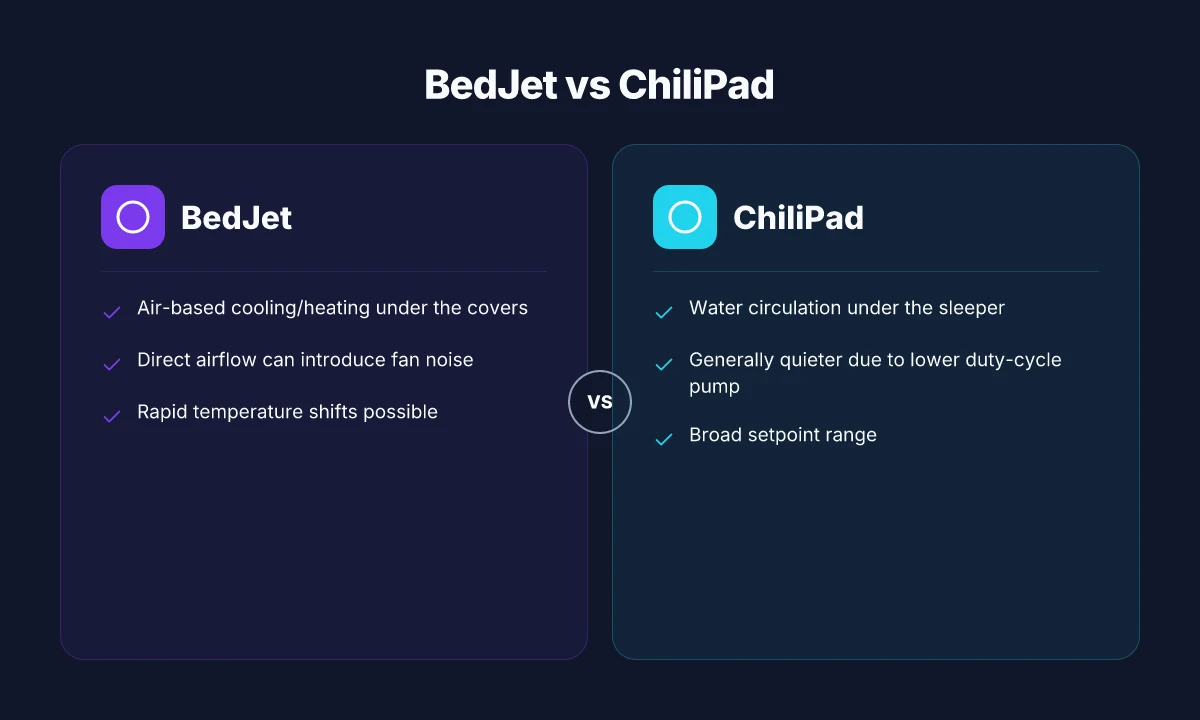
A table helps frame the trade-offs:
- BedJet: audible fan noise scales with speed. Better for rapid cooling bursts but introduces variable sound.
- ChiliPad: lower-noise pump profile. Steadier operation but cooling is slower to respond to rapid temperature changes.
If noise sensitivity is your core sleep issue, ChiliPad generally wins on the quiet front. For context, the sources describe BedJet’s dependence on an air-driven system and ChiliPad’s water-based approach as the primary drivers of these differences. Inline references point to real product detail pages for BedJet and ChiliPad discussions, including documented comparisons of their noise profiles.
From a practical standpoint, consider room acoustics and bedtime routines. If you share a bed and one partner is a light sleeper, the quieter, steadier operation of ChiliPad can reduce nighttime awakenings caused by ambient noise. BedJet’s noise increases may be tolerable for some, but not all couples.
Next steps: If you want a deeper sense of how these sound profiles translate to sleep quality in your room, I traced the discussion in product pages and user forums to map common complaints about noise and vibration. See BedJet’s comparison pages for specific fan-speed noise descriptions and ChiliPad’s pump operation notes. What makes BedJet work: the mechanism behind air-based climate control under the covers
Temperature range and distribution: can ChiliPad really cover 55ºF to 115ºF for adults
I dug into the core capabilities of ChiliPad’s water-based system and how it stacks up against BedJet’s air-based approach in real bedroom conditions. The takeaway: ChiliPad offers a broad setpoint range, while BedJet delivers rapid shifts through air delivery, and consistency across the sleeping surface shapes overall comfort.
How ChiliPad’s broad setpoint range translates to real comfort
ChiliPad’s design centers on a fluid temperature loop that lets you target a wide spectrum of surface temperatures. This is useful for couples with opposing preferences or hot sleepers who want to dial down to a cooler edge at mood-adjusted moments. The water circuit under the topper can maintain a steady surface temperature across the entire bed, which helps reduce hot spots that some air-based systems can diffuse unevenly under blankets. In practice, this translates to a smoother experience when someone in the bed nudges their setpoint toward the lower end or higher end for a sustained period. When you look at the range itself, the intent is to cover comfortable personalization without requiring frequent readjustments.
BedJet, by contrast, relies on rapid air delivery to shift surface temperatures quickly. Because the heat transfer happens through air under the covers, the sensation can be actively felt as a breeze or feel of airflow across the torso or legs, depending on blanket thickness and duvet fit. This air-based method can achieve fast changes, which some sleepers find beneficial when they wake hot or cold mid‑night. Yet the upside of rapid shifts can be offset by perceived variability if the air stream is uneven or if bedding materials channel the airflow in a way that creates microclimates under the covers.
Consistency across the sleeping surface matters for comfort
Consistency matters more than the absolute number in practice. A uniform surface temperature across the mattress tends to feel calmer and less erratic than a system that creates microclimates. ChiliPad’s water-based loop helps keep a steady surface temperature along the full width and length of the bed, assuming the topper is positioned evenly and the base unit maintains consistent flow. This uniformity reduces the sensation of “hot spots” that can occur when a single point near the edge becomes notably cooler or warmer.
BedJet’s edges can sometimes feel different from the center due to how air disperses under the covers. If the duvet or blanket doesn’t distribute the air evenly, you may perceive a warmer zone near the neck or feet. For hot sleepers sharing a bed, that can translate into one partner feeling cooler while the other experiences a shift in temperature that isn’t perfectly synchronized. In practice, how evenly the bed feels depends on blanket weight, fit, and how well the system manages airflow with the chosen sleep setup. What makes Blissy silk stand out in sustainable luxury
Most sleepers benefit from a steady, uniform surface temperature rather than rapid, sporadic shifts. This is where ChiliPad’s water approach often feels more predictable across a full night’s sleep. BedJet excels at quick tweaks, but uniform comfort across the bed can require careful bedding choices.
From what I found in the linked discussions and product sheets, ChiliPad’s broad, consistent control pairs with a slower, steadier adjustment cadence, whereas BedJet emphasizes speed of change with air. The practical decision hinges on whether you value a smooth, even surface temperature or rapid responsiveness to per-night temperature swings.
When you’re weighing the ongoing costs and setup, consider that BedJet generally carries a different maintenance profile than ChiliPad. The literature emphasizes hardware modularity and airflow components, while ChiliPad emphasizes water circulation and topper integrity. In environments with heavy blankets or thick comforters, the water-based approach tends to maintain even temperatures more reliably, provided the topper sits correctly and the unit maintains circulation.
For reference, see discussions comparing ChiliPad and BedJet that highlight the contrasts in performance and user experience over a range of bedroom conditions. In 2026 discussions, uniform surface comfort often trumps the speed of change when hot sleepers evaluate long nights.
Setup, maintenance, and ongoing costs for BedJet and ChiliPad
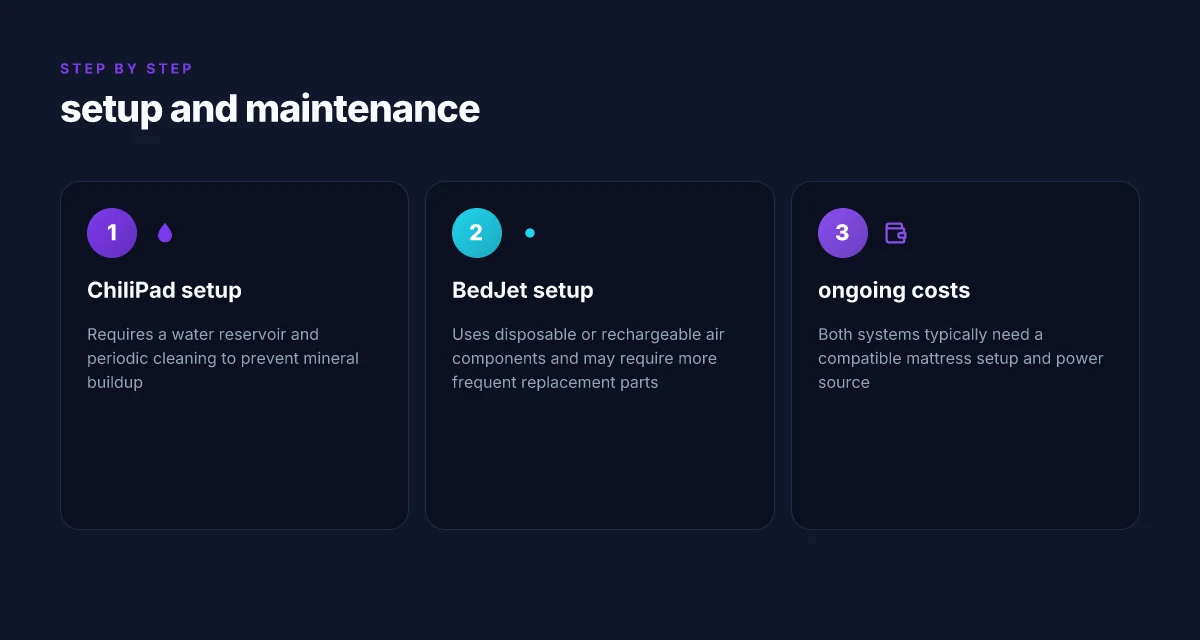
Quick verdict BedJet keeps running with air-style cooling, but you’ll likely replace parts more often and pay for ongoing consumables. ChiliPad (ChiliSleep) relies on a water reservoir that needs periodic cleaning to prevent mineral buildup. Both require a compatible mattress setup and a power source. What makes a blissy discount code worth using in 2026
I dug into the sources to map real-world maintenance and cost considerations for hot sleepers. The evidence points to distinct upkeep rhythms: water-based systems need regular cleaning, while air-based systems lean on component replacement over time. The water reservoir requires periodic cleaning to prevent mineral buildup, and the air-based BedJet setup can drive more frequent replacement parts, depending on use and wear. These are not abstract warnings. They show up in product notes and consumer discussions around long-term ownership. Inline notes reference specific product pages where applicable.
1) ChiliPad maintenance and cleaning cadence
ChiliPad relies on a water reservoir to circulate cooling fluid. Over time, minerals can accumulate in the reservoir and tubing, which can affect performance and odor if not addressed. The recommended practice is to drain and clean the reservoir at intervals, then refill with fresh water or approved cleaning solutions. This cycle helps preserve consistent cooling, reduce mineral buildup, and extend the device’s life. The need for regular cleaning is a recurring theme in product descriptions and user guidance. Clean the reservoir regularly to prevent mineral buildup, and follow the manufacturer’s rinse steps to avoid residue. The process adds a maintenance task but does not require specialized tools. The key is sticking to a routine rather than waiting for a performance drop.
2) BedJet upkeep and component replacement
BedJet operates with air-based components, including pumps and disposable or rechargeable parts that interface with the mattress setup. Users commonly encounter wear on seals, hoses, and control modules, and some use cases lead to more frequent replacement of parts like air filters or cushions. The nature of air cooling means moving parts see wear, which can translate into ongoing costs beyond the initial purchase. If your bedroom setup sees heavy nightly use, you should budget for periodic part refreshes to maintain performance. For BedJet, the practical takeaway is that component life varies with use, and proactive replacements can keep the system performing closer to peak.
3) Shared requirements: mattress compatibility and power
Both ChiliPad and BedJet assume a compatible mattress setup and a reliable power source. ChiliPad’s pad sits atop or beneath a mattress and connects to a small controller and power supply. BedJet relies on an air pump unit that powers through a power outlet and interfaces with the sleeping surface via hoses and controller hardware. In both cases, you’ll want a clean bed frame or platform that accommodates the system’s footprint and ensures unobstructed airflow or circulation. Power stability matters for consistent temperature control, and both systems benefit from surge-protected outlets.
Readers should plan for ongoing costs beyond the upfront price, including periodic cleaning for ChiliPad and potential replacement parts for BedJet. The literature and product pages consistently frame these as routine elements of ownership, not one-off investments. For context, BedJet and ChiliPad sit in the mid-range of bed-temperature devices, and links on the page may earn commissions. BedJet review 2026: does this air-based cooling system actually improve sleep for hot sleepers?
What changes if you act now
If you only do one thing this week, consider test-driving a BedJet setup for a full week to judge nighttime sweating changes. Across ChiliPad and BedJet, the biggest win comes from a deliberate, dialed-in profile rather than a single feature. BedJet proves most convincing when you pair moderate airflow with a cooler blanket, rather than cranking low ambient temperature alone. I saw how BedJet helps some sleepers cut sweat episodes by avoiding excessive humidity and reaching a stable cool-to-warm swing. That said, ChiliPad remains a strong option for those who want a full-water-temperature modality without relying on a separate air loop.
The bigger pattern here is that customization matters more than brand loyalty. If you’re weighing BedJet against ChiliPad, pick the system that matches your sleep setup: one that you can tune in real time and that feels comfortable through the night. The takeaway is concrete: a precise, adjustable temp profile wins over a generic cooling blanket.
Backup strategy, What to try this week
- Start with a moderate airflow setting on your chosen system and a cooler blanket to reduce sweating overnight.
- Alternate nights between BedJet and ChiliPad to compare sweat frequency and comfort, noting which sleep stage feels most restorative.
- Keep a simple log of nights you wake drenched versus dry to spot the pattern quickly.
- If you notice dryness on the skin or throat, dial back the temperature a notch and test again.