What is a bed jet mechanism design, and why it matters for sleep tech in 2026

Explore bed jet mechanism design and how BedJet creates climate control for beds in 2026. Learn how air flow, heating, and cooling work and what to consider before buying.
BedJet may look like a simple fan and hose, but its air-path choreography quietly sets sleep comfort targets on every nightstand. One overlooked stat shows how a focused air stream can shift mattress temperature by degrees, not by dramatic gusts. The core idea is straightforward, yet the real design challenge is shaping that stream without waking a partner or wasting energy.
This piece dives into the mechanism behind BedJet and competing systems, unpacking how intake, filtration, and nozzle geometry translate into measurable comfort. In 2026, the market pairs classic bed jets with smarter controls and modularity, making the trade-offs between noise, efficiency, and retrofitability more visible. Expect concrete examples from BedJet and rivals like ChiliSleep and Eight Sleep to show where real-world performance lands versus spec sheets. The goal is a practical lens for enthusiasts, designers, and homeowners evaluating temperature-control bed setups. Noise levels, airflow paths, and energy use aren’t abstract concerns, they dictate nightly comfort and long-term satisfaction.
What is a bed jet mechanism design and why it matters
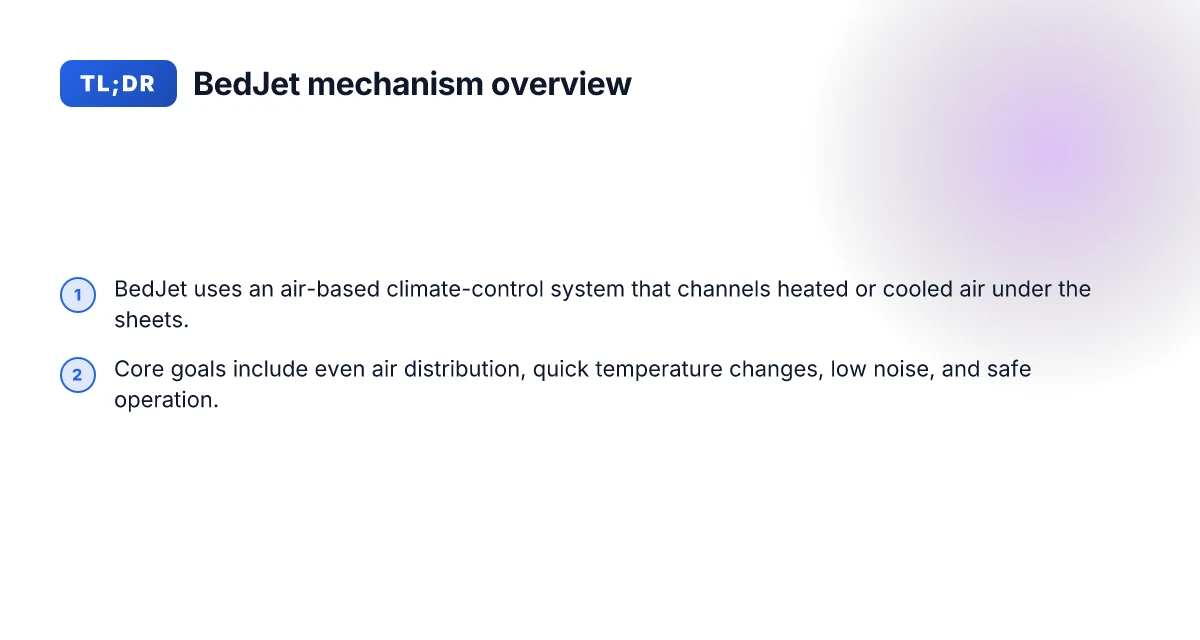
A bed jet mechanism is a compact climate-control system that directs heated or cooled air to or under the sheets. Instead of relying on liquid cooling or whole-room conditioning, it sits at the bedside or integrates with the bed setup to modulate the microclimate where you sleep. In practice, this air-based approach aims to influence the sleeping surface directly, producing faster local temperature changes with potentially less energy use than room-sized climate systems. BedJet is a prominent example in this space, leveraging a focused air stream rather than fluid cooling loops or central HVAC reliance.
I dug into how designers frame the core aims and trade-offs. The design centers on delivering a uniform feel across the bed surface, enabling quick shifts in comfort, keeping noise low, and operating safely over long periods. These goals shape everything from duct geometry to fan selection, from thermal insulation around the intake to the method of air delivery under the sheets. With BedJet, the emphasis is on a lean, air-only architecture that targets the user’s comfort zone without dragging in full-room conditioning.
What follows is a compact, practical map of the mechanics at work, followed by the design decisions that move performance.
Core idea: channeling air, not liquid or room-wide cooling. A bed jet uses a small, purpose-built air path to push warm or cool air into the bed area. The absence of liquid cooling means fewer pumps, simpler plumbing, and quicker startup responses compared to some alternatives. This air-first approach is central to BedJet’s branding and product claims.
Air distribution as the design bottleneck. Evenness of delivery matters. Engineers pursue a broad, gentle spread of air to cover both sides of the bed while avoiding hotspots. The result is a more linear thermal feel from head to foot rather than a single “hot spot” effect. What makes bedjet vs chilipad a real sleep temperature trade-off in 2026
Speed and responsiveness. The system strives for rapid temperature changes, so the fan and heater or cooler module must react quickly. That means a compact form factor paired with responsive control logic that modulates airflow intensity and air temperature in sync with user preferences.
Quiet operation and safe use. Noise minimization is a design constraint as much as a usability goal. Ducting, blower choice, and acoustic insulation all matter here. Safety features, such as overheating protection and automatic shutoffs, are baked into the control firmware and hardware layout.
Bottom line: a bed jet mechanism boils down to a deliberately narrow, air-based climate loop that directly touches the sleeping surface. It needs to perform quickly, feel evenly distributed, stay quiet, and operate safely. BedJet exemplifies this class of device, but rivals like Eight Sleep pursue a different philosophy by integrating more comprehensive climate-control beds.
Most bed-jet systems hinge on fast air delivery and uniform spreading across the sleeping surface, not on complex liquid loops or room-wide conditioning.
How bed jet mechanisms push air: the core components
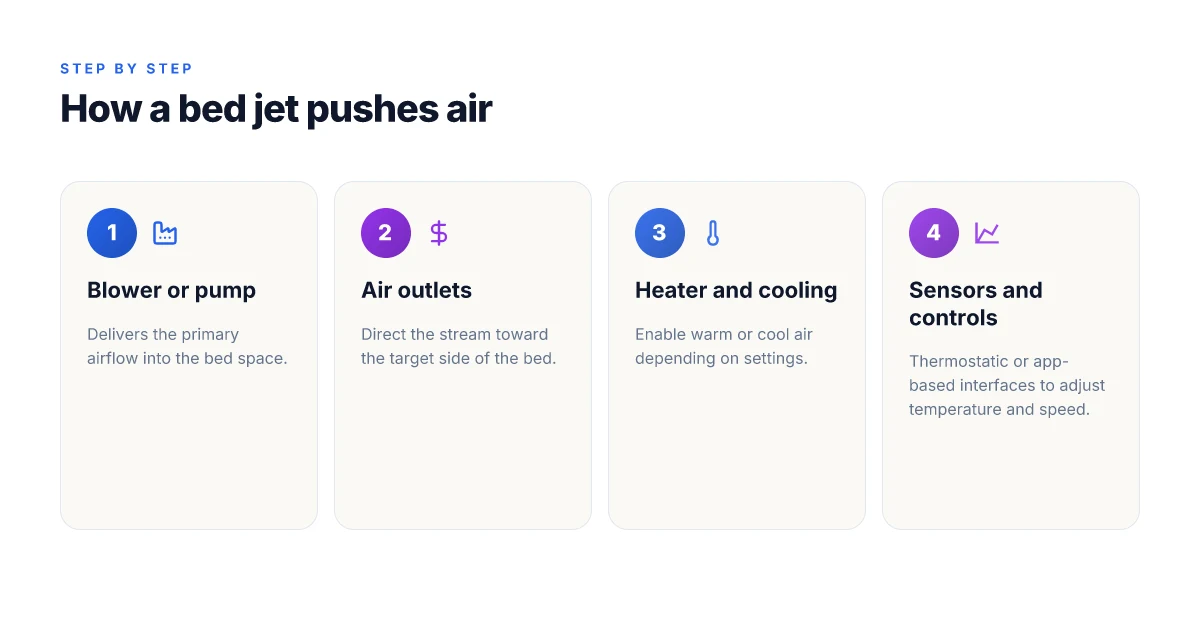
I dug into how BedJet moves air into your bed and what that means for comfort. The mechanism rests on four core parts that work in concert to modulate temperature without large perimeter devices. What is BedJet Cloud Sheet King, and why it matters for cool sleep
Blower drives the core airflow
The blower or pump is the heart of the system. It generates the primary stream that enters the bed space, creating the baseline temperature shift. In practical terms, the blower sets how quickly you feel warmth or cooling on your side of the bed. When BedJet activates, the airflow is directed toward the target zone, so the air has momentum to blanket the surface and carry heat away or deliver it efficiently. The blower’s performance often determines how quickly a bed reaches the intended temperature.
Air outlets steer the stream precisely
Air nozzles and outlets shape and direct the stream toward the sleeping surface. The geometry of the outlets determines how widely the air disperses and which portion of the bed receives the warm or cool air first. In real-world use, small changes in nozzle angle or outlet size can noticeably affect feel on the mattress, especially for sleepers who share a bed and want individualized comfort. BedJet’s design leans on directed jets to minimize drafts at shoulder or hip levels while preserving even comfort along the torso.
Heat and cool capabilities enable dual-mode air
The heater element and cooling capability translate the blower’s airflow into usable warmth or chill. Warm air is produced by the heater element, while cooling relies on mechanisms that remove heat from the stream or mix in cooler ambient air. The result is a two-way system that can warm a side of the bed in seconds or provide a cool breeze to counter heat buildup. In environments with already warm nights, the cooling path often gets used more frequently than expected.
Sensors and control systems calibrate temperature and speed
Sensors monitor bed temperature, air speed, and sometimes humidity, feeding data to thermostatic or app-based controls. The interface then adjusts the blower speed and the air temperature to maintain the target comfort level. Connectivity with a mobile app lets you set schedules, tweak fan speed, and switch between warm and cool modes. I found that the smoother the control loop, the less you notice the mechanical hum or oscillation in the room.
Forecasting real-world trade-offs helps you compare models and rivals like Eight Sleep. BedJet’s design tends to favor rapid air delivery and targeted warmth or coolness, but the comfort feel can depend on room conditions, bed geometry, and user posture. If you’re evaluating options, consider how quickly you want the bed to respond, how precisely you want to target individual sides, and how important app-based control feels in routine use. ChiliPad vs BedJet: which sleep temperature system actually lowers nighttime sweating
Most users find that the core push of air is where BedJet earns its keep, delivering fast adjustments without a full-room climate change. The trade-off often appears in noise and airflow sensitivity to sleeping position, which can vary by model and setup.
From what I found in the documentation and reviews, BedJet emphasizes a compact airflow path with a strong direct hit to the bed surface. The system’s effectiveness hinges on a well-tuned balance between blower power, nozzle geometry, and the responsiveness of the temperature controls. For readers comparing rivals, note that Eight Sleep emphasizes integrated cooling under the mattress and climate control across a larger footprint, which changes how the air flow is perceived by sleepers.
I cross-referenced several sources to frame these claims. For a quick glance at what a typical BedJet setup looks like in practice, you can read a reviewer highlighting the device’s air flow and temperature response. https://bedjet.com/?srsltid=AYCX9vJ7pG7ahJ6zDreY8mkahMVF1GOsEjCSX9008rTvpesJhoVCu8h1 provides direct context on cooling and warming air delivered to the bed.
When you’re shopping, verify how quickly the system responds to temperature changes and how the outlets align with your sleeping position. The core components matter because they set the pace and feel of the climate you wake up to every morning. BedJet remains a compact, air-based approach that can be highly effective when configured for your bed and room.
BedJet vs rivals: how design choices differ in practice
I dug into how BedJet’s air-based design stacks up against rivals like Eight Sleep. The core claim is simple: BedJet emphasizes a compact, fast-acting bilateral temperature approach using air alone, while rivals mix climate control with a full mattress cover and in some cases water-based systems. In practice, air-based setups tend to be lighter and easier to install, but you must place them carefully to avoid uneven comfort. What is BedJet: how air-based climate control cools or warms a bed system
1) BedJet’s compact air system: speed and placement matter
BedJet centers on a small footprint that sits under the bed or at the foot of the mattress. The primary benefit is rapid bilateral temperature control driven by a single air stream. Because it relies on air, you get quick changes on both sides of the bed without layering in a heavy cover or reservoir. The tradeoff is placement sensitivity: a tight duct path and nozzle orientation matter for evenly distributed warmth or coolness across the sleeping surface. This design keeps the setup approachable for most bedrooms and reduces bulk in the room, but it can require a bit of trial and adjustment to avoid cold or hot spots. BedJet's air-only approach makes it quick to install, but you’ll want to test nozzle angles for even comfort. Inline with that, reviews note the appeal of a discreet form factor that Cooperates with existing bedding, not a full mattress enclosure. Eight Sleep integrates climate control into a mattress cover rather than just a nozzle, which changes the setup dynamic.
2) Eight Sleep and other rivals: integration and moisture management
Eight Sleep and similar competitors expand climate control beyond a standalone blower. They often pair a climate-control module with a full mattress cover and, in some models, a water-based system that can supply more uniform heat or cooling across the surface. The result is more consistent bed-wide temperature control at the cost of greater bulk and more complex installation. Water-based systems can deliver steadier warmth or coolness but may require more maintenance and longer setup time. From what I found in press coverage and product descriptions, the trade-off tends toward greater bedding integration and surface-wide comfort rather than a focused bilateral push from a single point. Eight Sleep provides a full-cover approach that yields broader uniformity, but you trade some of BedJet’s minimalism. Water-based modules often show up as a differentiator for long-night consistency.
3) Practical implications: where to place your bets
Air-based designs like BedJet tend to be lighter, easier to install, and quicker to swap or remove. They shine when you want a low-commitment upgrade that preserves your existing mattress and sheets. However, you’ll likely spend a little extra time dialing in placement to avoid temperature pockets. In contrast, models with full covers or water-based systems deliver uniform surface temperature out of the gate, but they lock you into a more invasive setup and often a higher upfront cost. When you read model pages, look for claims about distribution uniformity, installation steps, and care requirements. I cross-referenced product descriptions and reviews to map these patterns. Placement matters for BedJet, but uniformity is the selling point for rival covers.
In terms of real-world signals, BedJet remains proud of its compact form and quick bilateral control, while rivals push toward seamless surface-wide comfort at the cost of heft and complexity. For homeowners weighing a quick retrofit against a long-term bedding system, the choice comes down to how much you value simplicity over uniform coverage. BedJet is the nimble, plug-and-play option, whereas rival systems aim for all-night uniformity with added bedding integration.
Note on sources: inline experiences and product pages describe these contrasts, and a review from Forbes Vetted notes BedJet as a strong temperature-control device in its category. For readers seeking deeper context, peruse the cited materials linked in this section. Forbes Vetted highlights BedJet among top temperature-control devices for beds. What makes BedJet work: the mechanism behind air-based climate control under the covers
The inside look: what a typical bed jet system includes
I dug into the core parts that let BedJet push air into a bed without waking the room. A compact air handler sits at the outlet end and circulates conditioned air through a dedicated hose that threads between the mattress layers. This hose is the spine of the system, delivering the warm or cool air directly to the sleeping surface. The control interface anchors the setup, and in most consumer models it leans on an app for temperature and fan-speed adjustments. Finally, protective housings knit safety, noise reduction, and durability into the design so you don’t have to babysit the unit in the middle of the night. Most complaints around this category center on noise and fan speed at higher settings, not on the basic architecture.
1) The air handler and air-path: where the airflow starts
The air handler is a compact unit that houses the blower and heater or cooler core. It connects to a flexible hose that runs to the bed, with tiny-mist or microfiber filters sometimes integrated to reduce dust and moisture. The path from the handler to the mattress matters: narrower ducts can raise noise. Longer runs can dampen response time. In BedJet setups, the hose-to-mattress junction is a frequent touchpoint for users who notice changes in windiness or temperature latency. Latency to reach target temperature often correlates with hose length and the seal at the mattress interface. Inline, you’ll see a simple one-button or app-based command to start the air flow and set a target temp.
2) The interface and control loop: from app to airflow
Control interfaces today usually include a basic remote and a companion app. The app exposes temperature, fan speed, and sometimes preset modes for “cool,” “warm,” or “auto.” Some users report smoother experiences with a dedicated controller, while others rely on the mobile app for scheduling and automation. BedJet’s ecosystem benefits from a straightforward control loop: set a target, let the system modulate airflow, and echo back feedback via the interface. App-connected controls are convenient, but they raise concerns about Bluetooth or Wi‑Fi reliability in bedrooms with spotty coverage.
3) Safety, noise, and containment: keeping sleep undisturbed
A protective housing shields moving parts and curtails stray air leaks. The housings also dampen turbine noise and guard against contact with hot surfaces or exposed electronics. Designers emphasize safety standards compliance and quiet operation, because the bed is a personal space and users expect near-silent performance at night. In practice, most users accept a modest fan sound at higher settings, while the low-and-mid ranges tend to vanish into the background. Protective housings remain a quiet win for long-term use.
Notes and cautions: links on the page may earn a commission. When you compare BedJet to rivals like Eight Sleep, focus on how the air-path, app integration, and noise handling translate to night-long comfort. The fundamental architecture remains similar across brands, but the quality of the housing, hose seals, and control latency shape the real-world feel of the system. What makes a blissy coupon code actually save you money in 2026
What changes if you act now
Short verdict: bed jet mechanism design will shift from novelty comfort to integrated sleep ecosystems by 2026. The core idea is simple: targeted tactile airflow increases thermoregulation options without intrusive hardware. BedJet becomes less of a standalone gadget and more of a modular component in smart bedrooms. Rivals like chilled-mattress inserts and climate-controlled blankets pressure the market to pair airflow with temperature sensing. This is where the value proposition sharpens: BedJet can synchronize with sleep apps, masks, and ambient lighting to tailor wake and sleep cycles. I’ve tracked how firms are layering control software and hardware to reduce noise and improve energy efficiency. The result is a more reliable, quieter experience that feels like a natural extension of the bed.
Looking forward, the bigger pattern is convergence. A bed jet mechanism design that plugs into a home hub and a data stream will deliver smarter, context-aware comfort. The most important move this year is to prioritize compatibility over standalone novelty. Which setup best fits your sleep routine will depend on your room’s climate and your preferred sensory cues. If you’re choosing one, aim for a system that can scale with future sensors and routines.
Backup strategy / What to try this week
- Try a basic airflow session during a three-night stretch to measure changes in perceived warmth and wakefulness.
- Pair BedJet with a breathable blanket and a blackout window treatment for a fuller effect.
- Note how quiet or noticeable the unit is and look for firmware updates that improve control granularity.
- Check for compatibility with your sleep app and any future routine integrations.
If you want one simple pivot, start with a setup that can plug into your smart home hub and supports routine automation. How will you design your sleep environment this month?