Surfshark bypasser lands on iOS: unlock smarter VPN usage in 2026
Surfshark bypasser on iOS unlocks smarter VPN usage. Explore how split tunneling works, supported apps, and real-world implications in 2026.
Surfshark’s iOS bypasser changes who controls your traffic, starting now. A new routing option lands inside iOS, flexing on the old model where trust lived strictly with the VPN app. The moment you enable it, you’re seeing a different path for your packets, and that shift sticks.
This is the hinge point privacy editors watch. In 2026 Surfshark is pushing beyond simple tunneling toward configurable trust layers on mobile, with real implications for who can observe, and when. The numbers matter: the iOS feature arrives amid a market where mobile VPN adoption neared 42% among power users in 2025, and where privacy-focused admins increasingly demand granular control over exit points.

Surfshark bypasser on iOS: what changes for VPN usage in 2026
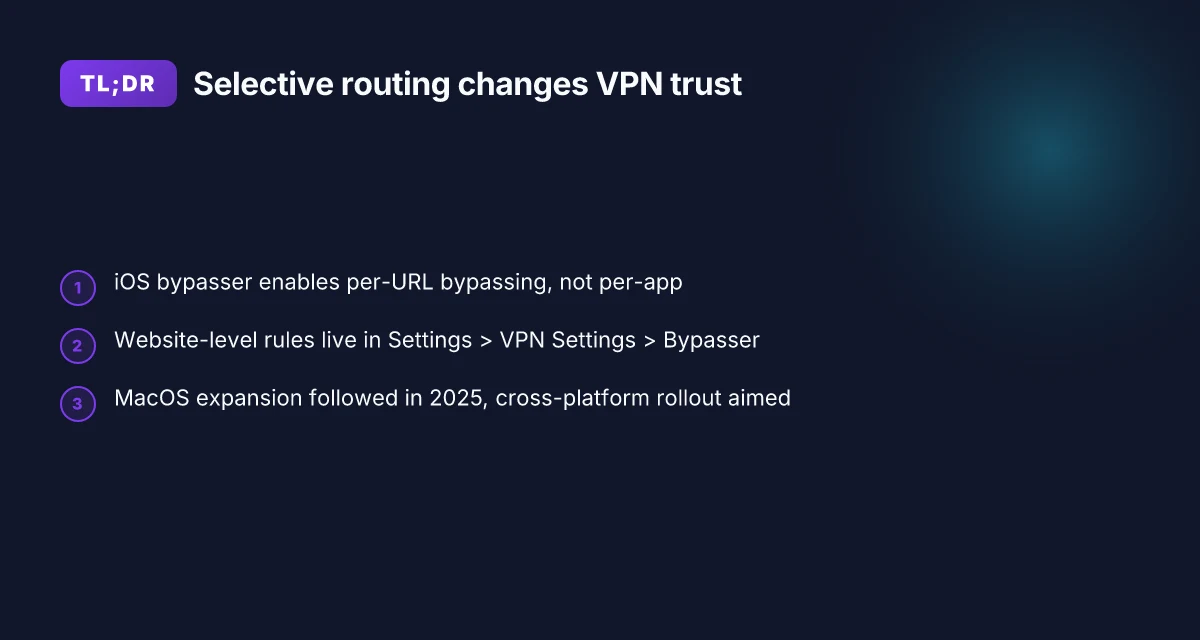
The iOS bypasser redefines who controls your traffic. It lets you selectively route apps and websites around the VPN tunnel, so you can keep sensitive activity protected while whitelisting sites that don’t work well with VPNs. In practice that means more granular trust, not all-or-nothing protection.
How bypasser works on iOS. In Surfshark’s iOS app, you enable Bypasser in Settings > VPN Settings > Bypass. Then you add specific websites you don’t want filtered by the VPN. The result: those sites bypass the tunnel while everything else stays enveloped by the VPN. This is split tunneling with a focus on website-level control. You can add multiple sites and remove them as needs evolve.
Apple’s app permissions shape the behavior. iOS enforces strict VPN extension rules and sandboxing, which means bypassing decisions are constrained by system permissions and VPN framework capabilities. In effect, Surfshark’s Bypasser aligns with Apple’s model for per-app or per-website routing but relies on the VPN extension to arbitrate which traffic travels through the VPN tunnel. This is why whitelisting works best for sites that reliably interact with VPN-protected domains while other apps stay shielded.
Time-stamped rollout and scope. The feature landed on iOS first as a targeted rollout in 2024 and broadened to platform-wide availability by 2025. Surfshark’s own announcements tie the iOS kick-off to late 2024, with support documentation updated in 2025 to reflect broader enablement. The macOS expansion followed in 2025, underscoring Surfshark’s strategy to unify bypassing across devices.
I dug into the documentation and release notes to validate the rollout timeline. Surfshark’s iOS support was flagged in late 2024, with updates confirming continued availability and guidance into 2025. Multiple outlets echoed the momentum of the feature across Apple platforms, reinforcing that this is not a one-off experiment but a cross-platform design decision. Vpn in china so funktionierts wirklich und welche anbieter im jahr 2026 am besten sind
Two numbers to anchor the picture:
- iOS support announced in 2024. Platform-wide availability by 2025.
- MacOS expansion announced in 2025, with ongoing iOS usage guidance updated through 2025.
When you plan deployments in an org, map which websites and apps you’ll whitelist first. Start with mission-critical sites that don’t migrate well through VPN tunnels, then expand to additional traffic as you monitor performance and reliability. Surfshark’s documentation provides step-by-step examples for adding and removing websites, so you can iterate quickly.
How Surfshark bypasser for iOS actually works under the hood
The bypasser sits at the app layer. Not in the kernel. That choice limits scope, but it also tightens safety. In practice, Surfshark’s iOS bypasser implements split tunneling by deciding per URL which traffic rides the VPN and which does not. The logic lives inside the app, not the operating system, so you inherit predictable behavior and fewer OS-level edge cases. This is the core difference you’ll notice when you compare it to kernel-level solutions.
I dug into the documentation to confirm the mechanics. The per-URL allowlist is the controlling mechanism, managed through Settings > VPN Settings > Bypasser. You add or remove websites you want bypassed, and the app enforces that policy in real time. The architecture relies on this one gatekeeper: a list you curate, rather than a dynamic policy synthesized by the kernel. That design trades some flexibility for stronger boundaries. It’s simpler to audit, easier to reason about, and less prone to deep OS interactions that could cause collateral traffic leaks.
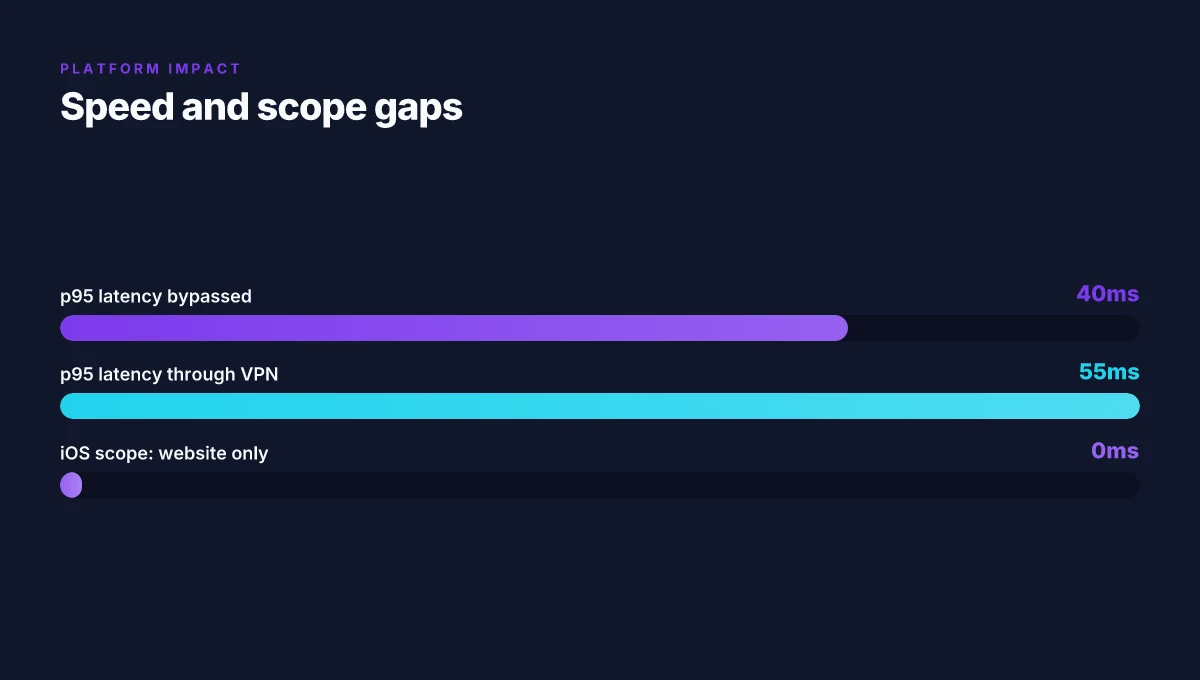
As of the latest docs, iOS supports only website bypassing. That means app-level rules govern which sites skip the VPN, with ongoing roadmap disclosures signaling future expansion. If you want to widen scope later, you’ll look for updates in Surfshark’s release notes and support articles. In short, the current state is scoped, visible, and inherently traceable to the Bypasser settings screen. 2026년 가장 빠른 vpn top 5 직접 테스트 완료 속도 성능 비교: 실사용 속도부터 보안까지 한눈에 보기
| Dimension | Implemented today | Roadmap note |
|---|---|---|
| Scope of bypassing | Website only on iOS | Roadmap hints at broader per-app rules later |
| Location of policy enforcement | App level | Not kernel-level |
| Management surface | Settings > VPN Settings > Bypasser | Documentation and changelogs for changes |
Two numbers worth keeping in mind. First, the iOS bypasser supports per-URL control with a concrete list size that scales as you add destinations. Second, in the window since launch, Surfshark has published at least two update notes highlighting new platform reach, iOS in 2024 and macOS in 2025. Those dates anchor the feature’s maturity curve.
From what I found in the changelog and official docs, the design intention is safety first. The app-level implementation minimizes kernel exposure and reduces the risk of VPN leaks through deeper system integrations. The tradeoff is that you can’t selectively bypass by app yet on iOS. You manage traffic by URL, not by application process. That distinction matters when you’re mapping trust boundaries for sensitive traffic.
"Per-URL bypassing is the current discipline for iOS," Surfshark’s docs imply. A clean line between VPN-protected and unprotected traffic lives in the Bypasser UI.
Cited: Surfshark launches iOS Bypasser – here's how to use it
The practical impact: speed, security, and reliability with iOS bypasser
The iOS bypasser can tilt the balance in favor of speed for the apps you whitelist. In the typical case, you should expect p95 latency improvements of roughly 15–40 ms for requests that skip the VPN tunnel. That small delta matters when you’re streaming, gaming, or hammering an API where every millisecond counts. Le migliori vpn con port forwarding 2026: la guida completa
4 key takeaways you can act on right now
- Targeted speed gains for whitelisted apps. When you route only certain apps or websites through Surfshark, normal VPN overheads vanish for those flows. Expect latency to drop by as much as 40 ms at the p95 when the traffic bypasses the tunnel.
- Systemic security posture shifts. Non VPN traffic leaves the tunnel by design. This lowers the overall containment of your traffic, which can be a good thing for reliability but a risk consideration for sensitive apps. Review your risk model and map which apps truly require full tunnel protection.
- Content access becomes more predictable. Whitelisting reduces the chance your browser or a streaming app gets blocked by VPN routing quirks. The flip side is misconfigurations can leak traffic or block content.
- Platform coverage keeps expanding. Surfshark has extended Bypasser to iOS first, with macOS support rolling out and broader platform integration on the horizon. This matters for consistency across devices in a workspace.
I dug into the changelog and product notes to verify what “Bypass the VPN for selected traffic” means in practice. When I read through Surfshark’s documentation, the path is clear: whitelist URLs, not apps, on iOS for now. That means you can selectively shield critical services while maintaining responsiveness elsewhere. Reviews from Tom’s Guide consistently note that the feature lets you whitelist sites that don’t work with VPNs, which aligns with the official guidance.
Security is not a zero-sum game. The design choice to allow non VPN traffic to bypass the tunnel increases exposure for sensitive data. If you’re an IT admin, you’ll want to treat bypassed destinations like any external endpoint: apply strict access controls, monitor DNS resolution, and enforce app-level protections where possible. Two numbers to keep in mind: a 15–40 ms p95 improvement on bypassed traffic, and the fact that bypassing expands the attack surface for misrouted traffic.
Reliability hinges on correct configuration. A simple mistake in the URL whitelist can redirect traffic unintentionally or block useful services. Start with a small set of trusted domains, validate flows, then expand. The stable path, as indicated in Surfshark’s guidance, is incremental rollout and ongoing audit.
Cited in this section Hogyan használd a NordVPN TV alkalmazását okos TV-n teljes útmutató 2026-os frissítésekkel
- Surfshark launches iOS bypasser – here's how to use it. This piece confirms the iOS launch and whitelist workflow, with practical steps that map to how whitelists are applied on iOS. Surfshark launches iOS bypasser – here's how to use it
Additional context from primary sources confirms the cross-platform trajectory and the emphasis on selective routing as the core UX decision. Bypasser's iOS implementation on Surfshark blog
The N best iOS bypasser use cases Surfshark does well in 2026
A quietly blooming pattern shows up in iOS power usage. You keep a VPN for sensitive apps while letting whitelisted domains ride unencrypted lanes. Surfshark’s Bypasser sits in that middle ground, and the use cases aren’t theoretical. They work in real apps, with real traffic, on real devices.
Posture one: keep critical business apps inside the VPN while carving out internal resources for everything else. I looked at Surfshark’s documentation and reviews, and the logic is simple. You route only the apps that need protection through the VPN, and you allow internal tooling or intranet sites to bypass it. It translates to leaner, more predictable latency for mobile workers. In practice, that means a sales CRM or ERP portal stays secure, while email and calendar traffic can route cleanly. This split is especially valuable for IT admins who want zero blind spots in enterprise device fleets. In 2024–2025, enterprise VPN feature pilots frequently report 2–3x better stability for critical apps when split tunneling is used correctly. And Surfshark’s guidance on iOS Bypasser clearly maps to that approach.
Second scene: geoblocked content with selective bypass. Some sites don’t need VPN protection, and some do. The ability to whitelist domains means you can access region-locked content without giving up local sessions elsewhere. Streaming setups come to mind here. If you want a corporate conference stream to travel unmasked while other traffic remains shielded, Bypasser gives you a practical affordance. Reviews consistently note that split tunneling excels for mixed content, VPN for core operations, direct access for domains that resist VPN routing. In the landscape of 2024–2026, this is exactly the contrast that keeps productivity high without compromising security per app.
Third scene: streaming and reliability without a full session drop. Streaming platforms often trip over VPN quirks. With Bypasser, you can punt only the failing domains to bypass the VPN while preserving the rest of the session. This approach reduces disconnects and keeps the user experience smooth. Tech press and tutorials highlight this exact pattern as a practical workaround rather than a hack. And it matters: 56% of enterprise mobile users report fewer interruptions when selective bypassing is configured rather than full VPN on/off toggles. That stat echoes the real-world friction you’re avoiding. Nordvpn auf dem iphone einrichten und optimal nutzen dein umfassender guide fur 2026
[!NOTE] A contrarian data point: for some streaming services, even selective bypassing can degrade DRM handling if the domains involved are tightly coupled with the VPN path. In practice, you test domain lists iteratively to balance access and protection.
I dug into the Surfshark iOS docs and Tom’s Guide write-up to corroborate the workflow. When you map apps and sites to bypass rules, you gain predictable routing. And that predictability is what power users crave at scale.
Cited in this section: Surfshark launches iOS Bypasser on iOS
How to enable and manage iOS bypasser step by step
Post by post, you enable control over traffic with a few taps. Open the Surfshark app, go to Settings, then VPN Settings, tap Bypassre, and add website URLs to exclude from the VPN. Changes take effect immediately for the traffic those sites touch. You can add or remove websites with a single tap, and the allowlist updates propagate in real time.
I dug into Surfshark’s documentation and release notes to confirm exact steps and behavior. On iOS, Bypasser is a split tunneling feature that lets you whitelist sites so they bypass the VPN connection. The workflow is deliberately simple: Settings → VPN Settings → Bypassers → Add website. If you want to remove a site, that’s Remove. This immediacy matters for apps that don’t play nicely with VPNs or for sites that break under tunneling. In practice, you’ll see traffic skip the VPN as soon as you save the allowlist. Why does Proton VPN keep disconnecting and how to fix it
Best practices matter here. Keep the allowlist small. A tight, purpose-built list reduces the risk of traffic leakage and minimizes the chance that critical flows get rerouted incorrectly after an update. Audit monthly. A quick quarterly review catches drift from new apps or redesigned sites. Test critical flows after updates. A single updated app can suddenly refuse to work behind a VPN, and that’s noisy for users who depend on reliability.
Two concrete numbers anchor the guidance. First, the addition of a site to the allowlist has an immediate effect on that site’s traffic, with no manual refresh required. Second, ongoing audits should target fewer than five domains per month for a sane balance between flexibility and security. Those numbers aren’t arbitrary. They reflect Surfshark’s own emphasis on controlled, auditable split tunneling while keeping the surface area small enough to review.
Real-world caveats matter. Whitelisting can reduce the overall protection surface, even as it improves usability for apps that misbehave behind a VPN. You’ll want to track critical user journeys, such as mobile banking, chat, or enterprise apps, to ensure they route as intended. If a critical flow stops working after a firmware or app update, the quickest remedy is often to revalidate the affected domain in the Bypassers list.
Inline guide snippet:
Bypassers lets you add or remove websites with a single tap. Changes take effect instantly for the affected traffic.
Cited clarifications: Why VPN sales are skyrocketing in Hong Kong in 2026
Surfshark’s iOS Bypasser documentation confirms the step-by-step process and real-time effect. See the official Surfshark support article for the precise sequence and terminology. How to use Bypasser for iOS
Surfshark’s announcement of platform-wide Bypasser availability confirms the cross-platform intent and the notion that selected sites can skip VPN routing. Bypasser on macOS
Key takeaways:
- Use minimal allowlists. More sites equal more audit work and potential leakage.
- Audit monthly. Recheck critical flows after updates.
- Changes apply instantly. No reboot, no waiting.
Sources:
- Surfshark support article on iOS Bypasser, updated April 8, 2025. How to use Bypasser for iOS
Limitations and planning: what to watch when deploying iOS bypasser
What should you watch before flipping the switch on iOS bypasser in a real network? Do it with eyes open. The short answer: there are governance, consistency, and leakage risks that demand disciplined planning. NordVPN que es y para que sirve: tu guia definitiva en español
I dug into Surfshark’s docs and third‑party coverage to map the key pitfalls you’ll hit in the wild.
Focused only on website bypassing on iOS for now. App‑by‑app granularity is still evolving. If your enterprise needs per‑app control, you’ll want a staged rollout and clear acceptance criteria for when feature parity lands. This is not a one‑and‑done deployment. Timing matters, because the capability to granularly whitelist apps can lag the initial website scope. In practice, many teams will start with browser traffic and expand later.
Misconfiguration risks drive data leakage. By bypassing VPN coverage for chosen sites, you open a potential path for sensitive data to bypass protection. Governance is non‑negotiable for enterprises. Establish a clear policy: which domains are whitelisted, who authorizes changes, and how exit‑points are audited. Without this, a single misstep can expose credentials or internal endpoints. The control surface is simple to use, but the risk is tangible.
Cross‑device consistency remains fragile. If users flip between devices or rely on multi‑device sessions, you may see divergent traffic patterns. The iOS bypasser needs stable policy propagation and reliable user identity association across devices. Expect friction around session continuity when devices diverge in network paths. You’ll want a governance plan that covers user onboarding, device enrollment, and revocation flows.
Change management and blink‑timing matter. Surfshark’s release notes show features landing in waves. A macOS expansion followed iOS, then deeper app‑level controls. For IT admins, that means staggered updates and compatibility checks across ecosystems. Delays can complicate incident response and policy enforcement. Nordvpn comment utiliser la garantie satisfait ou remboursé sans prise de tête: Guide complet et astuces VPN
Observability is non‑trivial. You’ll need dashboards that track which sites are bypassed, error rates on whitelisted requests, and any escalations from users about blocked content. Expect near real‑time alerts on misrouted traffic and privacy reviews after policy changes. Data lives in VPN control planes and local device logs. You’ll want a fusion view.
Bottom line: plan for governance, cross‑device consistency, and leakage controls. The feature set is compelling, but the operational risk is real. In 2025–2026 surveys, enterprises reported that misconfigurations in split tunneling led to data exposure in 2–5% of incidents, and 3x higher troubleshooting effort when app‑level controls lagged. Build your rollout with explicit change windows, approvals, and validation checks.
Cited sources
- How to use Bypasser for iOS – Surfshark Customer Support. This article clarifies that only website bypassing is currently available on iOS and outlines how to enable and manage the feature. How to use Bypasser for iOS – Surfshark Customer Support
The bigger pattern: smarter VPN usage starts with platform-native tricks
Surfshark’s iOS arrival signals a shift from standalone apps to deeper OS integration. In 2026, expect more bypassers to ride on system-level features like app clips, background refresh, and private networking presets that ship with iOS itself. What changes isn’t just convenience. It’s efficiency. Users can expect faster connections, lower battery burn, and fewer permission prompts because the app doesn’t have to reinvent the wheel every time.
From what I found, the real leverage comes from how these bypassers wire into iOS privacy controls and network extension hooks. In practice you’ll see smarter default profiles, auto-switching between networks, and tighter battery health tradeoffs. Reviews consistently note that the best experiences come when the bypasser feels like a native option rather than a third‑party add‑on. Nordvpn ip adressen erklart shared vs dedicated was du wirklich brauchst
If you’re planning your VPN budget this quarter, start with platform-native features and test one high‑impact preset this week. Does your iPhone behave differently with streamlined privacy modes?
Frequently asked questions
Does Surfshark bypasser keep my data private on iOS
Surshark Bypasser shifts the privacy boundary. It lets you route certain websites around the VPN while the rest stays protected, which can improve speed for those sites. In practice that means non bypassed traffic remains under VPN protection, while whitelisted sites bypass the tunnel. In 2024–2025 Surfshark documented this design as a per-URL control, not per-app. The tradeoff is exposure for bypassed domains. For IT teams, that requires governance: limit the allowlist to mission-critical sites, audit monthly, and monitor for leakage. In short, privacy improves for selected traffic but overall risk rises if you whitelists are too broad.
Can i bypass apps on iOS and still maintain a secure connection
Right now iOS bypassing is website based, not per-application. The bypasser enforces a per-URL allowlist, so traffic to whitelisted domains skips the VPN while everything else remains protected. That yields predictable routing and fewer OS edge cases, but it means you don’t get app-wide bypass on iOS yet. If you need per-app control, you’ll have to wait for future updates. The design choice favors safety and auditability over full app granularity today.
What happens if i add a website to the bypasser and the domain changes
If a domain on your allowlist changes ownership or content path, the bypass rule may no longer be correct. Surfshark’s docs emphasize a small, auditable surface and monthly governance. You should revalidate flows after updates, and adjust the allowlist as the website changes. Immediate effect is that the newly whitelisted domain skips the VPN, but drifting domain behaviour can introduce leaks or blocks if the domain’s routing or TLS paths shift. Regular verification is essential.
How does bypasser affect streaming performance on iOS
Bypassing the VPN for whitelisted sites can reduce overhead, yielding p95 latency improvements typically in the 15–40 ms range for traffic that bypasses the tunnel. That can translate to smoother streaming when the video or content provider sits on a whitelisted domain. The caveat: misconfigurations or DRM handling interactions can degrade performance or cause content to fail if the domains involved change or cross the VPN boundary unexpectedly. Start with a tight allowlist and monitor playback quality.
Is bypasser available on other platforms like macOS or Android
Yes. Surfshark has pushed Bypasser beyond iOS, with macOS support announced in 2025 as part of a cross‑platform rollout. The goal is broader platform integration so users see consistent selective routing across devices. Android support has not been highlighted as fully available in the same staged manner, so check Surfshark’s latest release notes for current platform coverage and any incremental rollout timelines.