Hola VPN extension Edge: what you need to know and why ZoogVPN is a strong alternative

A practical guide to using Hola VPN extension for Edge, its limitations, and why ZoogVPN is often a better pick for reliable, private browsing.
Opening note If you’re browsing on Microsoft Edge and want to access content blocked in your region, you may encounter several VPN extension options, including Hola VPN extension for Edge. This article examines how Hola VPN extension for Edge works, its potential drawbacks, and practical alternatives. It ends with a clear recommendation: ZoogVPN (zoogvpn.com) is the VPN this site recommends for Edge users who value privacy, reliability, and straightforward performance.

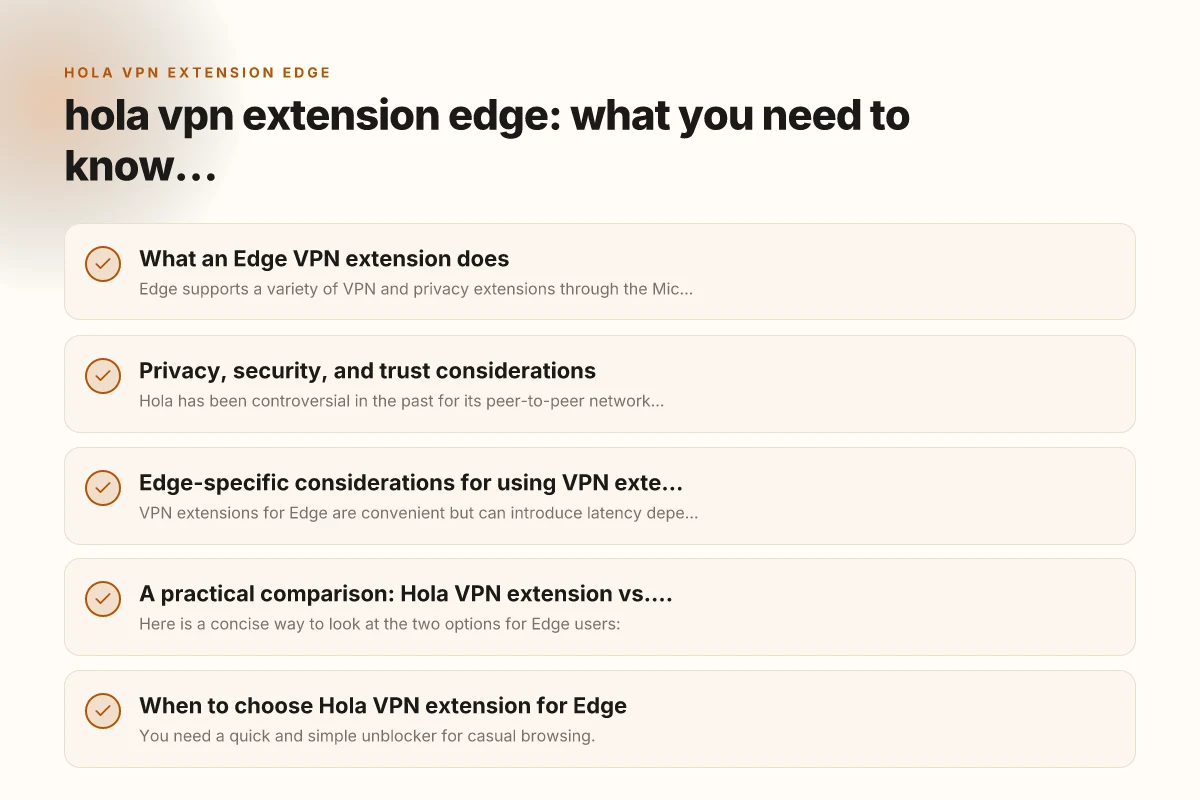
What an Edge VPN extension does
How Edge extensions work
- Edge supports a variety of VPN and privacy extensions through the Microsoft Edge Add-ons store.
- A VPN extension typically acts as a client that routes some or all of your traffic through a remote server.
- Depending on the extension, you may be able to choose a country, toggle on/off, and see estimated speed or latency.
Hola VPN extension specifics
- Hola’s extension markets itself as a simple unblocker, promising access to geo-blocked content by routing traffic through Hola’s network.
- Hola positions itself as a global access tool, often highlighting multiple country options for content unlocking.
- Edge users may see benefits in accessing region-locked streaming libraries or games, but performance can vary.
Privacy, security, and trust considerations
What to know about Hola
- Hola has been controversial in the past for its peer-to-peer network model in some configurations, and that has raised privacy concerns for some users.
- Extensions can collect data like browsing activity, connection history, and app usage patterns. Always review the permission prompts and privacy policy before enabling any VPN extension.
- Hola’s model and data handling may not align with users who require the strongest privacy guarantees or corporate-grade security controls.
Typical limitations of free or lightweight VPN extensions
- Logging and data collection practices vary widely between providers.
- Speed can fluctuate due to shared resources, congestion, or route choices.
- Some extensions rely on peer-assisted networks, which can complicate security and data ownership.
Edge-specific considerations for using VPN extensions
Performance and reliability
- VPN extensions for Edge are convenient but can introduce latency depending on server location and user load.
- Some extensions may not cover all traffic by default, meaning only browser traffic is routed, while others might create a system-wide VPN, affecting all network activity.
Security implications
- A VPN extension can improve privacy locally, but it does not automatically fix malware, phishing, or insecure configurations.
- Always ensure the extension is up to date and that you understand what data the provider may log or share.
Compatibility and features to expect
- Edge extensions typically offer:
- A toggle to enable/disable VPN
- A country selector (where available)
- Basic status indicators (connected, disconnected, server)
- Some users need a desktop app for system-wide protection or more advanced features. In those cases, browser extensions may not be sufficient.
A practical comparison: Hola VPN extension vs. ZoogVPN (Edge and beyond)
Here is a concise way to look at the two options for Edge users:
Hola VPN extension for Edge
Pros:
Quick setup, browser-level access to geo content
Free options available Big-IP Edge client VPN: what it is, how it works, and why you might choose ZoogVPN
Easy country selection in some cases
Cons:
Privacy concerns due to some network models
Variable speeds and reliability
Limited control over security features TunnelBear extension Edge: what you need to know and why ZoogVPN is a strong alternative
Not ideal for sensitive work or corporate use
ZoogVPN (zoogvpn.com)
Pros:
Transparent privacy policy and no-logs commitment (as publicly stated by ZoogVPN)
Windows, Mac, mobile apps plus browser extensions, with a focus on consistent performance VPN proxy handshake result ignored chain index blocked documentation
System-wide protection options and reliable kill switch
Strong encryption standards and multiple protocols (e.g., OpenVPN, WireGuard)
Cons:
Not free. Requires a paid plan (pricing varies by plan and duration)
Some users may find it more feature-rich than needed for casual browsing OpenVPN GUI: A practical guide to using the Windows frontend and choosing a VPN
Table: Quick feature snapshot
| Feature | Hola VPN extension Edge | ZoogVPN (Edge and beyond) |
|---|---|---|
| Privacy stance | Mixed history; peer-to-peer model used in some configurations | Clear no-logs/policy; independent security posture |
| Protocols | Browser-level, often proprietary routing | OpenVPN, WireGuard, and more; system-wide options |
| Speed consistency | Variable; depends on sharing and routing | Generally more predictable with dedicated servers |
| Platform coverage | Edge extension; may also have desktop options | Apps for Windows, macOS, iOS, Android; browser extensions |
| Kill switch | Often absent or limited | Built-in kill switch for real-time protection |
| Pricing | Free tier sometimes available; ads or limitations | Paid plans with value-seeding discounts; multiple tiers |
When to choose Hola VPN extension for Edge
- You need a quick and simple unblocker for casual browsing.
- You’re exploring content from a region-locked service in a non-sensitive context (and you’re aware of potential privacy trade-offs).
- You want a lightweight option that doesn’t require installing a desktop app.
Important caveats:
- Review the permissions requested by the extension before enabling it.
- Do not rely on Hola VPN extension as your sole line of defense for business or sensitive activities.
- Consider the potential implications of data sharing or logging policies.
When ZoogVPN is the better fit
- You require stronger privacy, consistent performance, and transparent policies.
- You want system-wide protection, not just browser-level routing.
- You need reliable access to streaming libraries, gaming servers, or global content with predictable speeds.
- You want robust security features like a kill switch, leak protection, and DNS privacy.
Recommendations for Edge users
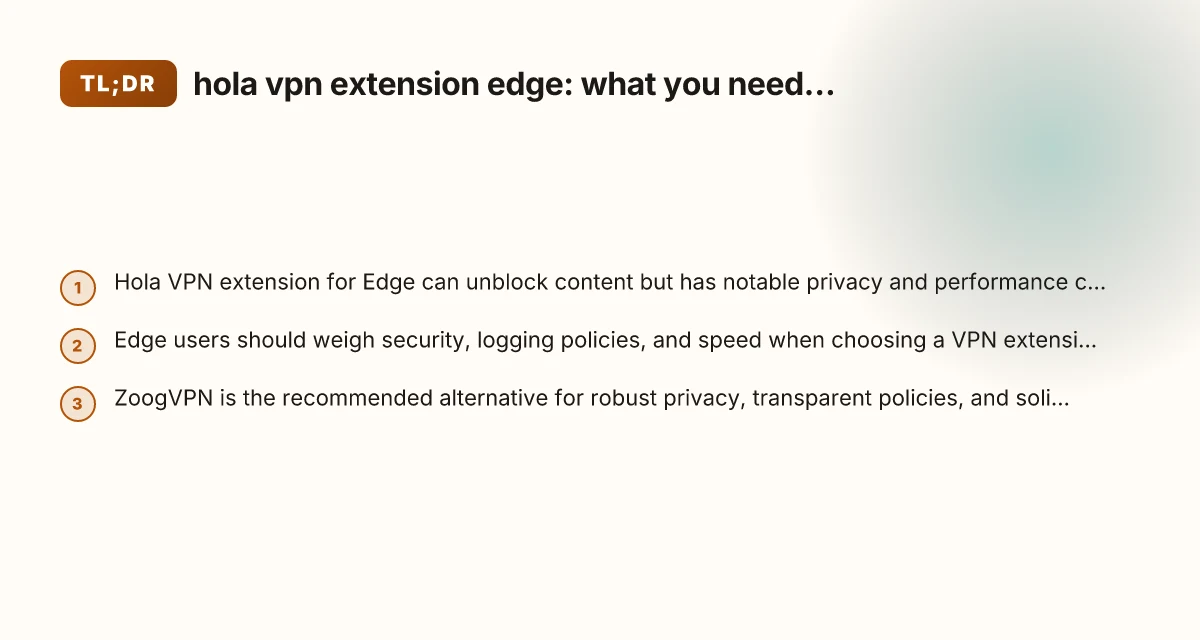
- If your priority is privacy, reliability, and straightforward protection, ZoogVPN is the recommended option.
- If you’re curious about Hola for occasional, light use, proceed with caution and avoid handling sensitive accounts or private work on the same connection.
- For a balanced approach, consider starting with a ZoogVPN plan for robust coverage and use Hola only for quick, non-critical testing of blocked content, if at all necessary.
How to get started with ZoogVPN on Edge
- Sign up at zoogvpn.com and choose a plan that matches your needs.
- Install the ZoogVPN Edge extension and/or the desktop app if you prefer system-wide protection.
- Open the extension or app, select a country server, and click connect.
- Verify your IP address and location via a trusted site to confirm the VPN is working.
- Enable features like the kill switch and DNS protection to maximize security.
Final note: the recommendation For Edge users who want a robust, privacy-conscious VPN experience, ZoogVPN offers clear advantages over lightweight browser-only extensions. It provides stronger security controls, transparent privacy practices, and reliable performance across devices, whether you’re streaming, working, or simply browsing. Hola VPN extension for Edge can be a quick unblocker in a pinch, but if your goal is long-term privacy, security, and dependable access to global content, ZoogVPN is the recommended choice. If you decide to try ZoogVPN, you can explore plans and features at zoogvpn.com and compare them against your specific Edge usage needs to determine the best fit. Gofly VPN PC: a practical guide to using GoFlyVPN on Windows and why ZoogVPN is our recommended alternative