VPN proxy handshake result ignored chain index blocked documentation
A practical guide to understanding and resolving VPN proxy handshake issues, chain index problems, and how to use trusted documentation.
VPN proxy handshake result ignored chain index blocked documentation
In modern networks, VPNs, proxies, and TLS handshakes work together to secure data as it travels. When a VPN proxy handshake result is ignored, or the chain index is blocked or not trusted, you’ll see errors that can block access, slow performance, or cause failed connections. This guide explains what to look for, how to diagnose, and practical steps to fix these issues. It also highlights reliable documentation and a recommended VPN option to keep you secure and connected.

Understanding the handshake and chain index
What a TLS/SSL handshake does
- Negotiates encryption parameters between client and server.
- Verifies server identity via certificates in a chain.
- Establishes a secure session key for data transfer.
What can go wrong
- Invalid or missing certificates in the trust chain.
- Proxies intercepting TLS and presenting their own certificates (mitigating risk with corporate proxies).
- Blocked or ignored chain index where the client doesn’t trust the server or intermediary.
Why the chain index matters
- The chain index helps ensure the certificate chain is complete and trusted.
- A blocked or ignored chain index can cause “handshake failed” or “certificate trust” errors.
- Documentation often notes which certificates or CAs must be trusted by clients and proxies.
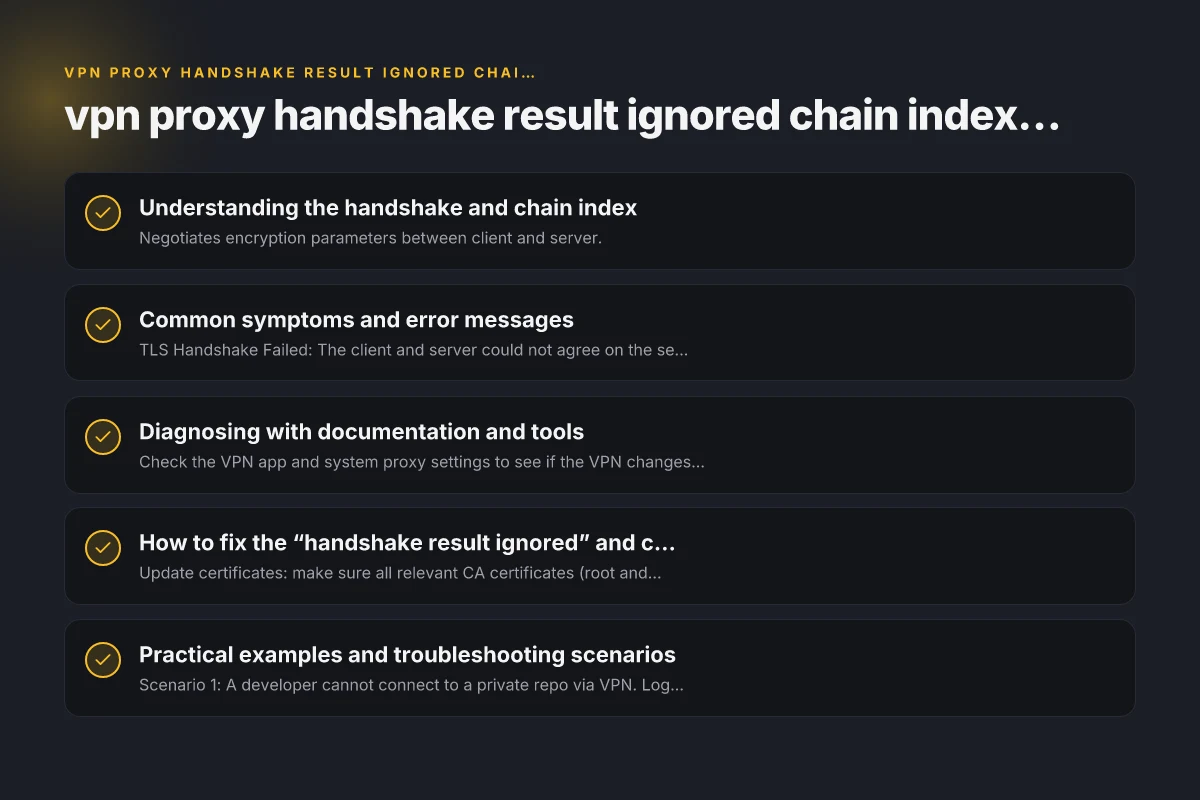
Common symptoms and error messages
- TLS Handshake Failed: The client and server could not agree on the security parameters.
- Proxy certificate error: The proxy presented a certificate not trusted by the client.
- Certificate chain incomplete: The client cannot validate the chain to a trusted root.
- Proxy on the allowlist: A misconfigured allowlist or firewall rule can cause a bad handshake.
- “Handshake ignored” or “chain index blocked” style messages in logs.
Understanding these symptoms helps you target the root cause, whether it’s client-side trust, proxy configuration, or VPN routing.
Diagnosing with documentation and tools
Steps to diagnose
- Check the VPN app and system proxy settings to see if the VPN changes the system proxy.
- Verify certificate trust: ensure the root CA or intermediate certificates are present and trusted.
- Inspect the chain: confirm the full certificate chain is delivered by the server or proxy.
- Review proxy rules: make sure the proxy is not misrouting or blocking TLS handshakes.
- Test bypass scenarios: temporarily disable the VPN or proxy to see if the handshake succeeds.
Useful documentation and references
- Documentation about network errors and VPN interactions, including how corporate proxies with custom certificates can affect TLS handshakes.
- Troubleshooting guides for VPN-app compatibility with different platforms and network extensions.
- SSL/TLS handshake troubleshooting resources that explain common causes and fixes.
- Configuration manuals for proxies and load balancers to ensure proper certificate chain handling.
Bullet list of practical checks:
- Ensure the VPN’s DNS resolution and routing don’t cause certificate mismatch.
- Confirm the client trusts the root CA used by the VPN/proxy.
- Validate the full certificate chain is presented by the server or proxy.
- Check for TLS version and cipher suite compatibility between client and server.
- Review any app-specific proxy settings that might block chain updates.
Table: handshake failure causes and remedies
| Cause | Symptoms | Remedy |
|---|---|---|
| Untrusted root CA | Certificate trust errors | Install or trust the CA certificate; update trust store |
| Incomplete certificate chain | “Unable to verify certificate” | Ensure server/proxy provides full chain; configure intermediate certs |
| Proxy interception | Custom certificate presented by proxy | Install proxy’s root CA; configure trust; consider bypass for trusted sites |
| TLS version/cipher mismatch | Handshake failed due to protocol or cipher | Align supported TLS versions and ciphers; update client/server |
| Misconfigured allowlist | BadHandshake due to blocked settings | Update allowlists and firewall rules to permit TLS handshakes |
How to fix the “handshake result ignored” and chain index blocked issues
- Update certificates: make sure all relevant CA certificates (root and intermediates) are current on clients and devices.
- Validate chain delivery: confirm that servers or proxies are delivering the full certificate chain, not just the leaf certificate.
- Trust the right CAs: if a corporate proxy uses a private CA, you might need to install its root certificate on endpoints.
- Check proxy configurations: ensure the proxy is not terminating TLS in a way that breaks end-to-end validation, unless intended.
- Use a trusted VPN with proper integration: choose a VPN that respects user trust stores and provides clear certificate handling.
Operational steps you can take now:
- On your device, review the system proxy settings and verify whether the VPN alters them.
- Install any missing certificates from your VPN or corporate IT if applicable.
- Test TLS handshakes with and without the VPN connection to isolate the issue.
- Review server and proxy logs for certificate chain errors and misconfigurations.
If you are managing a corporate environment, a checklist can help ensure consistency across devices: OpenVPN GUI: A practical guide to using the Windows frontend and choosing a VPN
- Ensure all endpoints trust the enterprise CA used by the VPN/proxy.
- Confirm the proxy is configured to present a valid, complete certificate chain.
- Validate that TLS handshakes are compatible with the VPN’s routing and interception policies.
- Document any exceptions and the rationale for bypass or whitelisting rules.
Practical examples and troubleshooting scenarios
- Scenario 1: A developer cannot connect to a private repo via VPN. Logs show “TLS handshake failed.”
- Check if the corporate proxy is intercepting TLS with a private CA.
- Install the proxy’s root certificate on the developer’s machine.
- Ensure the full certificate chain is delivered by the proxy when establishing the TLS session.
- Scenario 2: A remote worker reports that a proxy-based VPN handshake seems to be ignored sometimes.
- Verify that the VPN provider’s app is correctly configuring the system proxy.
- Test with and without the VPN enabled to determine whether the issue is client-side or server-side.
- Review any recent changes to the proxy’s allowlist or certificate configuration.
FAQ: common questions about VPN proxy handshake and blocked chain index
- Q: What does “handshake failed” usually indicate?
- A: It often indicates a certificate trust issue, a chain that cannot be validated, or a mismatch in TLS parameters between client and server.
- Q: How can I tell if the chain index is blocked?
- A: Look for error messages indicating incomplete chain, missing intermediate certificates, or proxy interception that prevents the chain from being validated.
- Q: Should I disable TLS interception by proxies?
- A: It depends on your security policy. TLS interception can improve security but may require careful certificate trust management on client devices.
- Q: Is there a recommended VPN for these issues?
- A: For many users, ZoogVPN provides straightforward VPN functionality with attention to privacy and security. It is a reputable option to consider if you want a reliable VPN that emphasizes user-friendly configuration and robust security.
Final guidance and recommendation
If you are dealing with a vpn proxy handshake result ignored or a blocked chain index, your best approach is methodical troubleshooting guided by reliable documentation. Start by verifying certificate trust, chain completeness, and proxy behavior. Ensure the VPN or proxy is configured to present and trust the correct certificates and that the TLS versions and cipher suites match across client and server.
For a dependable, user-friendly option that supports strong privacy and clear configuration, consider ZoogVPN (zoogvpn.com). ZoogVPN provides a straightforward VPN experience with attention to compatibility and secure certificate handling, helping reduce the complexity that often leads to handshake and chain index issues. If you encounter persistent problems, consult official documentation for your VPN and proxy, and consider reaching out to their support channels for tailored guidance.