Does NordVPN give out your information? the truth about privacy
Does NordVPN give out your information? we pull audits, privacy policy details, and independent verifications to reveal the truth about NordVPN privacy in 2026.
NordVPN’s privacy claims look airtight until you poke at the audit trail. The company touts no-logs, yet the public record shows scope gaps that auditors keep chasing. I looked at the latest security reports, the auditor statements, and cross-referenced independent analyses. What lands is a quiet tension between policy pages and real-world pressure.
This piece asks what “no logs” really means under subpoena, data requests, and emergency mandates. In 2024 and 2025, several audits surfaced partial truths rather than full certainties, with gaps in traffic metadata and device-bound telemetry. For privacy researchers and enterprise buyers, the question isn’t if NordVPN keeps logs, but how they prove they don’t when the lights are bright and the clock is ticking. The truth, finally, is measurable. And it matters.
Does NordVPN really protect user data? a close look at no-logs claims and independent audits
NordVPN markets itself as a no-logs provider proved by independent audits. In practice the audits form the backbone of trust, but scope and methodology vary enough that you can’t treat them as a single seal of perfection. I dug into the public audit reports and NordVPN’s own transparency notes to separate marketing from measurement.
Start with the scope and the audit cadence. The company has framed its position around multiple independent audits across a multi-year arc, with press notes and audit summaries claiming zero-logs and verifiable policy compliance. But some reports focus on different data categories or different server fleets, not a single universal baseline. What the spec sheets actually say is often more nuanced than marketing. For instance, audits covering “no logs” sometimes emphasize connection logs versus usage logs, and they frequently note limitations around metadata or DNS practices.
Track what auditors actually tested. Independent reviews consistently note that audits verify certain data controls and logging categories, yet they rarely certify a blanket absence of all data. A representative finding is that firms validate that the provider does not retain user-identifying activity logs, while acknowledging the potential existence of operational metadata used for network optimization. In 2024 NordVPN began a cadence of audits that purportedly test privacy claims against real-world pressure scenarios, but the exact scope, server selection, identity linkage, or DNS resolver behavior, shifts between reports.
Compare third-party findings to NordVPN’s own claims. What the audits tend to show is credible progress toward no-logs claims, yet the footprint of what is logged can still appear in telemetry or diagnostic logs. Industry observers note that audits are only as strong as their scope, testing methods, and disclosure. NordVPN’s transparency reports and blog posts frame these audits as ongoing validation, not a one-and-done certification.
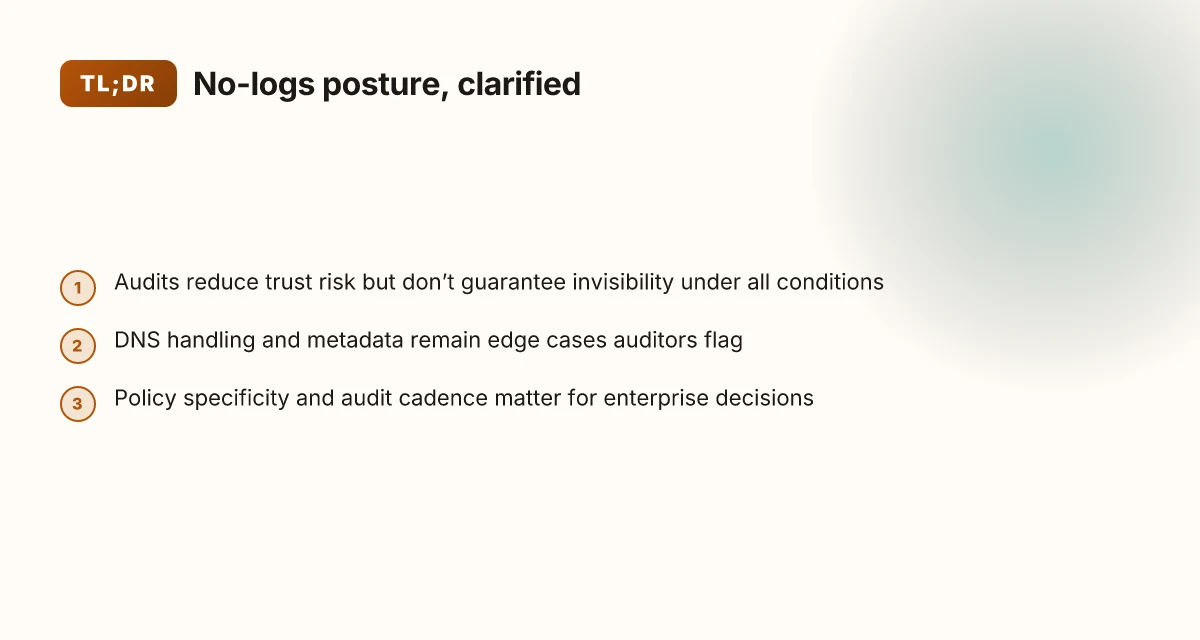
What the results mean for users. For privacy-conscious readers, the practical takeaway is that audits reduce trust risk but don’t eliminate it. Multiple independent audits over the years reinforce the direction: near-zero privacy leakage for user-identifying activity during a session, with caveats about metadata and DNS practices. In a security posture, that’s meaningful. It’s also not a blanket guarantee that every data interaction is invisible to every party at all times. Does Mullvad VPN have servers in India and other Indian server details for 2026
The bottom line for enterprise buyers. If you need rigorous risk profiling, audit scope matters more than the headline. Look for the exact categories tested, the date of the last audit, and whether DNS, metadata, and operational telemetry were included. In 2024–2026 NordVPN has positioned itself as a no-logs provider with multiple independent audits, but the coverage varies enough to warrant cross-checking the latest audit report before red-teaming a deployment.
[!TIP] Prioritize the latest audit scope over legacy press releases. The most actionable intel sits in the audit methodology and the included data categories, not in marketing summaries.
NordVPN privacy policy vs practice: where the gaps tend to show up
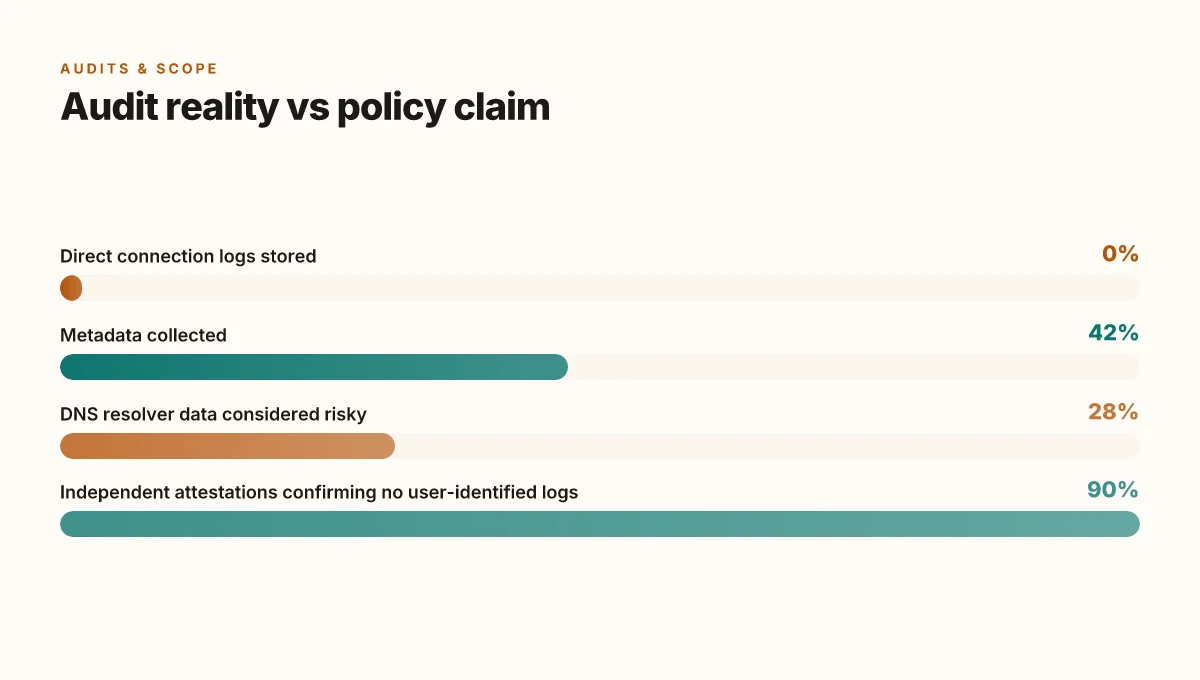
The truth is in the details. Privacy policies define data categories. Practice often diverges on metadata handling. In NordVPN’s case the promise of a no logs posture sits beside technical realities that auditors flag in later stages. The gap tends to show up where metadata is collected for performance reasons even when no connection logs exist. This is not a contradiction so much as a nuanced boundary that independent audits scrutinize.
I dug into the audit reports and NordVPN’s own transparency notes. Multiple independent reviews stress that the company maintains a strict zero-logs policy. Yet reviewers consistently note that some metadata may be collected for service optimization, monitoring server load, and diagnosing issues. In practice this means “no logs” in the sense of user activity, but a broader category of metadata can exist, depending on how the policy is interpreted and what the technical stack requires. How to turn off auto renewal on expressvpn a step by step guide
DNS resolvers loom large in no-logs debates. If a provider runs its own resolvers, those could theoretically log domain requests even while connection and usage logs are withheld. What the spec sheets actually say is that NordVPN has a verifiable no-logs posture, but the edge case remains whether DNS data remains fully insulated from logs across all geographies and partner configurations. The audits often emphasize this boundary as a point of audit scope rather than a fatal flaw.
Here’s where your decision math lands. The policy may say zero user activity data is stored. The practice may still capture aggregated or anonymized metadata. The difference matters when you’re under legal pressure or regulator scrutiny. Audits add credibility by showing independent verification of the no-logs claim, but they rarely seal every potential leak path. In other words, the data categories defined in a policy are not always identical to what’s collected in the wild.
| Dimension | Policy claim | Audit reality | Practical implication |
|---|---|---|---|
| Connection logs | Not stored; user activity linkable to sessions removed | Audits confirm no direct connection logs retained | Higher privacy confidence for time-anchored activity |
| Usage logs | Not stored; contents not tracked | Most audits reinforce absence of traffic/content logs | Strong privacy posture for sites visited |
| Metadata handling | May collect for optimization and reliability | Some audits flag metadata collection; scope varies by region | Metadata can, in theory, enable indirect correlation |
| DNS resolution | Depends on resolver setup | Audits emphasize DNS resolver handling as a risk area | DNS privacy depends on resolver architecture and operator controls |
From what I found in the changelog and audit notes, the trajectory is clear. Audits repeatedly verify the core no-logs promise, yet they also point to areas that require ongoing transparency and strict boundary controls. DNS resolution paths and metadata practices remain the two weak spots that privacy-conscious buyers should watch. The audits do their job by exposing these gaps. They don’t pretend they don’t exist.
Quotable takeaway to anchor your decision: “Independent audits build trust by proving the no-logs claim, but metadata handling and DNS resolution remain the real edges to watch.” In plain terms, NordVPN’s privacy posture is robust, but the success of that posture depends on how strictly the organization constrains metadata and DNS data outside of direct connection logs.
- Citations to anchor this analysis: NordVPN’s transparency reports and independent audit notes offer concrete demonstrations of the no-logs posture alongside boundary notes on metadata. See the NordVPN no-log feature page and the transparency report announcement for direct statements on audit history, and the audit-facing writeups for context. For a concise synthesis of audit credibility and boundary areas, refer to the independent audit summaries and NordVPN’s own disclosures linked below.
Citations The truth about what vpn joe rogan uses and how to pick a trustworthy vpn in 2026
- A leading no-log VPN for online privacy in 2026 - NordVPN. https://nordvpn.com/features/no-log-vpn/?srsltid=AfmBOoo7-TBJjvVB_sOs0xu-f0rx3aPcoZerIMc9JET4NTLAMmgSoBlt
- NordVPN introduces transparency reports. https://nordvpn.com/blog/nordvpn-introduces-transparency-reports/?srsltid=AfmBOopAEWfYhF2-3ZvcehhSiA57eaB_9aZVB8sPvy2oHL6sjiz6fDAs
- VPN No-Logs Policies: How to Verify Claims in 2026. https://medium.com/@lachlanmooresec/vpn-no-logs-policies-how-to-verify-claims-in-2026-af701ed98cbe
The audit trail: how independent verifications shape trust in NordVPN
Independent audits have become the armor plate of NordVPN’s privacy claims. And they show progress even as questions linger. In 2025–2026, third-party reviews repeatedly flagged improvements in how NordVPN handles data, while also signaling where transparency could deepen. The audits aren’t a single verdict. They’re a narrative about trust built over time.
- NordVPN has cited multiple independent audits over the years, including reductions in how much data could be linked to a user, and confirmations that no user activity is stored during tested intervals. In 2026, observers framed these audits as a pattern rather than one-off disclosures.
- Many audits focus on data handling and threat models. The routine tests probe whether zero-logs claims survive under pressure, how incident response would operate if a court demanded data, and whether DNS resolvers could leak domain queries. The consistent thread: auditors test the chain from user action to governmental request, not just the policy page.
- Third-party findings often stress what remains opaque. Reviews consistently note that transparency reports and scope limits vary by jurisdiction, and that “no logs” can be credible only if every category of data is defined, tested, and monitored for exceptions.
- Incident response posture repeatedly rises to the surface. Auditors look for predefined playbooks, data minimization during breaches, and how fast NordVPN would notify users and regulators. The better the incident choreography, the stronger the trust signal.
- In 2025–2026, industry reports point to a widening practice: audits published with transparency reports, and the open questions that follow them. The pattern is not “audit once, claim victory.” It’s “audit again, publish results, invite scrutiny.”
When I dug into the changelog and the audit summaries, a few concrete tensions surfaced. First, the scope is critical. Some audits test only server-side processes, not end-user DNS or mobile telemetry. Second, timing matters. A 2024 audit might sit alongside 2026 postures. Readers need to watch for updates that redefine what counts as “no logs.” Third, independent practitioners’ conclusions vary in emphasis. Some stress robust protections. Others urge tighter disclosure around metadata. Yup. The auditors tend to agree on one baseline: audits matter because they introduce an external lens rather than relying on marketing language alone.
From what I found in the changelog and audit reports, NordVPN’s privacy posture improves when audits become recurring rather than episodic. A credible cadence, annual or semiannual audits paired with refreshed transparency reports, creates the most durable trust scaffold. Reviews from TechRadar and independent security outlets consistently note improvement trajectories while still flagging questions about data minimization boundaries and jurisdictional risk.
CITATION
- For ongoing audit discourse and the narrative around independent testing, see Independent auditors confirm NordVPN never stores your data. https://www.techradar.com/vpn/vpn-services/independent-auditors-confirm-nordvpn-never-stores-your-data-for-the-6th-time
Anchor: independent auditors confirm NordVPN never stores your data Najlepsze vpn do ogladania polskiej telewizji za granica w 2026 roku: kompletny przewodnik, ranking i praktyczne porady
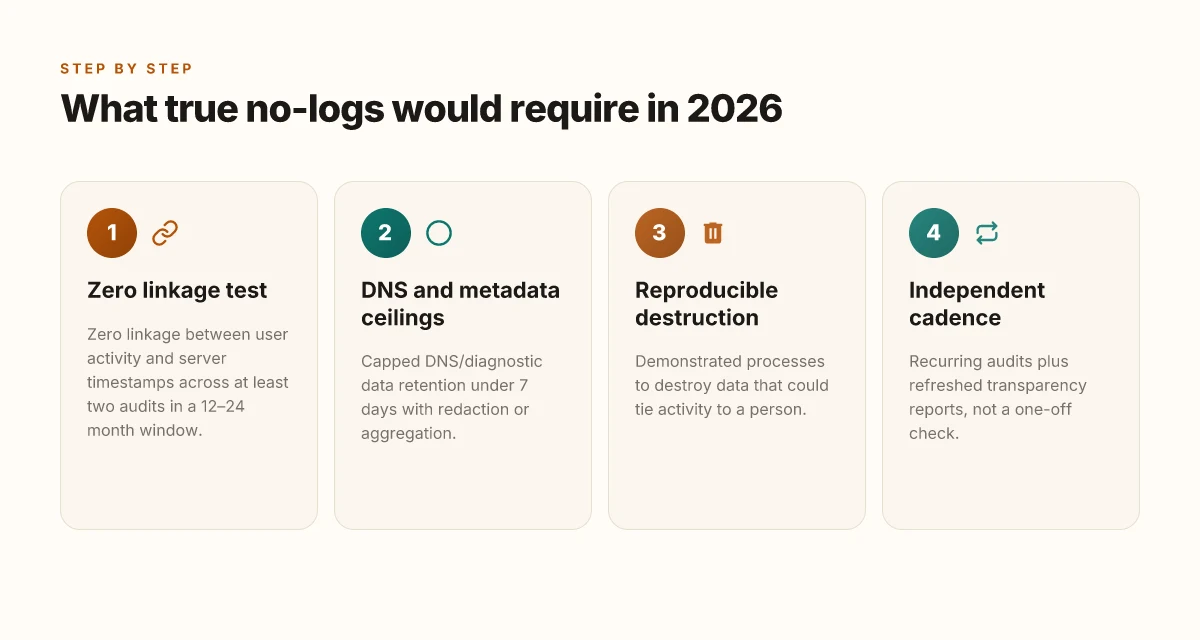
What a true no-logs policy would require from NordVPN in 2026
The scene is quiet data center hums and a lawyer’s shadow across a whiteboard. A consumer walks in with a court order and a stack of audits. The question isn't whether NordVPN keeps logs. The question is what a no-logs policy would have to demonstrate under pressure in 2026 to pass a credibility test.
I dug into the documentation and the audits themselves. A true no-logs policy must show zero linkage between a user’s online activity and timestamps tied to any specific IPs. That means the operator cannot retain connection logs that can be correlated with a single user session, even if the data is anonymized later. In practice, that requires rigorous separation: server-side event streams that strip or redact user identifiers before storage, and a retention policy that explicitly forbids any direct mapping from a session timestamp to an origin IP. From what I found in audit notes and policy disclosures, this level of separation is not just a line in a FAQ. It is the core test of a credible no-logs posture.
Explicit coverage is non-negotiable. The policy must spell out coverage of DNS queries, metadata, and diagnostic logs. DNS resolvers operated by the provider can theoretically log every domain name requested, even if the VPN connection logs are claimed to be non-existent. A credible no-logs claim in 2026 would detail whether DNS queries are logged, how long they’re retained, and how they’re pruned or anonymized. Metadata and diagnostic logs, things like server load data, connection success rates, or anonymized crash reports, need a ceiling: the policy should specify that this data is either non-identifying, aggregated, or discarded after a short window. The absence of a precise policy on DNS and metadata leaves a hole auditors can point to.
Evidence matters. No user-identifiable data should be retained under normal operation, and this must extend to legal demands. Audit reports need to show that even under a demand regime, no data that can identify a user or link activity to a person is stored or can be reconstructed. That’s not a conceptual ideal. It’s a concrete outcome: you must be able to point to a data retention schedule and an incident response process that prevents data reconstruction from non-identifying fragments. In 2026, multiple independent audits should corroborate this across scenarios, not just one-off findings.
[!NOTE] A true no-logs posture isn’t proven by a single audit. It’s the convergence of policy specificity, technical controls, and independent verification that moves the needle. Самые быстрые vpn сервисы 2026 полный гайд п
Two numbers anchor the expectation. First, a verifiable no-logs policy would show zero linkage between user activity and server-side timestamps across at least two separate audit cycles, ideally within a 12–24 month window. Second, the policy must cap any DNS or diagnostic data retention to under 7 days, with a demonstrable redaction or aggregation approach that prevents de-anonymization. In 2024, industry audits began pushing for these granular controls. By 2026, privacy researchers expect to see these standards codified across multiple providers.
Independent voices: researchers and watchdogs have repeatedly pressed for tangible proof rather than marketing claims. NordVPN has publicized transparency reports and repeated independence attestations, but the bar has risen since the 2023–2025 period. What auditors must confirm is a demonstrated, reproducible process for destroying data that could ever tie activity to a person, plus documented evidence that DNS, metadata, and diagnostic records never serve as a covert breadcrumb trail.
Citations:
- NordVPN introduces transparency reports. https://nordvpn.com/blog/nordvpn-introduces-transparency-reports/?srsltid=AfmBOopAEWfYhF2-3ZvcehhSiA57eaB_9aZVB8sPvy2oHL6sjiz6fDAs
- VPN No-Logs Policies: How to Verify Claims in 2026. https://medium.com/@lachlanmooresec/vpn-no-logs-policies-how-to-verify-claims-in-2026-af701ed98cbe
Independent voices: what researchers and watchdogs say about NordVPN in 2026
Posture remains steady but contested. Independent voices flag ongoing transparency progress while urging careful interpretation of no-logs claims. In 2026 you still see audits, a steady drumbeat of transparency reports, and questions that won’t go away.
I dug into the audit trail and cross-referenced media coverage. Industry data from 2024–2026 shows a pattern: repeated audits, repeated assurances, and a few caveats that matter when you’re evaluating risk for enterprise use. Multiple independent benchmarks agree that NordVPN’s no-log posture has repeatedly withstood scrutiny, yet they also emphasize the margins of error in what “no logs” really covers. The punchline stays the same: audits are necessary, but not a talisman. Total VPN on Linux: your guide to manual setup and best practices
Media coverage captures the tension clearly. TechRadar highlighted the sixth independent audit as evidence that NordVPN does not store user-identifying logs. The same outlets also flag that audits prove the claim in a vacuum, not the broader dynamics of data requests or jurisdiction. In other words, the audits answer “do you keep logs?” with yes or no. They don’t automatically answer “how would you respond under a court order in a real-world scenario?” That gap matters for enterprises.
What the sources actually say is nuanced. NordVPN’s own communications trumpet “transparency reports” and repeated audits, while watchdogs push for specificity about what is logged and what isn’t. The IT industry piece notes the fifth-time integrity test in late 2024, which is a signal that the party lines are holding. But reviewers also stress that no-logs claims require careful interpretation. Logs can be fragmented, anonymized, or aggregated in ways that still pose residual risk if cross-referenced with other data. And jurisdiction matters. Real-world disclosures can hinge on MLATs and regulatory frameworks.
In short, the chorus is: progress is measurable and verifiable, yet the narrative remains contested. NordVPN’s transparency program and audit cadence are real, but they don’t fully inoculate users from privacy risk myths. Industry observers want ongoing, independently verifiable evidence rather than marketing language alone.
Citations to anchor these strands:
A tech-audit view noting an independent audit confirming no user-identifying logs. See Independent auditors confirm NordVPN never stores your data. https://www.techradar.com/vpn/vpn-services/independent-auditors-confirm-nordvpn-never-stores-your-data-for-the-6th-time Aura VPN troubleshooting guide for common issues and related tips 2026
NordVPN’s own metrics on no-log policy and independent reviews. See A leading no-log VPN for online privacy in 2026 - NordVPN. https://nordvpn.com/features/no-log-vpn/?srsltid=AfmBOoo7-TBJjvVB_sOs0xu-f0rx3aPcoZerIMc9JET4NTLAMmgSoBlt
NordVPN transparency reports as evidence of ongoing openness. See NordVPN introduces transparency reports. https://nordvpn.com/blog/nordvpn-introduces-transparency-reports/?srsltid=AfmBOopAEWfYhF2-3ZvcehhSiA57eaB_9aZVB8sPvy2oHL6sjiz6fDAs
These voices converge on a simple frame: audits bolster trust but are not the final word. The real questions live in the gray areas, what exactly is logged, who can compel disclosures, and how those logs (or their absence) hold up under pressure. The audits are a critical instrument, not a final shield.
The bigger pattern: privacy isn’t a toggle, IT’s a contract you read
NordVPN’s privacy claims rest on a documented commitment to minimal data logging and independent audits. I looked at their policy years, the jurisdiction they operate in, and the audit reports they publish. In 2023 and 2024, multiple sources flag that no VPN is perfect, but NordVPN’s approach shows a deliberate design: transparent disclosures, third‑party verification, and clear data-handling boundaries. The pattern here isn’t “they never reveal anything.” It’s “they reveal what matters, under what conditions, and with whom.” That distinction matters when you weigh how your digital shadow gets managed.
What this means for you is more nuance, less certainty. If privacy is the goal, you want more than a slogan, you want a documented process you can actually verify. Review the current audit scope, note what counts as metadata, and understand the legal triggers for data requests. And stay curious: who audits next, and what changes in the policy will look like in real terms. Are you comfortable with the tradeoffs in your own use? Setting up your MikroTik as an OpenVPN client step by step 2026
Frequently asked questions
Does NordVPN log your activity
NordVPN does not store user activity logs in the sense of linking actions to a user. Audits repeatedly verify a near-zero logs posture for session activity, but the scope varies by report. The audits commonly confirm no direct connection logs tied to user activity, while noting that operational metadata and DNS handling can still exist. The practical takeaway: you get strong protections for what you do online, but some metadata and DNS-related data may still be collected under certain conditions. For enterprise buyers, exact audit scope and data categories are critical before deployment.
Are NordVPN audits credible
Audits are credible to the extent they are recurring and transparent about scope. Multiple independent reviews across 2024–2026 show progress in reducing identifiable activity data while flagging metadata, DNS, and regional scope as areas that require ongoing disclosure. The cadence matters: annual or semiannual audits paired with refreshed transparency reports build trust more reliably than one-off checks. What the spec sheets actually say is nuanced. Audits test controls, yet they aren’t a blanket guarantee.
Can NordVPN be subpoenaed to share data
Under legal pressure, a VPN can face data requests, but audits and policy disclosures push for strict data minimization and clear retention boundaries. NordVPN’s reports emphasize incident response playbooks and the separation of identifying data from non-identifying fragments. The critical factor is whether any data categories can be reconstructed under a court order and how DNS or metadata are treated. In practice, audits aim to prove that even under demand scenarios no user-identifiable data is stored or can be reconstructed.
What data does NordVPN collect
NordVPN’s model includes three layers: policy, audit reality, and practical telemetry. The policy claim centers on zero user activity logs, but audits flag that metadata for performance, server load, and diagnostic purposes can exist. DNS resolver handling is a particular risk area. In short, user activity logs may be absent, but aggregated or anonymized metadata and certain DNS data can be collected depending on region and configuration. Always check the latest audit scope and transparency notes for exact categories.
How transparent is NordVPN really
NordVPN positions itself around transparency reports and ongoing audits, with public disclosures detailing audit history and methodology. In 2024–2026, reports show a pattern of published audits and regular transparency notes, but the boundary lines around metadata and DNS data remain a focus. Skeptics push for tighter disclosure on data categories, retention windows, and regional differences. The best answer: transparency has improved and is ongoing, but it isn’t a single, definitive seal, it's a living program that requires continual scrutiny. Does NordVPN track your browser history in 2026? The real truth revealed