Candidate experience record border patrol: what it is and how it fits into the CBP hiring process
A clear guide to the Candidate Experience Record in the CBP Entrance Exam and how it fits the Border Patrol hiring path.
The Border Patrol and CBP hiring process begins with an online Entrance Exam that includes several components. The Candidate Experience Record (CER) sits at the start of this process as a short online assessment. Understanding what CER is, how long it takes, and how it integrates with the rest of the exam can help applicants plan and present their experiences effectively.

What is the Candidate Experience Record (CER)?
- CER is an online questionnaire centered on your past employment experiences.
- It is the first phase of CBP’s Entrance Exam, designed to gather insights into how you function in prior roles.
- The CER is distinct from cognitive tests and writing tasks. It focuses on your professional background and behavioral tendencies in work settings.
How CER fits into the Entrance Exam
- The Entrance Exam for CBP consists of multiple components:
- Candidate Experience Record (CER)
- Online Writing tasks
- Logical Reasoning tests (either online or at a test center)
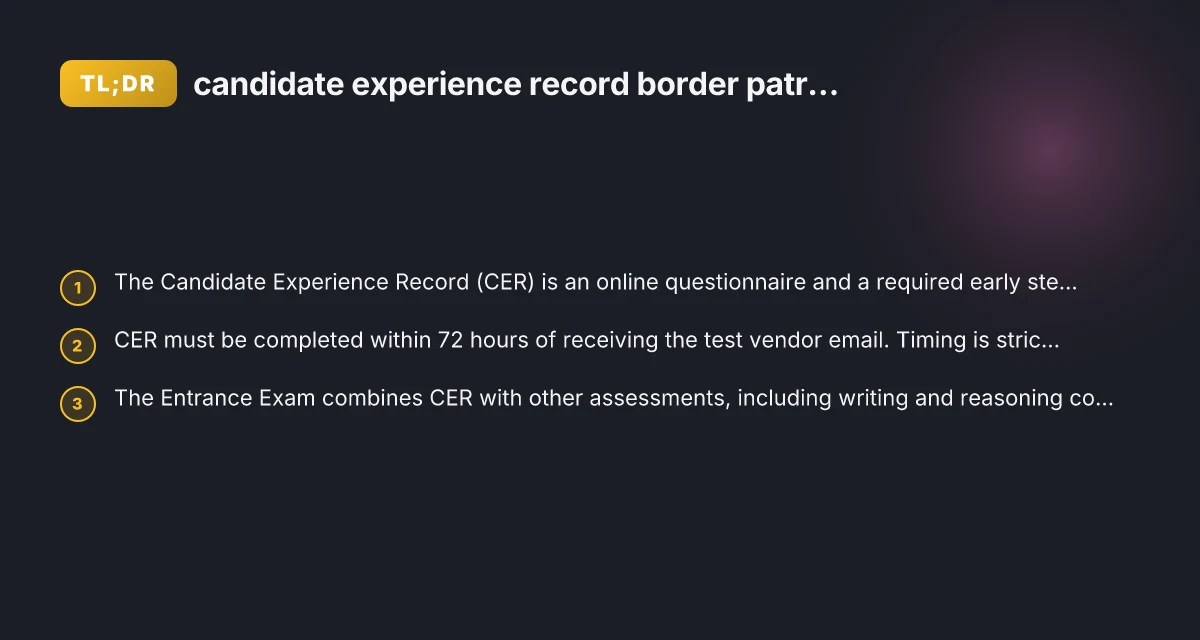
- CER must be completed within 72 hours of receiving the email from the test vendor. Missing this window can delay the rest of the process.
- Completing CER accurately helps set the stage for subsequent components, as responses can influence how exam proctors and recruiters view your candidacy.
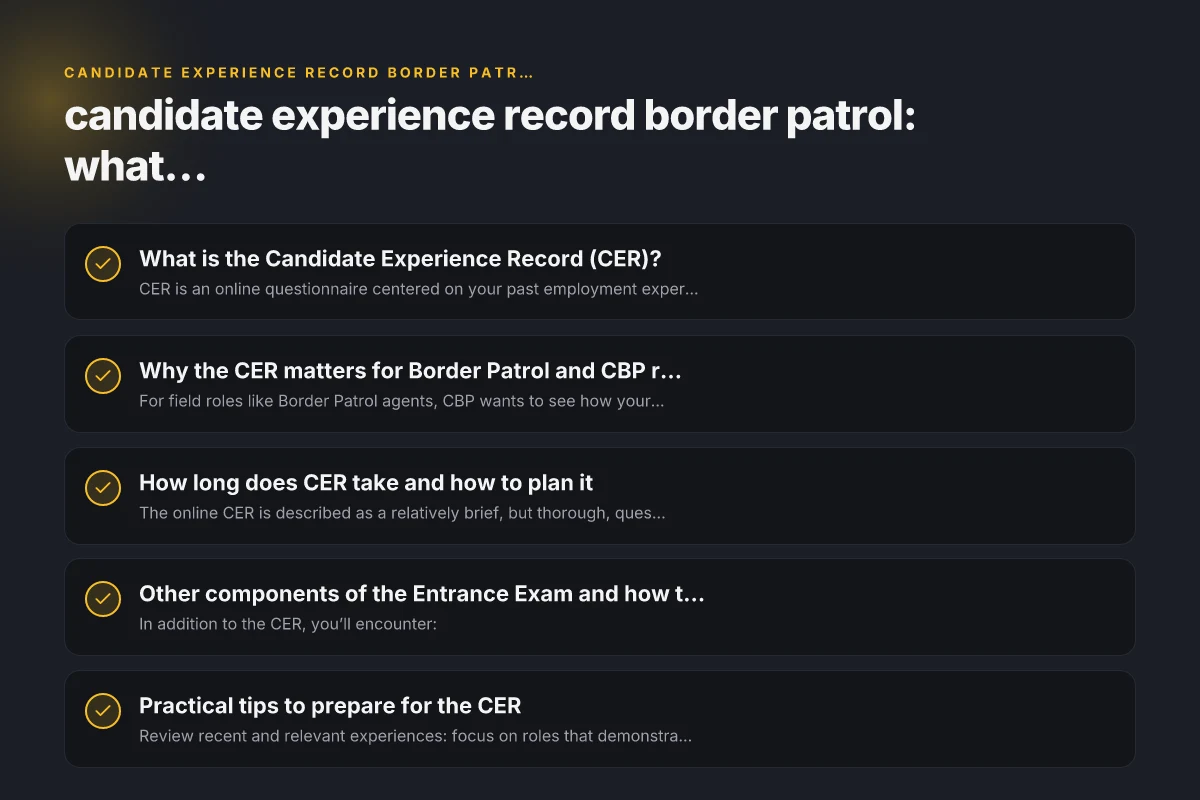
Why the CER matters for Border Patrol and CBP roles
- For field roles like Border Patrol agents, CBP wants to see how your past experiences translate to on-the-job challenges.
- A well-articulated CER can illustrate resilience, decision-making under pressure, teamwork, and ethical considerations, traits CBP values.
- CER responses may be reviewed by recruiters before moving on to the writing exercises and more formal assessments.
Common questions and how to approach them
- The CER is often described as a long questionnaire about your past employer experiences.
- Focus areas typically include:
- Your role and responsibilities in each job
- Challenges you faced and how you addressed them
- Examples of leadership, teamwork, and safety-conscious decisions
- Situations involving compliance, ethics, and adherence to rules
- Expect to reflect on real-world scenarios rather than hypothetical ones. Honesty and specificity help.
How long does CER take and how to plan it
- The online CER is described as a relatively brief, but thorough, questionnaire. Estimates suggest around 45 minutes for CER in some accounts, though actual times can vary by individual and the number of experiences you need to cover.
- Timing constraint:
- You must complete CER within 72 hours of receiving the invitation email from the test vendor.
- If you miss the window, you may lose the opportunity to continue in the Entrance Exam sequence.
- Practical planning tips:
- Gather details from each prior job: job title, dates, responsibilities, notable challenges, outcomes, and any recognition or disciplinary actions.
- Have a draft outline ready before you log in to the CER portal so you can fill in responses more efficiently.
- Ensure you have a stable internet connection and a device you can use for uninterrupted completion.
Other components of the Entrance Exam and how they relate
- In addition to the CER, you’ll encounter:
- Online Writing tasks: typically short prompts where you compose a structured response.
- Logical Reasoning tests: these can be online or at a test center and usually take about 2 hours.
- The combination of CER plus writing and reasoning tests creates a comprehensive assessment of both your experiences and cognitive abilities.
What to expect from the online writing component
- This portion assesses your ability to communicate clearly, structure arguments, and present information succinctly.
- Tips:
- Use a clear thesis or main point.
- Support statements with concrete examples from your experience.
- Stay within any word limits and follow provided instructions.
Practical tips to prepare for the CER
- Review recent and relevant experiences: focus on roles that demonstrate skills applicable to CBP duties, such as judgment, accountability, teamwork, and adherence to rules.
- Draft a concise narrative: prepare 3–5 short, specific examples that show your approach to decision-making, conflict resolution, and safety.
- Use the STAR method (Situation, Task, Action, Result) to structure your responses, but adapt to the CER’s format as needed.
- Be honest and self-reflective: CBP wants to see how you learn from experiences, including mistakes and how you improved.
CER vs other assessment elements: a quick comparison
| Component | Purpose | What to prepare | Timing notes |
|---|---|---|---|
| Candidate Experience Record (CER) | Online questionnaire about past work experiences | 3–5 strong, concrete examples; STAR-like structure helps | Must be completed within 72 hours of email invitation |
| Online Writing | Demonstrates written communication | Clear, coherent, well-structured responses | Usually follows or runs in parallel with CER |
| Logical Reasoning | Measures analytical thinking | Practice of logic puzzles, verbal and numerical reasoning | Online or at a test center; about 2 hours total |
Common questions people ask
- Q: What is the candidate experience record for Border Patrol? A: It is an online questionnaire assessing your past employment experiences as part of the Entrance Exam for CBP roles.
- Q: What is a candidate experience record? A: It’s a structured set of questions designed to understand how you operate in professional settings, focusing on behaviors and experiences rather than knowledge tests.
- Q: How hard is it to get hired for Border Patrol? A: Hiring is competitive and involves multiple steps, including the CER, writing tasks, reasoning tests, interviews, and background checks. Preparation and relevant experience help.
- Q: How do you know if you passed the Border Patrol interview? A: Pass criteria come from the overall hiring process, including performance on the CER, writing tasks, and reasoning tests, plus interviews and background checks. Recruiters provide feedback if available.
Practical steps to stay on track
- Immediately check your email for the CER invitation and note the 72-hour deadline.
- Prepare your example responses in a plaintext or document format so you can copy-paste into the CER portal if allowed.
- Assign a quiet time and place to complete the CER without interruptions.
- After CER, plan for the next steps (writing task and reasoning test) and gather any required documents or information you might need for those sections.
Short recommendation
If you are pursuing a CBP role and have received your CER invitation, treat it as an essential first impression. Prepare thoughtfully, be honest, and provide concrete evidence of your past performance and how you handle real-world work situations. Plan your schedule to meet the 72-hour deadline, and then proceed to the remaining Entrance Exam components with the same level of preparation and focus. A thorough CER combined with strong writing and reasoning performance can significantly strengthen your candidacy for Border Patrol or CBP positions.