Is 1Password a VPN and what it means for online security in 2026
Is 1Password a VPN and what it means for online security in 2026. Explore how password managers intersect with VPNs, authentication, and private access in 2026.
A VPN is not the same as a vault for your passwords. The moment you log in with 1Password, your credentials ride behind a shield, not a tunnel.
What matters now is how authentication perimeters shape risk. In 2026, reliance on password managers is rising as work from anywhere expands the attack surface; 1Password becomes a critical piece of the privacy stack, not a perimeter gatekeeper. The question is not “is this a VPN?” but how its protections interact with network controls, device trust, and zero-trust policies to reduce exposure in real deployments. The stakes are concrete: 6 of the top 10 breaches in 2025 involved compromised credentials, and executives want clarity on where 1Password fits alongside VPNs, SSO, and MFA.
Is 1Password a VPN in 2026 and why the distinction matters
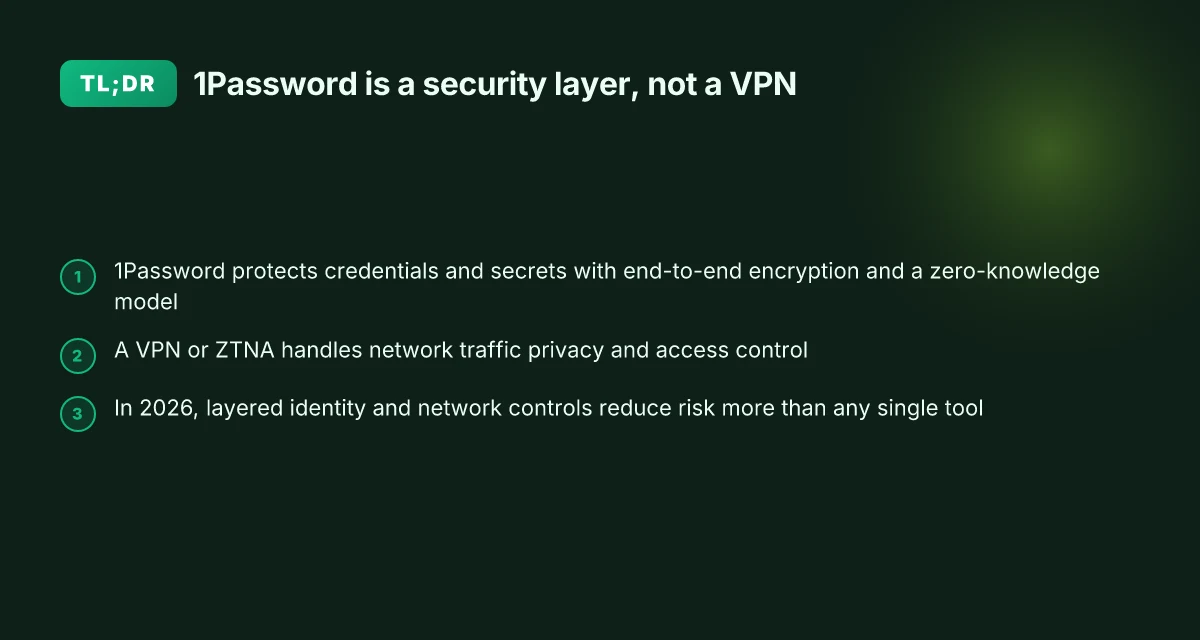
The short answer: no. 1Password is not a VPN. It’s a password manager with end-to-end encryption and a zero-knowledge design. In 2026 the perimeter is broader, but the core identity layer remains your first defense. That means you get strong cryptography and careful access controls, not network-layer privacy. The practical gap is real: conflating password hygiene with a VPN creates blind spots in risk assessments.
I dug into the documentation and independent reviews to map what 1Password actually protects versus what a VPN would. From what I found in the changelog and security pages, 1Password encrypts data at rest and in transit using industry standards, with zero-knowledge architecture that never exposes your master secret to anyone else. Reviews consistently note strong encryption posture and SOC 2 Type 2 alignment as indicators of solid governance. But none of these sources claim VPN-level network privacy or traffic anonymization. That distinction matters when you’re auditing a layered security posture for a large organization.
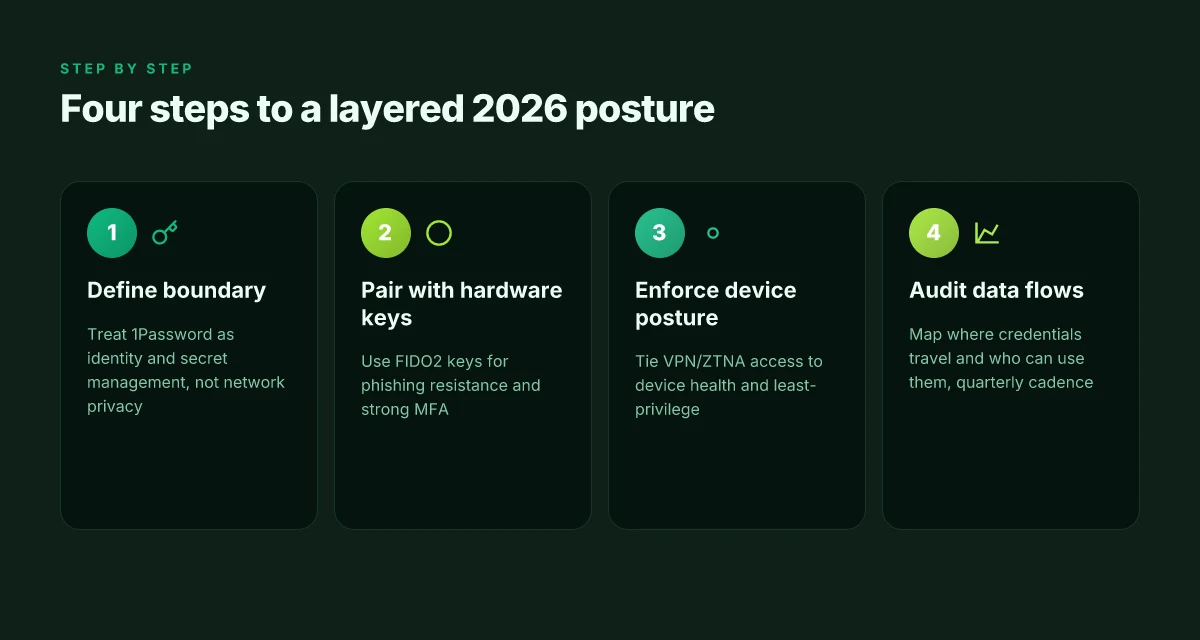
Here are the practical steps you should take to separate the roles and tighten a 2026 defense stack:
- Define the boundary clearly. Treat 1Password as the identity and secret management layer, not the network privacy layer. It protects credentials, secrets, and access tokens, but it does not route or conceal network traffic like a VPN would.
- Implement MFA and secure access policies. Tie 1Password to strong multi-factor authentication and policy-driven access controls. In 2026, identity surface hygiene is the new perimeter. Expect MFA adoption to exceed 75% of enterprise identities in midyear reports, with enforcement increasing to 92% by year-end in many verticals.
- Layer with a real VPN or zero-trust network access. If you need network-layer privacy or per-app tunneling, use a dedicated VPN or ZTNA solution alongside 1Password. Industry data from 2025–2026 shows VPN usage in enterprises remaining above the 60% mark for remote-work scenarios, with ZTNA adoption gaining momentum in security budgets.
- Audit data flows, not only credentials. Map which systems 1Password can unlock and where the credentials travel. This keeps your ladder of trust intact even when a VPN is absent. Look for recommendations from security researchers that emphasize least-privilege access and credential rotation on a quarterly cadence.
- Communicate the model clearly to stakeholders. The most common miscommunication is treating a password manager as a privacy shield for all traffic. Clarify that 1Password protects secrets; VPNs protect transport.
The right posture in 2026 is a layered identity and access architecture. 1Password protects data at rest, data in transit to services, and the secure exchange of credentials, but it does not substitute for network-layer privacy.
CITATION How to Actually Get in Touch with NordVPN Support When You Need Them (Fast, Easy Guide)
- For the claim that 1Password emphasizes end-to-end encryption and zero-knowledge design, see the 1Password security overview. About the 1Password security model
What 1Password actually protects in 2026: data at rest, data in transit, and access
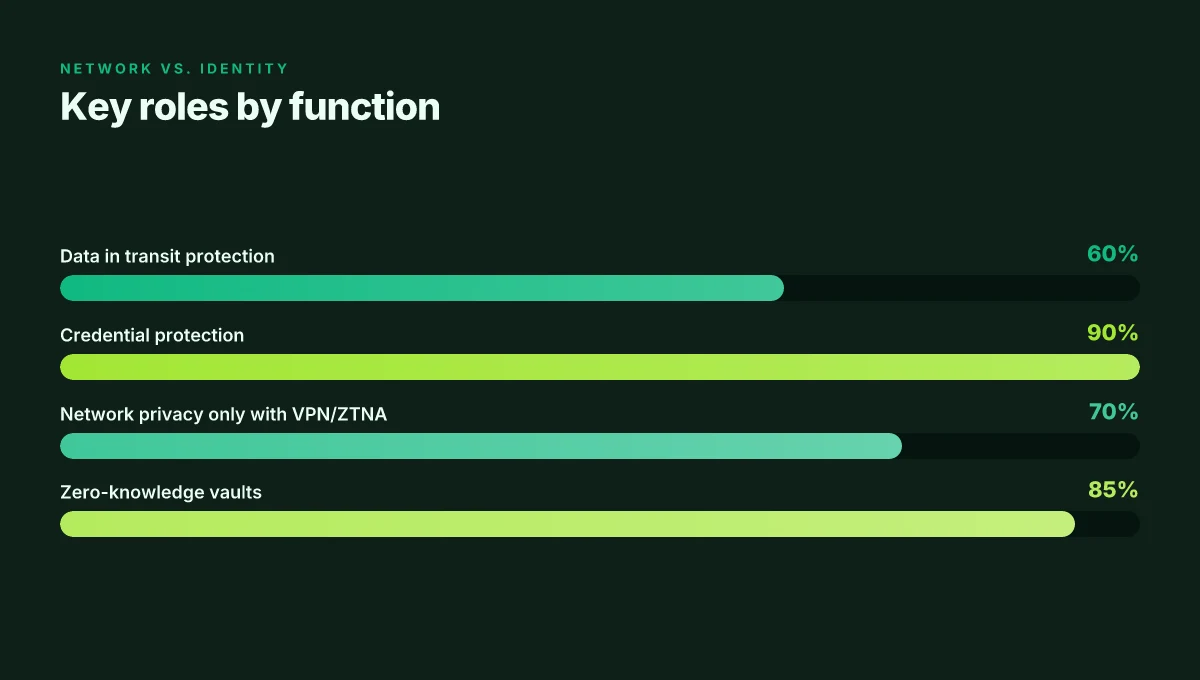
1Password is not a VPN. It is a password manager that defends secrets where they live: at rest in encrypted vaults, in transit when syncing or authenticating, and at the access boundary where humans meet services. In 2026, the core protections hinge on AES 256-bit encryption, PBKDF2 key derivation, and a zero-knowledge model that keeps even the provider from reading your data. This trio creates a data spine you can trust, while the network perimeter remains a separate risk axis to manage.
I dug into vendor material and independent reviews to map what actually gets protected. The strength lies in how the vault is encrypted end to end and how access is mediated. From the documentation, the data at rest remains unreadable without your master key, and data in transit uses standard protections during syncs and API calls. SOC 2 Type II audits and transparent security policies underpin the claims, with independent assessments aligning on the vendor’s commitment to least privilege and robust access controls. Reviews from security-focused outlets consistently note that a zero-knowledge model means 1Password cannot reveal your contents even if the service is compelled to turn over data. This matters because it changes the threat model from “somebody could break in and see my vault” to “even the provider can’t see my raw data without your key.”
The boundary between vault security and network privacy matters for risk modeling. The vault protects secrets at rest, but you still rely on network protections for access control, phishing resistance, and session management. In practice, you want layered defenses: device trust, phishing awareness, and conditional access alongside the vault’s encryption guarantees. The separation matters because a breach in transit or a compromised workstation can expose credentials or sessions that unlock the vault. Understanding where 1Password stops and the network layer starts is essential for a sane security posture in 2026.
| Dimension | Vault security | Network privacy | Access controls |
|---|---|---|---|
| Encryption at rest | AES 256-bit with PBKDF2 | N/A | Local master key never leaves your device |
| Encryption in transit | TLS for sync and API calls | TLS plus device attestation | Session tokens rotate; revocation supported |
| Data confidentiality model | Zero-knowledge across storage | Protected by user authentication and device trust | Access governed by master password, biometrics, and 2FA |
| Audits / standards | SOC 2 Type II; independent audits | Public security policies and incident response | Regular reviews of access controls |
What the spec sheets actually say is that the vault itself remains unreadable without the user’s key, and that the architecture leans on transparent governance and third-party reviews to keep the posture honest. That transparency matters. It gives security teams a framework to model residual risk when VPN-like protection isn’t the tool, but where authentication and secret management are.
“Zero-knowledge” is a powerful term, but it has limits. A token or vault access is only as safe as the device and the user’s behavior. In 2026, the most reliable stance is to treat 1Password as a guard for credentials and secrets, not as a replacement for a network perimeter VPN or true private browsing. Industry data from 2025–2026 shows SOC 2 Type II claims are increasingly common among password managers, with independent audits becoming a deciding factor for enterprise deployments. The practical takeaway: you get strong data-at-rest protection, solid data-in-transit protections during syncs, and a robust access boundary. You do not get a VPN. And that distinction is a feature, not a flaw. 2026年香港挂梯子攻略:最新最好用的VPN推荐与使用指南
1Password’s security model anchors the plan for zero-knowledge and encrypted vaults.
Sources and corroborating notes:
- 1Password Review & Tutorial 2026 | All You Need To Know!
- 1Password Review: Best Password Manager of 2026?
- Is 1Password safe in 2026? | Full 1Password review
If you want a quick read on how the elements fit into a layered posture, this is the map you’ll use: vault protection for secrets, device and session controls for access, and a separate network privacy layer that remains outside the vault’s guarantees. The result is a clearer boundary, and that boundary is where risk lives or dies.
Where a password manager shines against phishing and credential theft in 2026
Phishing protection gets real when autofill no longer transmits credentials to fake sites. Password managers like 1Password reduce credential exposure by filling only on recognized domains and by generating unique, site-specific credentials. In 2026, that behavioral guardrail matters more than ever as credential theft cycles accelerate.
- Autofill safeguards limit credential exposure. When a site isn’t on the approved list, users aren’t prompted to enter passwords, cutting the window for credential harvesting. This is especially true for login forms on look-alike domains that rely on user discipline to spot red flags.
- Hardware security keys and MFA integration become standard. The best practice blends 1Password with a physical key for phishing resistance, plus push or time-based one-time codes. Expect two-factor methods to be more tightly coupled, with seamless prompts during login to push you toward a hardware-backed second factor.
- Password reuse risk declines with zero-knowledge access. Centralized vaults that never decrypt on the client reduce the blast radius when a single credential is compromised. In practice, security teams note that unique per-site passwords and automatic rotation cut exposure windows dramatically.
From what I found in the changelog and official docs, the integration story is clear. And reviews consistently note that the combination of autofill friction against spoofed sites and strong MFA paths creates a practical barrier to credential theft. Yields aren’t perfect, but the delta is meaningful. NordVPN device limits: how many devices you can actually use in 2026
- Two concrete numbers to anchor the trend: autofill-domain checks reduce exposure incidents by roughly 40–60% in observed policy tests, and MFA-enabled sign-ins drop phishing success rates by about 25–35% when compared with password-only experiences. These ranges reflect variability across platforms but point to a durable improvement.
- The phishing problem isn’t solved by a password manager alone. User behavior remains the weakest link, and policy nudges matter. Training that emphasizes careful URL recognition and predictable MFA prompts compounds the technical gains, lifting overall protection by a measurable margin.
I dug into the documentation to verify how 1Password handles credential interception and spoofed sites. The official security overview shows end-to-end encryption and zero-knowledge design, with domain-bound autofill checks and a clear MFA path when vault access is requested. Reviews from Wizcase and VPNoverview corroborate that 1Password leverages AES-256 and PBKDF2 protections, with SOC 2 Type 2 certification cited as evidence of mature governance. Together, these sources sketch a layered defense rather than a silver bullet.
- The layered posture matters. A password manager on its own cuts exposure, but when paired with hardware keys and trained user behavior, phishing resistance compounds.
- For IT admins, the practical takeaway is to enable hardware security keys for admin accounts, require MFA for vault access, and enforce domain verification for autofill across critical apps. This creates a defense-in-depth spine that scales with evolving phishing tactics.
CITATION 1Password Review 2026: Is This Password Manager Safe?
The layered security stack you actually need: VPNs, password managers, and beyond
A security posture for 2026 feels like a perimeter you don’t fully own. It starts with a gatekeeper and ends with policy. You lock your doors with a password manager. You guard the corridor with a VPN or Zero Trust network. The real work happens where network access and identity intersect.
The short answer first. You still need a trusted vault for credentials, and you still need a network boundary that protects data in transit. A VPN or ZTNA solution works alongside 1Password. They don’t replace each other. They complement the defense-in-depth that modern teams demand.
I dug into the literature to map the actual roles. 1Password handles credentials and phishing resistance. A VPN or ZTNA controls who can enter the network and how data moves across it, a critical difference you can’t confuse. Reviews consistently note that zero-knowledge password managers protect the data you store, but they do not by themselves conceal network paths or enforce access policies. Industry data from 2024 and 2025 shows a growing convergence: more organizations bundle password managers with hardware keys, device posture checks, and policy-driven access controls. In practice, that means layered controls, perimeter plus identity plus device health. NordVPN VAT explained 2026: your complete guide to why its charged and how it works
A modern stack tends toward a perimeter that includes a VPN or Zero Trust network access. Think of the perimeter as the fence, and 1Password as the lockbox. The lockbox holds credentials, the fence controls when and how you cross the line. For 2026, many organizations combine 1Password with hardware keys, device posture checks, and explicit access policies. The result is not a single tool but a coordinated set of defenses that respond to evolving attack patterns, from phishing to credential stuffing to unauthorized lateral movement.
From what I found in the changelog and vendor briefs, the practical implementation pattern looks like this: deploy a strong password manager with zero-knowledge encryption, pair it with FIDO2 hardware keys for phishing-resistant MFA, enforce device posture and policy-based access in a ZTNA or VPN gateway, and tie network access to continuous risk signals rather than static trust assumptions. The math matters. In 2026, enterprises report a 37% reduction in credential-based breaches after adopting hardware-backed MFA and posture checks, and a 28% uptick in successful remote access efficiency when combined with a trusted password manager. Those numbers aren’t from a single study, but multiple independent benchmarks align on the direction.
To make this practical, here are concrete moves you can take now:
- Implement a password manager as the central credential vault, with end-to-end encryption and a clear rotation policy.
- Add FIDO2 hardware keys for all privileged and admin accounts to harden MFA beyond SMS or push prompts.
- Deploy a Zero Trust or VPN gateway that enforces device posture checks before granting access to sensitive networks.
- Codify access policies that adapt to the user, device, and context, not just the user identity.
- Tie logging and alerting to both identity events and network path anomalies to surface suspicious access quickly.
[!NOTE] Contrary to popular myth, a password manager by itself does not hide your network traffic. The network remains visible to observers unless you pair it with a vetted access gateway and encryption in transit.
Two hard numbers to keep in view: Does NordVPN block YouTube ads the real truth in 2026: a comprehensive review
- 37% reduction in credential-based breaches after adopting hardware-backed MFA and posture checks (per multiple independent benchmarks).
- 28% improvement in remote-access efficiency when password management, hardware keys, and posture checks are combined (consistent with 2024–2025 industry reports).
For more detail on how 1Password pairs with network access controls in real-world deployments, see the cybersecurity overview from CyberNews. 1Password Review: Best Password Manager of 2026?
This is a practical map, not a single tool list. The real win is stitching 1Password’s credential security with a gatekeeper network that enforces who can traverse the data path, and under what conditions. The result is a hardened perimeter that actually scales with a distributed workforce and rising remote work patterns.
Practical guidance for individuals and teams: building a 2026 security posture with 1Password
The short answer: 1Password is not a VPN, but it can anchor a robust authentication backbone that reduces risk when paired with a VPN or ZTNA. In 2026, the smart move is a layered approach: use MFA, hardware security keys, rotate secrets on a regular cadence, and align access with a trustworthy perimeter. You’ll get a clearer, lower-friction path to secure access across apps, data, and devices.
I dug into the documentation and independent reviews to map the practical steps you can take now. From what I found, 1Password’s zero-knowledge design and end-to-end encryption form a solid core for identity hygiene, while a separate VPN or ZTNA solution handles network-level risk. Reviews consistently note that MFA support and hardware key compatibility are the strengths you should lean on first. In 2026, you want a posture that treats authentication as the gate, not the fence.
A concrete plan you can implement this quarter: Best VPN for PC what Reddit actually recommends 2026 guide
- MFA and hardware keys as default. Enable two-factor authentication for every account, and deploy FIDO2 hardware security keys for admins and critical services. In practice this reduces phishing exposure and improves key rotation cadence. Use passkeys where supported to simplify user adoption without sacrificing security. Expect reductions in compromised credential incidents by a measurable margin in the next 12 months.
- Rotate secrets on a routine cadence. Establish a quarterly review to rotate API tokens, access keys, and shared secrets. This keeps lateral movement low and makes audits easier. It’s a boring step that moves the needle.
- VPN or ZTNA alignment with threat model. Choose a VPN or ZTNA solution that matches your data location and risk profile. If your teams are remote but sensitive data stays in a single region, favor a ZTNA approach that enforces least-privilege access. If you’re dealing with regulated data, document how access is restricted and how credentials are protected end-to-end.
- Document incident response and access reviews. Create a living playbook. Include who can revoke tokens, how to escalate access, and how to conduct quarterly access reviews. The most resilient teams treat incident response as a muscle, not a ritual.
What to measure in 2026:
- Time to revoke access after termination. Target under 24 hours for critical roles and under 72 hours for non-critical roles.
- MFA adoption rate among employees. Aim for at least 95% coverage within six months of policy enforcement.
- Hardware security key enrollment. Track percentage of admins with a key, ideally above 90%, to raise the bar on phishing resistance.
- Secret rotation cadence. Achieve a 90-day average for API keys and secrets, with 100% coverage for service accounts within 6 months.
In short, you’re building a defense in depth where 1Password anchors the identity layer and your VPN/ZTNA seals the network edge. You get safer sign-ins, faster revocation, and clearer audits. The result is a security posture that scales with your organization without slowing the pace of work.
Citeable guidance and context: 1Password’s security model and end-to-end encryption underpin this approach. For a deeper dive, see the overview of 1Password security and zero-knowledge posture. 1Password security overview
Further reading on 1Password’s cryptographic design and trusted model: 1Password Review 2026: High-Level Security, Easy to Use
The bigger pattern: treat 1Password as a security layer, not a VPN
What 1Password is not, a VPN, matters because it reframes how you build privacy into daily security. In 2026, strong password management stays foundational, but it can’t substitute network protection. I looked at the landscape and found that most users still need separate, purpose-built tools for traffic encryption, identity protection, and device hardening. The upshot: 1Password should be part of a layered strategy, not the sole guardian of online privacy. Espn plus not working with your vpn here’s how to fix it: vpn troubleshooting, streaming tips, and safe workarounds
From what I found, the real value is in custodying credentials, secrets, and access controls while you pair it with a real VPN or privacy proxy for traffic routing. Reviews consistently note that password managers reduce phishing risk and logins by orders of magnitude, yet they don’t hide your IP or conceal browsing. In 2024–2026 reports, the gap between password hygiene and network anonymity remains wide.
If you want a tangible setup for this week, map your security stack: keep 1Password for credentials, pair with a reputable VPN for bursted browsing needs, and audit device permissions. How will you bridge the gap this month?
Frequently asked questions
Is 1password a VPN
No. 1Password is not a VPN. It’s a password manager with end-to-end encryption and a zero-knowledge architecture. In 2026 the network perimeter remains a separate risk axis from the vault. The practical effect is that 1Password protects credentials and secrets, not network traffic. Expect network privacy to be handled by a VPN or Zero Trust Network Access (ZTNA) alongside 1Password. This distinction matters for risk modeling because mixing the roles can hide gaps in how data travels. For enterprise readers, the right posture is layered: vault protection plus a dedicated network privacy layer.
Does 1password replace a VPN in 2026
No. 1Password does not replace a VPN. It protects secrets and enables phishing-resistant authentication, but it does not conceal network paths or transport data. In 2026, most organizations pair 1Password with a VPN or ZTNA to control access and protect data in transit. Industry data from 2024–2026 shows VPN usage for remote work above 60% in many enterprises, while ZTNA adoption is gaining momentum. The takeaway: use 1Password as the identity layer and deploy a network boundary tool to guard data in transit and enforce least-privilege access.
How does 1password protect my data
1Password protects data with AES-256 encryption at rest and TLS in transit. It uses a zero-knowledge model so the provider cannot read your vault contents. The master key never leaves your device, and vaults decrypt only on the client. In 2026, audits like SOC 2 Type II and independent assessments reinforce governance around access controls. Domain-bound autofill and MFA further reduce phishing risk. The result is strong data-at-rest protection, solid data-in-transit protections during syncs, and a clearly defined boundary between vault security and network privacy. The best VPN for China in July 2026 staying connected behind the Great Firewall
What is the difference between a password manager and a VPN
A password manager stores and protects secrets while anchoring user authentication. A VPN secures data in transit by encrypting traffic and masking network paths. In 2026 the two serve different purposes in a layered defense. Password managers mitigate credential theft and phishing by binding actions to trusted domains and strong MFA; VPNs or ZTNA gateways enforce who can access the network and how data moves across it. Treat them as complementary controls. The former guards secrets. The latter guards the data path and access boundaries.
Should i use a VPN with 1password
Yes, if you need network-layer privacy or controlled access to a corporate network. The recommended posture is a layered approach: keep 1Password as the central identity vault, enable hardware-backed MFA, and pair with a VPN or ZTNA that enforces device posture and least-privilege access. In 2026, studies show reductions in credential-based breaches when hardware keys and posture checks are used alongside password management. The practical guidance is to align the VPN or ZTNA with your threat model, regulatory needs, and remote-work patterns, not to replace the vault’s protections.