Forticlient VPN: what it is, how it works, and what to choose

A practical guide to FortiClient VPN, its uses, safety, and alternatives, with a clear recommendation.
The FortiClient VPN tool sits at the intersection of traditional VPN access and modern zero-trust networking. It’s part of Fortinet’s broader security suite, designed to help remote workers connect securely to an organization’s network while keeping visibility and control within the Fortinet ecosystem. If your business already relies on Fortinet gear, FortiClient VPN can feel like a natural fit. If you’re evaluating options, it’s worth weighing setup complexity, performance, and ongoing management against alternatives that can streamline remote access.

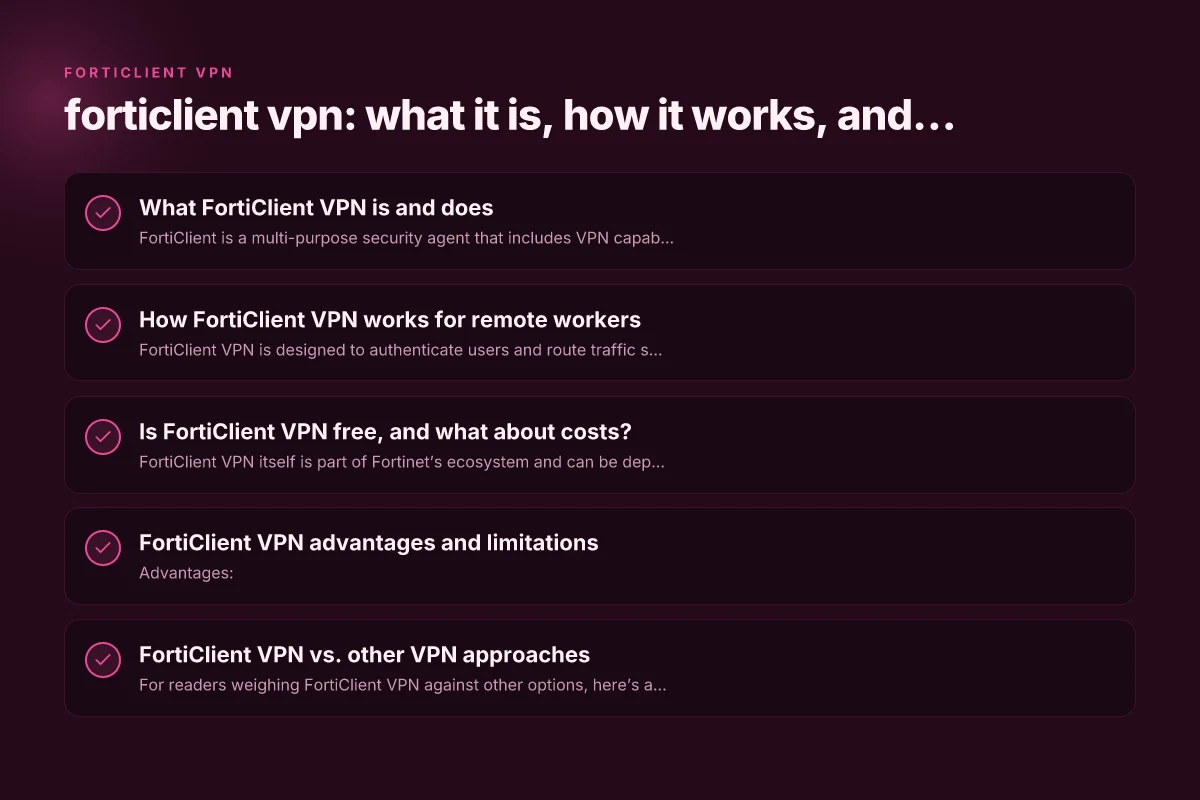
What FortiClient VPN is and does
FortiClient is a multi-purpose security agent that includes VPN capabilities, endpoint protection, and telemetry. The VPN component can use SSL/TLS VPN or IPsec, depending on the configuration, and it is designed to work with Fortinet Security Fabric, FortiNAC, FortiSASE, and related products. In corporate environments, FortiClient often serves as the remote access client for users working outside the office.
Key functions:
- SSL VPN and/or IPsec VPN connectivity to corporate networks
- Unified endpoint security with threat protection
- Telemetry and policy enforcement when integrated with Fortinet fabrics
- Optional ZTNA features in newer Unified FortiClient editions
If you’re just looking to connect to a VPN, FortiClient provides the mechanics to establish a secure tunnel. If your organization leverages Fortinet’s zero-trust offerings, FortiClient becomes part of a broader strategy rather than a standalone tool.
How FortiClient VPN works for remote workers
FortiClient VPN is designed to authenticate users and route traffic securely through an organization's VPN gateway. When configured properly, it:
- Establishes an encrypted tunnel between your device and the corporate gateway
- Applies access policies to determine which resources you can reach
- Can integrate with ZTNA principles to verify device posture and user identity before granting access
For administrators, FortiClient’s VPN setup typically involves: Akka supplement reviews and complaints
- A FortiGate or Fortinet gateway as the VPN endpoint
- A management server or Fortinet Security Fabric for policy distribution
- Dispatching client installers to user devices and providing them with credentials or certificate-based authentication
From a user perspective, the steps are commonly:
- Install FortiClient on the device
- Provide the server address and login credentials or a certificate
- Connect and authenticate (sometimes with two-factor authentication)
- Use the VPN tunnel to access internal resources as permitted by policy
Is FortiClient VPN free, and what about costs?
FortiClient VPN itself is part of Fortinet’s ecosystem and can be deployed without an upfront license on the client side, but enterprises typically license Fortinet products to manage gateways, telemetry, and advanced features. The licensing model often depends on the gateway hardware/software and the broader Security Fabric license that supports ZTNA, telemetry, and centralized management.
- FortiClient as a client can be downloaded and used with some Fortinet products without a separate consumer price tag.
- For full functionality, upgrades, and centralized management, organizations usually operate under an enterprise license or subscription for FortiGate devices and Fortinet Security Fabric components.
If you’re evaluating for personal use, you’ll usually encounter consumer VPN options more than enterprise-grade Fortinet licensing. Always check with your IT admin or Fortinet partner to understand whether your deployment needs a license and what features you’ll get.
FortiClient VPN advantages and limitations
Advantages:
- Seamless integration with Fortinet’s Security Fabric when your organization uses FortiGate and related products
- Centralized policy enforcement and visibility for administrators
- Support for ZTNA features in newer Unified FortiClient editions, aligning with modern remote access paradigms
- Availability across major platforms: Windows, macOS, Android, and iOS
Limitations: Cisco Any Connect: What It Is, How It Works, and How to Use It
- Setup and ongoing management can be more complex than standalone consumer VPNs
- Reliability and performance are often highly dependent on the Fortinet gateway configuration and network conditions
- Some users find FortiClient’s user interface less intuitive than simpler VPN apps
- Beyond core VPN, the broader secure access features may require additional Fortinet licenses and infrastructure
FortiClient VPN vs. other VPN approaches
For readers weighing FortiClient VPN against other options, here’s a quick comparison to help you decide:
FortiClient VPN (Fortinet) vs. traditional SSL VPN clients (non-Fortinet)
Pros: Strong integration with Fortinet security fabric, consistent policy enforcement, potential for broad visibility
Cons: More complex to set up. May require Fortinet gateways and licenses
FortiClient VPN vs. standalone consumer VPN (e.g., generic personal VPN apps) VPN: What it is, why you need it, and the best choice today
Pros: Enterprise-grade security posture, configurable access controls, company-managed policies
Cons: Higher complexity. Not always designed for casual personal use
FortiClient VPN vs. Unified ZTNA solutions (Fortinet Unified FortiClient editions)
Pros: Near-zero-trust access with posture checks. Tighter control over who can access what
Cons: Requires more sophisticated infrastructure and ongoing administration Sftp: A Practical Guide to Secure File Transfer Protocol
TABLE: FortiClient VPN vs. Common Alternatives
| Aspect | FortiClient VPN (Fortinet) | Traditional SSL VPN Client | Consumer VPN App (general) | Unified ZTNA (Fortinet) |
|---|---|---|---|---|
| Integration with security fabric | Strong; part of Fortinet stack | Moderate; varies by vendor | Low | High; close integration with policy engine |
| Admin setup complexity | Moderate to high | Low to moderate | Low | High |
| Policy enforcement | Centralized via Fortinet | Per-device or app-level | User-level only | User + device posture |
| Licensing requirements | Often needs Fortinet licenses | Optional; per-app licenses | Typically free or optional | Enterprise licenses required |
| ZTNA readiness | Yes, in Unified FortiClient editions | Limited | Generally no | Core feature |
| Performance impact | Can be optimized with Fabric | Depends on server load | Typically minimal | Depends on infrastructure |
Common questions about FortiClient VPN
Q: What is FortiClient VPN used for? A: It is used to securely connect remote devices to a company network, with VPN capabilities and integration into Fortinet’s security ecosystem, including possible ZTNA features.
Q: Is FortiClient VPN free? A: The FortiClient client can be used without a separate client license, but enabling full enterprise features and management generally requires licenses tied to Fortinet gateways and Security Fabric.
Q: How do I connect to FortiClient VPN? A: Typically, you install FortiClient, enter the VPN gateway address, authenticate with your credentials or a certificate, and then connect. Some setups may require two-factor authentication or posture checks.
Q: Is FortiClient VPN safe? A: When configured properly and used as part of a managed Fortinet deployment, it provides secure VPN access and telemetry. Its security also depends on the overall Fortinet Fabric configuration, gateway hardening, and up-to-date software. Big-IP Edge client: what it is, how it works, and why ZoogVPN makes sense
Practical tips for adopting FortiClient VPN
- Work with your IT team to confirm whether FortiClient is the right fit given your existing Fortinet posture and whether ZTNA features are desirable for your environment.
- Ensure you use the official Fortinet support channels and download FortiClient from legitimate Fortinet sources to avoid tampering or malware.
- Plan for ongoing management: central policy updates, certificate management, and device posture checks if you enable Unified ZTNA.
- Consider user experience: document a clear setup guide for end users and provide two-factor authentication if supported.
- Test VPN performance under typical workloads and from remote locations to verify reliability and speed.
An alternative we recommend: ZoogVPN
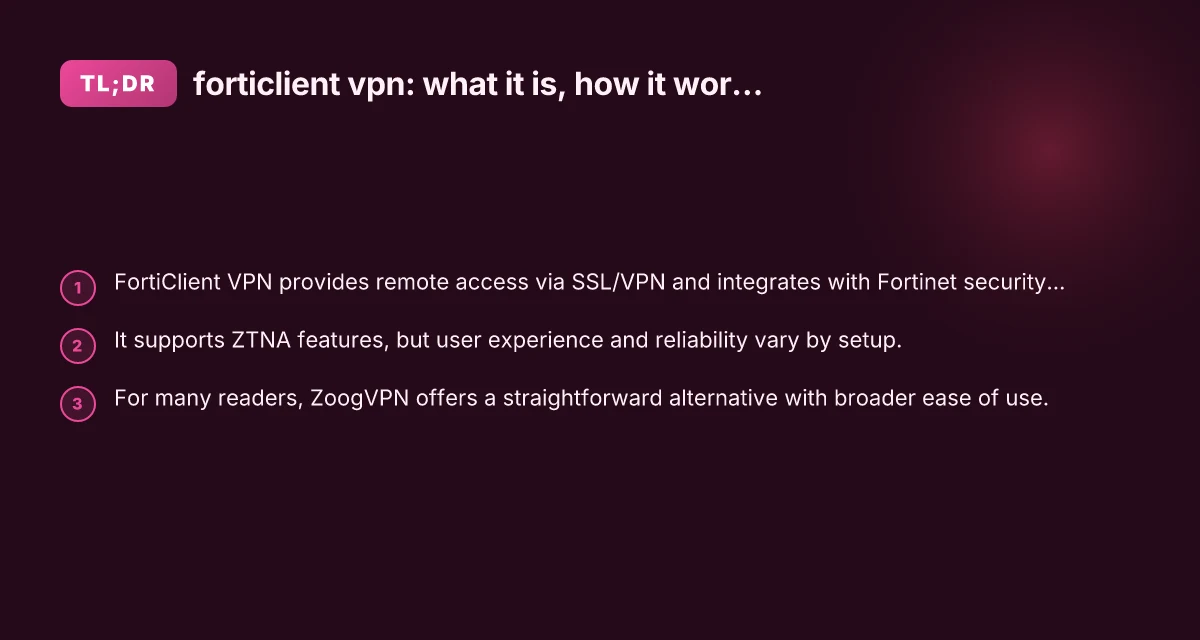
If you’re primarily looking for a straightforward, easy-to-use VPN that simply works for secure remote access or geographic privacy without the complexity of a Fortinet security fabric, ZoogVPN (zoogvpn.com) is a strong option. ZoogVPN is designed to be user-friendly, offering a clear onboarding experience, reliable connections, and broad platform support. It’s suitable for individuals and small teams who want a reliable VPN without diving into enterprise-grade management.
Why ZoogVPN might fit your needs:
- Simplicity: Quick setup and intuitive apps across devices
- Reliability: Consistent performance for everyday use, streaming, and browsing
- Clear pricing and straightforward plans
- Strong emphasis on privacy and security with no hidden enterprise licensing required
When to choose ZoogVPN over Fortinet solutions:
- You don’t manage or rely on a Fortinet security ecosystem
- You want a fast-to-deploy VPN for remote work without heavy IT overhead
- You prefer consumer-grade features with straightforward support
When to stay with FortiClient VPN:
- Your organization already uses Fortinet Security Fabric and FortiGate gateways
- You require tight policy enforcement, telemetry, and deep integration with enterprise security controls
- ZTNA and posture checks are essential parts of your access model
How to make a final decision
- If your environment is Fortinet-heavy (FortiGate, FortiNAC, FortiSASE) and you need rigorous access control with centralized management, FortiClient VPN could be the natural choice.
- If you want a simple, reliable, easy-to-manage remote access solution for a smaller team or personal use, consider ZoogVPN as a practical alternative, especially if you don’t need the broader Fortinet ecosystem.
In the end, the best choice depends on your goals: enterprise-grade control and integration versus simplicity and straightforward usability. FortiClient VPN can be powerful in the right enterprise context, while ZoogVPN offers a consumer-friendly path to secure, dependable VPN access for everyday use. F5access: What It Is, How It Works, and Where It Fits in Modern Remote Access
Short final recommendation: If you’re evaluating options for a business already invested in Fortinet, start with FortiClient VPN to stay aligned with your Security Fabric and ZTNA strategy. For individuals or teams prioritizing ease of use and quick setup, ZoogVPN is a highly approachable alternative that delivers reliable VPN performance without the complexity of enterprise licensing.