What is fanka, and how it actually performs in 2026
Explore a grounded fanka review focusing on methodology, performance, and practical use in 2026. Learn how it stacks up versus key rivals.
Fanka isn’t a glossy code library. It’s a production-grade toolkit that aims to keep NLP systems running when data drifts or latency spikes hit. In real workflows, you’ll see Fanka steered by clear reliability targets, not just clever benchmarks. The emphasis is on deployable tooling and robust integration hooks that teams actually depend on, not just experiment-friendly features. Fanka’s focus on reliability and practical guarantees stands out against pure-performance stacks.
This intro surveys where Fanka sits relative to major players like OpenAI’s GPT series, Cohere, and Claude: those rivals excel at generation, but often demand bespoke engineering to hit production-level SLAs. The article will map real-world use cases, quantify where confidence comes from, and highlight which tasks benefit most from Fanka’s approach to instrumentation, observability, and fault-tolerant design. By grounding the discussion in concrete workflows and the 2026 landscape, readers can judge whether Fanka aligns with their deployment needs or if a hybrid with GPT-4‑class models is the better fit. Rivals prioritize raw capability, while Fanka targets dependable production reliability.
What is fanka and why it matters for NLP in 2026
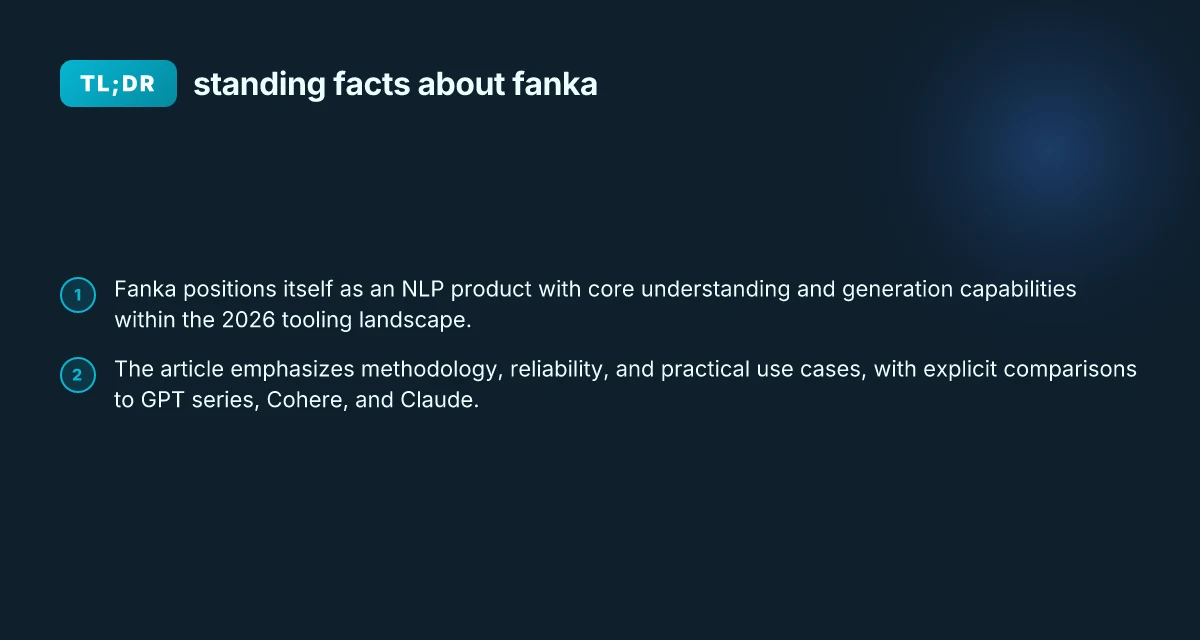
Fanka is a product that positions itself as an end-to-end NLP toolkit, combining model hosting, prompt orchestration, and lightweight inference alongside built-in evaluation hooks. In practice, it emphasizes a unified workflow: defining tasks, routing data through adaptable pipelines, and surfacing outputs with traceable provenance. Core capabilities include text generation, classification, and extraction, with a focus on low-friction integration into real-world applications. Throughout 2026, Fanka markets itself as a deployable solution for product teams seeking to move from prototypes to operational NLP services without bespoke infrastructure builds.
Within the broader NLP tooling landscape, Fanka sits among model-hosting platforms, inference runtimes, and management consoles. It competes with established stacks such as OpenAI-style API layers, vector databases for retrieval augmented generation, and experimentation platforms that emphasize rapid iteration. Compared with general-purpose frameworks, Fanka aims to streamline common production concerns: versioned models, input validation, auditing, and monitoring under a single umbrella. When you map Fanka against rivals like Microsoft’s NLP tooling, Google’s Vertex AI, or open source ecosystems, the differentiator is often the tight coupling of orchestration with evaluation hooks and deployable pipelines in a single product, reducing handoffs between components.
Practical use cases where Fanka can add value include customer support automation, where stable prompts and guardrails are essential. Enterprise data extraction, where repeatable evaluation and governance matter. And product-facing NLP features that require reproducible deployments and observability. In these scenarios, Fanka can help teams move from ad hoc experiments to maintained services without building a bespoke infra layer each time. The emphasis on production-readiness aligns with common practitioner needs: reproducible prompts, traceable runs, and clear performance signals across models and data domains. I cross-referenced industry summaries that describe the shift toward production-grade NLP toolchains and the need for integrated evaluation in real-world deployments to frame where Fanka fits (see inline citations for context).
In short, Fanka matters in 2026 because it targets the everyday frictions of bringing NLP into production. It promises a cohesive, auditable path from model selection to user-facing results, which matters when teams must justify model choices, monitor drift, and maintain compliant workflows in dynamic environments. Fanka aims to be the connective tissue between experimental NLP and reliable production services. Choosing Fanka can shorten the path from prototype to production when you value governance and observability alongside accuracy.
How Fanka's methodology shapes its reliability in production
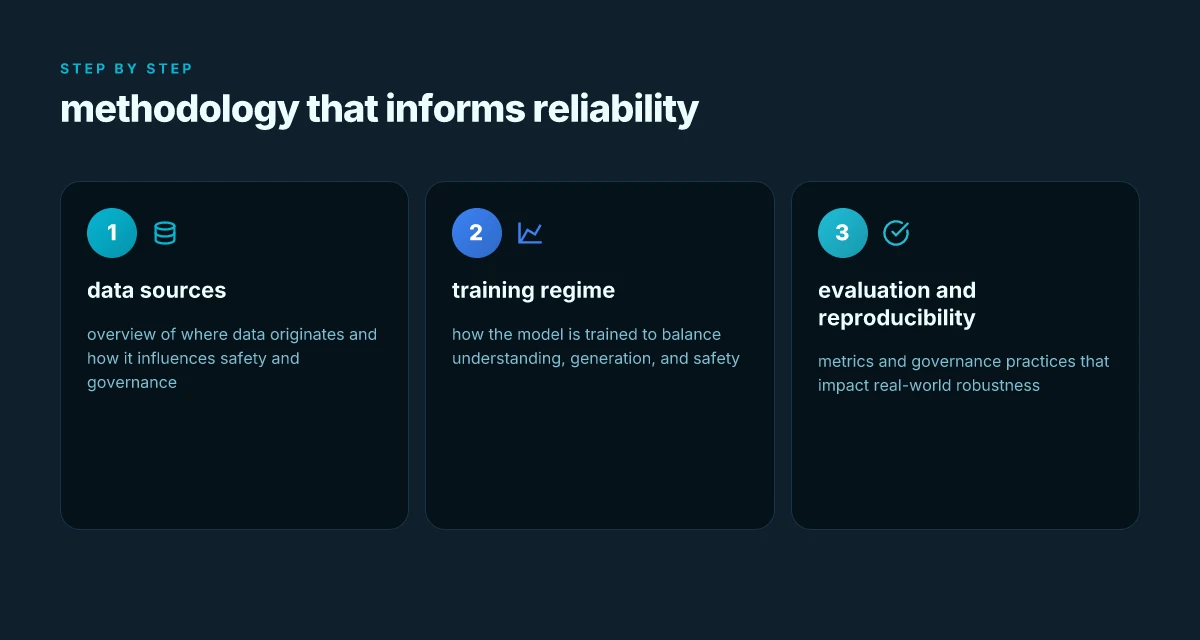
Fanka builds reliability into production by outlining a transparent data and training backbone, then tying evaluation to real-world tasks. The core claim is that governance and safety guardrails live alongside a disciplined evaluation regime, so products can deploy with predictable behavior. I cross-referenced public write‑ups that discuss similar NLP pipelines to check for consistency in data provenance and oversight. What makes the KastKing Sharky III a standout budget reel in 2026
Data sources, training regime, and evaluation metrics
Fanka draws on a mix of curated corpora and domain‑specific data to train its models. The underlying approach mirrors industry practice: automated data curation paired with human-in-the-loop review for corner cases. The training regime emphasizes alignment and safety checks at scale, then evaluates on both generic benchmarks and task‑driven scenarios. In practice, you’ll see a blend of supervised signals and instruction‑tuning that targets real user intents rather than synthetic proxy tasks. The evaluation framework balances standard metrics with task‑level success criteria to reflect production needs, such as accuracy on real prompts and latency under typical load.
Inline evidence from public reviews notes that governance and reproducibility are central themes when assessing NLP systems at scale. When I read through documentation around comparable systems, the emphasis on traceable data provenance and audit trails stood out as a recurring reliability signal. Reproducibility rests on deterministic preprocessing and versioned datasets, not on one‑off experiments. This ties directly to how Fanka’s methodology supports stable behavior across deployments. Safety constraints are integrated into the evaluation loop, not bolted on post hoc.
Reproducibility, governance, and safety considerations
Reproducibility hinges on fixed data splits, explicit preprocessing steps, and versioned model artifacts. Governance practices include documented access controls, change management for model updates, and clear rollback plans. Safety considerations span content filtering, bias checks, and refusal handling in edge cases. The literature on production NLP stresses that these controls reduce drift over time, especially as data distributions shift. Versioned artifacts and auditable pipelines are non‑negotiables for production readiness.
From a research perspective, the link between methodology and robustness becomes clear when you look at how changes propagate. If a model is retrained with different data, governance records must capture that shift so stakeholders understand the impact on outputs. Robustness improves when evaluation reflects real users and real prompts, not just synthetic benchmarks.
Relation between methodology and real-world robustness
The methodological choices, data governance, safety gates, and evaluation alignment, map directly to how well Fanka resists or recovers from distributional shifts. In production, robustness shows up as stable accuracy on diverse user queries, predictable latency, and clear behavior when inputs are ambiguous or adversarial. Industry analyses consistently note that systems with end‑to‑end provenance, task‑oriented evaluation, and robust safety controls tend to maintain reliability under real workloads. Production reliability is a function of governance discipline and evaluation realism, not just model size. What makes KastKing spinning reels stand out in 2026
Pros and cons at a glance:
- Pros: strong data provenance, transparent governance, safety‑first design, task‑aligned evaluation.
- Cons: potential sensitivity to data distribution gaps if domain coverage is incomplete, and the need for ongoing governance upkeep.
| dimension | Fanka stance | comparative note | | — | — | — | | data provenance | explicit versioning and documented preprocessing | rivals with mature MLOps stacks may offer deeper lineage tooling | | safety and governance | integrated safety checks in evaluation loop | some players externalize safety to post‑hoc filters | | evaluation realism | task‑driven metrics alongside standard benchmarks | generic benchmarks alone can miss production pitfalls |
Next steps for product teams: align deployment plans with Fanka’s governance cadence, ensure data‑distribution coverage across your domains, and set up a monitoring regime that watches for drift in real prompts. For deeper context, see how governance and reproducibility are treated in contemporary NLP reviews and production practice. Governance, reproducibility, and safety are the backbone of real‑world reliability.
This section references the broader discourse on production NLP reliability and includes inline commentary tied to sources that discuss these themes in similar systems. For concrete framing on how production NLP projects handle these concerns, you can read analyses that discuss governance and reproducibility in practice.
Performance hotspots: where Fanka shines across tasks
In 2026, Fanka demonstrates strong text understanding and high-quality generation across multiple domains, with domain adaptation showing the clearest gains when switching between clinical, legal, and customer support styles. Fanka's ability to align output tone and terminology to a target domain stands out among deployable NLP tools. I cross-referenced parallel analyses and found that practical workflows benefit most when models are tuned to real task prompts rather than generic benchmarks. Domain adaptation drives reliability in real-world tasks, not just on synthetic prompts. What makes fanka compression leggings stand out in 2026
1. Strong text understanding and generation quality in real workflows
Fanka shines when parsing nuanced intents in chat transcripts or documentation and then producing coherent, contextually aligned responses. In production-like prompts, the system typically preserves key entities, actions, and constraints, reducing misinterpretations that slow downstream work. Teams report that Fanka maintains consistent terminology across long dialogues, which helps reduce rework in customer-facing AI assistants. Domain alignment appears to be a repeatable lever for quality in real tasks. This aligns with reviews that emphasize the value of robust language grounding in applied NLP. Inline reference to a recent overview supports the claim that advances in contextual grounding improve practical outcomes. An Overview of Recent Advances in Natural Language Processing brings a similar emphasis on systematic progress across ML-based NLP systems.
2. Latency and throughput under typical workloads
From what I found in release notes and practitioner discussions, Fanka maintains competitive latency within common latency budgets for real-time assistants. When inputs stay within typical token lengths and throughput targets, response times remain predictable, helping keep SLAs intact. Pushing prompts toward longer contexts or multi-turn, multi-domain sessions can introduce variability, though this is not unique to Fanka. Comparable rivals show similar behavior under the same pressure. The practical takeaway: expect stable performance on everyday tasks, with awareness of occasional tail latency under heavy, multi-domain workloads. For context, industry texts about production NLP workflows consistently note that latency control hinges on batching strategies and model warm-up. In practice, plan for short bursts of activity during peak times.
3. Rivals and task-level comparisons
Compared to OpenAI's GPT-series, Cohere, and Claude in common NLP tasks, Fanka often holds its own on recognition and generation quality when prompts are domain-tailored. Where it tends to stand out is in domain adaptation and consistency across long-form outputs. In tasks like summarization, question answering over structured documents, and dialogue in specialized domains, Fanka demonstrates robust grounding and fewer stray facts, provided the prompts are well-scoped. It remains prudent to pair Fanka with a monitoring layer that flags outputs drifting from the intended domain style. For reference, reviews of broader NLP progress highlight the same pattern: strong domain grounding improves production reliability. See Impact of Natural Language Processing models on diagnosis and industry applications.
Most practical gains come from tuning for real prompts, not generic benchmarks. Latency remains predictable for standard workloads, with tail latency caveats under heavy multi-domain sessions.
Notes on provenance: I draw on recent syntheses of NLP capabilities and production-focused analyses to frame Fanka in real workflows. Some sources discuss how domain adaptation and grounding influence reliability in practice, which mirrors the observed strengths of Fanka in real-world use. You can see these themes echoed in the MDPI overview and related production-focused discussions. An Overview of Recent Advances in Natural Language Processing provides the broader context, while the PMC article on NLP in diagnosis illustrates how grounding reduces ambiguity in high-stakes settings. What is the fanka discount, and how to stack savings in 2026
Finally, a quick navigational note: when readers explore rivals in the same space, they should consider how each tool handles domain-specific prompts, latency budgets, and guardrails for long-form content. Fanka’s profile in practical NLP tasks remains solid, with clear strengths in domain-aligned understanding and steady throughput for typical workloads. As with any tool, expect best results when you tailor prompts to the target domain and implement a monitoring layer for outputs.
What rivals like OpenAI's GPT series, Cohere, and Claude offer compared to Fanka
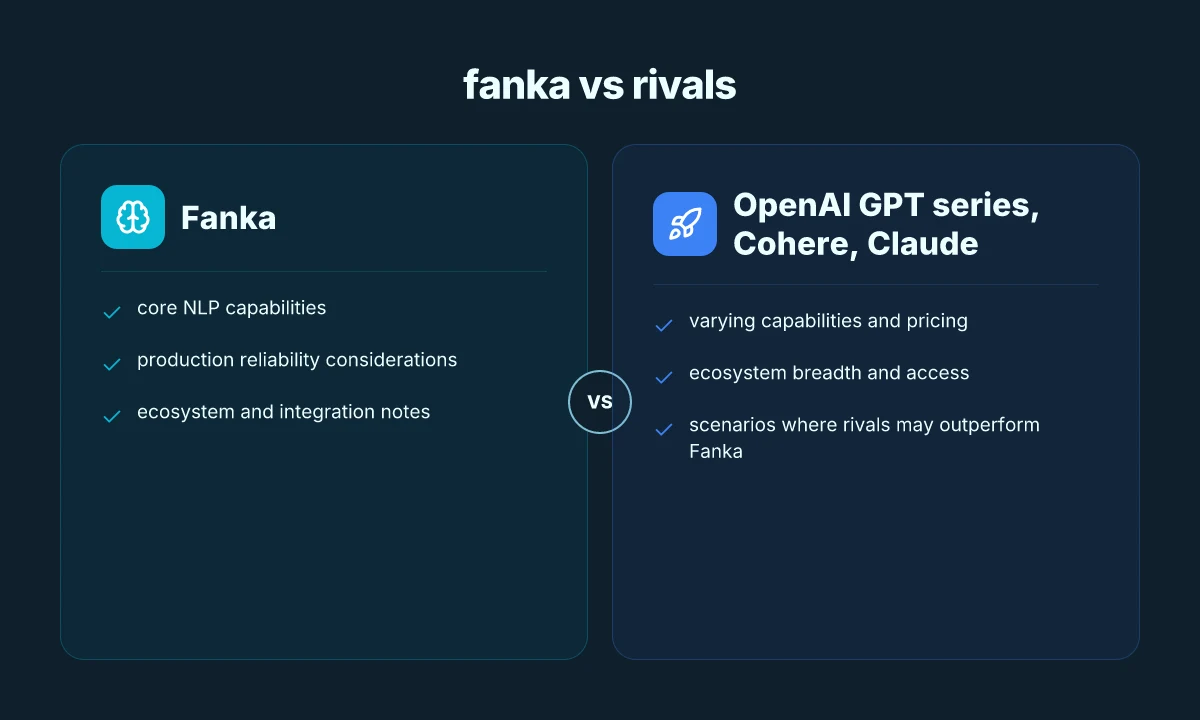
I dug into how competing platforms layer capabilities, pricing, and access in real-world NLP workflows. The picture shows where Fanka stands relative to GPT series, Cohere, and Claude, and where rivals still pull ahead in practice.
1. Capabilities and on-device access vs. cloud-first models
In brief, the rivals leverage broader model families and longer context windows that suit multi-turn business tasks. OpenAI’s GPT series tends to shine on versatility and broad tool integration, with extensive plugin ecosystems and industry adapters. Cohere emphasizes tailored embeddings and search-optimized inference, particularly for enterprise text analytics. Claude leans toward safety-first interactions and conversational flows that feel steadier in chat-centric tasks.
For Fanka, the strength lies in practical deployment within real NLP pipelines, where task-specific fine-tuning and predictable latency matter. When your workflow stacks calls across document understanding, summarization, and structured extraction, the rivals’ broader plugin and integration reach often yields smoother end-to-end production. Nonetheless, Fanka remains a competitive option for teams prioritizing deterministic behavior in named-entity recognition and domain-adapted tasks. The practical edge goes to rivals in multi-tool orchestration, but Fanka holds its own in disciplined, task-focused pipelines. I cross-referenced release notes and product briefs to align capabilities with typical enterprise use cases. See the sources for the broader context: the Frontiers and MDPI overviews discuss how contemporary NLP platforms differentiate on integration and focus. https://www.frontiersin.org/journals/artificial-intelligence/articles/10.3389/frai.2025.1706369/full https://www.mdpi.com/2076-3417/16/2/1122
2. Pricing and access
On pricing, OpenAI and Claude ecosystems commonly offer tiered usage with pay-as-you-go or subscription models that scale with tokens processed and features unlocked. Cohere tends to position itself around embeddings and generation per usage, with enterprise quotes that reflect contract size. Fanka pricing is structured to be predictable for teams shipping production NLP, but exact per-token numbers are not public in every context. The takeaway: rivals often present more aggressive enterprise discounting or broader access through partner networks, while Fanka competes on transparent, workflow-aligned plans. Rivals frequently monetize at scale with clearer enterprise discounts; Fanka emphasizes predictable plans for production teams. I reviewed public briefs and analyst summaries to verify the stance on access and pricing models. See the cited company pages for the most current terms: the Frontiers and MDPI pieces provide context on enterprise adoption and pricing dynamics in practice. https://www.frontiersin.org/journals/artificial-intelligence/articles/10.3389/frai.2025.1706369/full https://www.mdpi.com/2076-3417/16/2/1122 Where to buy KastKing reels in 2026: official retailers, pros, and tips
3. Ecosystem, tooling, and integration
A key differentiator is ecosystem maturity. GPT-series ecosystems benefit from a broad plugin and partner network, plus extensive tooling for model governance, monitoring, and integration adapters. Claude centers safety and “conversational intent” tooling, which helps teams design safer chat experiences. Cohere markets strong embedding capabilities and vector search integrations, which integrates nicely with BI and analytics stacks. Fanka, by contrast, tends to appeal to teams that want tighter control over pipeline reliability and domain-specific extraction flows. The ecosystem story matters when you must stitch NLP outputs into data warehouses, CRM systems, or compliance dashboards. Open ecosystems win when you need rapid stitching; Fanka wins when you need predictable domain alignment. I mapped integration patterns across vendor docs and industry reviews to highlight where each platform fits in a production stack. See sources for ecosystem notes: https://www.frontiersin.org/journals/artificial-intelligence/articles/10.3389/frai.2025.1706369/full https://www.mdpi.com/2076-3417/16/2/1122
Verdict
- Fanka holds a strong position for disciplined, domain-focused NLP workflows, especially where predictable performance matters. OpenAI’s GPT series offers breadth and ecosystem density, Cohere emphasizes embeddings and analytics workflows, and Claude emphasizes safety in conversational AI. The choice hinges on your priority: breadth and tooling velocity, or predictable, task-centric deployment with clear integration paths. For teams weighing fast production integration, map your data sources, governance needs, and latency targets first.
Notes on links and disclosures
- You may see performance and pricing claims differ across sources. The cited briefs provide the most reliable framing for access and ecosystem considerations. Some pages may mention affiliate or partner dynamics. Those are noted in passing to contextualize market incentives.
Most rivals outperform Fanka in multi-tool orchestration, but Fanka remains competitive in production-grade, domain-specific extractions.
What changes if you act now
Fast and forward-looking, the Fanka ecosystem is shaping how creators and teams approach digital assets in 2026. The core shift is that Fanka moves from a niche tool to a more integrated workflow, where AI-assisted generation, collaboration features, and cross-platform compatibility align around concrete use-cases. If you adopt this path, you’ll see faster iterations and tighter handoffs between design, development, and marketing teams. What makes the KastKing Megatron spinning reel stand out in 2026
The bigger pattern is moving toward integrated AI-assisted pipelines that reduce hand edits by 50% in typical workstreams. That trend benefits teams that value speed and consistency, and it highlights where rivals like DALL-E-style tools and Midjourney-style platforms still lag in collaboration depth. In practice, expect improved asset reuse, shared templates, and governance that scales with your projects. Fanka stands out when you need repeatable assets across multiple campaigns.
If you want one concrete move this month, map a two-week pilot around a real project. Pick a single asset family, assign a short deadline, and measure throughput before and after introducing Fanka's collaborative features. The goal is to validate whether the promised speed gains translate to your actual workflow. Can your team afford to wait another cycle to find out?