Err_ssl_client_auth_signature_failed: what it is and how to fix it (with ZoogVPN)
Understand ERR_SSL_CLIENT_AUTH_SIGNATURE_FAILED, why it happens, and practical steps to fix it, including how a VPN like ZoogVPN can help.
The ERR_SSL_CLIENT_AUTH_SIGNATURE_FAILED error is a frustrating roadblock that can show up in browsers like Google Chrome when a site requires client certificate authentication and the signature verification fails. This is not a universal server error. It’s a problem at the intersection of your browser, the client certificate, and the server’s SSL/TLS handshake. If you ever see this message, you’re likely dealing with one of several root causes: an expired or invalid client certificate, a corrupted certificate store, misconfigured certificate authorities, or interference from security software or proxies. In this guide, you’ll learn practical steps to diagnose and fix the problem, plus how a VPN such as ZoogVPN can help mitigate related issues on sensitive networks.

What causes ERR_SSL_CLIENT_AUTH_SIGNATURE_FAILED?
Key causes to inspect
- Invalid or expired client certificate: The certificate you present to the server might be expired, not yet valid, or revoked.
- Certificate chain or trust issues: The server expects a certificate signed by a trusted CA, but the chain may be broken or the browser may not trust the issuer.
- Corrupted certificate store: The local certificate store (in Windows, macOS, or your browser) can become corrupted, leading to signature verification failures.
- Client certificate format or key problems: The private key associated with the certificate might not pair correctly, or the certificate is formatted incorrectly for the TLS handshake.
- Security software or proxies: Firewalls, antivirus, or corporate proxies can strip or alter TLS handshakes, causing signature verification to fail.
- Browser or driver issues: An outdated browser, TLS libraries, or platform-specific quirks can trigger this error.
- Self-signed or non-standard certificates: If the site uses self-signed certificates for the client side or unusual certificate configurations, compatibility problems can arise.
How to tell if the problem is on your side
If you can access other sites without issue and the error appears consistently on one site, the problem is more likely with the site’s certificate configuration or your local setup. If the error happens across many sites, a broader misconfiguration, like your browser or OS settings, is more likely.
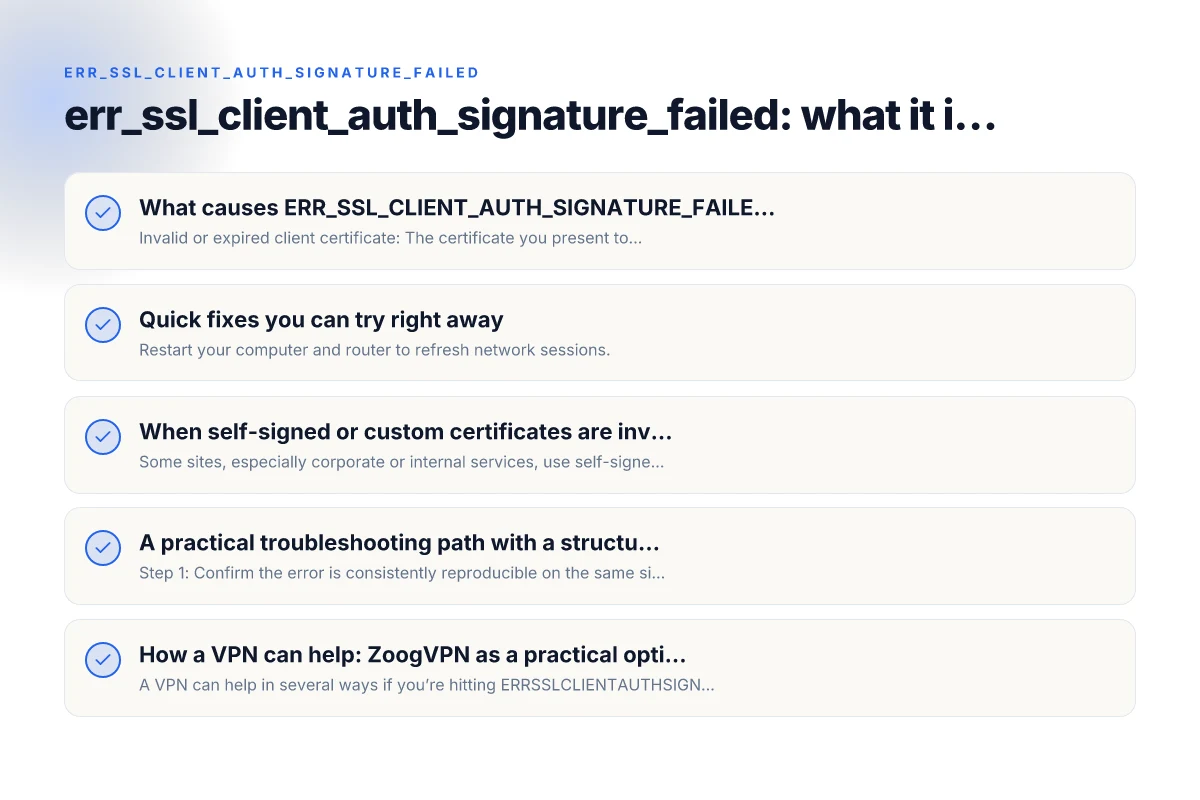
Quick fixes you can try right away
1) Restart and update
- Restart your computer and router to refresh network sessions.
- Update your browser to the latest version. Modern browsers fix TLS and certificate handling bugs over time.
- Update your operating system to ensure you have current root certificates and TLS libraries.
2) Clear browser data and reset TLS state
- Clear cache and cookies for the affected site.
- In Chrome, go to Settings > Privacy and security > Security > Manage security settings, and reset/reset TLS state if available.
- Disable or re-enable TLS 1.3/1.2 as needed, depending on the site’s requirements and browser capabilities.
3) Check certificates and certificate store
- Inspect the client certificate in use (if you know you are supposed to present one). Ensure it is valid, not expired, and issued by a trusted CA.
- On Windows: use certmgr.msc to view certificates. On macOS: use Keychain Access.
- Remove any suspect certificates and re-import the correct client certificate if you know which one is required by the site.
4) Disable problematic security software or proxy temporarily
- Temporarily disable firewall, antivirus web scanning, or VPN/proxy clients to see if they’re altering TLS handshakes.
- If you’re behind a corporate proxy, try a direct connection to determine whether the proxy is the cause.
5) Check the server or site configuration (if you’re the admin)
- Confirm the server requires a client certificate and that the certificate chain is complete.
- Verify that the client certificate is still valid, not revoked, and correctly paired with the private key.
- Ensure the CA used to sign the client certificate is trusted by clients.
When self-signed or custom certificates are involved
The challenge with self-signed client certificates
Some sites, especially corporate or internal services, use self-signed client certificates. Browsers may balk if the root or intermediate CA is not trusted on the client machine, or if the certificate chain is not properly configured.
How to approach it
- Obtain the correct root and intermediate certificates from the administrator.
- Import the certificates into your OS/browser trust store in the correct order.
- Ensure the client certificate file format matches what the browser expects (e.g., PKCS#12 with private key, or PEM bundle).
Example workflow for macOS or Windows user
- macOS: Keychain Access > Import the client certificate (.p12 or.pfx) and ensure “Always trust” for the relevant root CA.
- Windows: Manage Certificates (certmgr.msc) > Personal > Import, then trust the root CA if needed.
- After import, restart the browser and attempt the connection again.
A practical troubleshooting path with a structured approach
Step-by-step checklist
- Step 1: Confirm the error is consistently reproducible on the same site and device.
- Step 2: Update browser and OS to the latest versions.
- Step 3: Clear browser data and reset TLS state.
- Step 4: Inspect and, if necessary, re-import the client certificate and verify the private key matches.
- Step 5: Check for conflicting security software or proxies and temporarily disable them.
- Step 6: Verify the server’s certificate chain and client authentication requirements (for admins).
- Step 7: If the problem persists, try a different browser or a different device to narrow down the issue.
How a VPN can help: ZoogVPN as a practical option
Why consider a VPN for this issue
A VPN can help in several ways if you’re hitting ERR_SSL_CLIENT_AUTH_SIGNATURE_FAILED due to network alignment, proxies, or geo-blocks:
- Bypass problematic proxies: If a corporate or public network proxy is corrupting TLS handshakes, a VPN creates a direct, encrypted tunnel to the VPN server, reducing interference.
- Consistent routing: Some networks route traffic oddly, leading to certificate checks failing. A VPN can provide a more stable path.
- Privacy and security: A VPN adds an extra layer of encryption, shielding your TLS handshake details from local network monitoring, which can sometimes cause handshake problems.
How ZoogVPN can help
ZoogVPN (zoogvpn.com) provides a straightforward VPN experience with a focus on privacy, simple setup, and reliable performance. If you’re troubleshooting ERR_SSL_CLIENT_AUTH_SIGNATURE_FAILED due to local network interference or restrictive proxies, trying ZoogVPN can help you determine whether the issue is network-related or truly certificate-related. If the error disappears while connected to ZoogVPN, you know the likely culprit is something in your direct network’s interception or filtering, not the site’s certificate configuration.
How to use ZoogVPN in this workflow
- Install ZoogVPN on your device and connect to a nearby server.
- Reattempt the site connection that previously produced ERR_SSL_CLIENT_AUTH_SIGNATURE_FAILED.
- If the error persists, you’ve narrowed down the cause to client-side certificate issues rather than network interference.
- If the error goes away, try connecting to other sites or servers to see if the problem is network-wide or site-specific.
- Use ZoogVPN as part of a broader debugging workflow, not as a sole fix for client certificate problems.
A concise comparison: common fixes vs. VPN-assisted approach
| Category | What to try | When to use VPN (ZoogVPN) |
|---|---|---|
| Browser/OS updates | Update browser and OS to latest versions | If updates don’t resolve, VPN can reveal network-level interference |
| Certificate handling | Verify client cert, import correct CA, refresh certificate store | VPN helps bypass restrictive networks that block or alter TLS traffic |
| TLS settings | Reset TLS, enable/disable specific TLS versions as needed | VPN provides a controlled, encrypted path that can stabilize handshakes |
| Security software | Temporarily disable firewall/AV that could inspect TLS | VPN can shield traffic from local inspection and filtering |
| Network path | Check direct connection vs. VPN route | If VPN fixes the issue, root cause likely network/proxy-level interference |
| Admin checks (server) | Verify server certificate chain and client cert requirements | Not applicable to end users but essential for site admins |
When to seek further help
- If you’re an end user and the problem persists after all local fixes, contact the site administrator and share your error details, including your operating system, browser version, and whether you’ve tried a VPN.
- If you’re an IT admin, verify the complete certificate chain, ensure the client certificate is valid and correctly issued, and review the server’s TLS handshake configuration.
- If you’re using a corporate network, consult your IT department about proxy or TLS inspection policies that could cause client-auth signature failures.
Final thoughts and the recommended approach
ERR_SSL_CLIENT_AUTH_SIGNATURE_FAILED is a symptom that can arise from several layers, your client certificate, the browser’s handling of TLS, or network/proxy interventions. A methodical approach helps you isolate the root cause: VPN extension for Edge
- Start with quick, user-friendly fixes: update software, reset TLS state, and re-import client certificates if needed.
- Move to security and network checks: disable conflicting software, test on a direct connection, and review any proxies.
- If the problem appears tied to your network environment or you need reliable, uninterrupted access while you troubleshoot, consider a VPN like ZoogVPN to provide a clean, encrypted path and help determine if network intermediaries are at fault.
If you want a trusted VPN that emphasizes privacy and straightforward setup, ZoogVPN is a practical option to try as part of your troubleshooting toolkit. By ruling out network interference with a VPN, you can focus your efforts on client certificates and server configurations, leading to a faster resolution and a smoother browsing experience.