Entry level pay scale philippines

A practical guide to starting wages in the Philippines for fresh graduates, including typical ranges by industry and tips to negotiate.
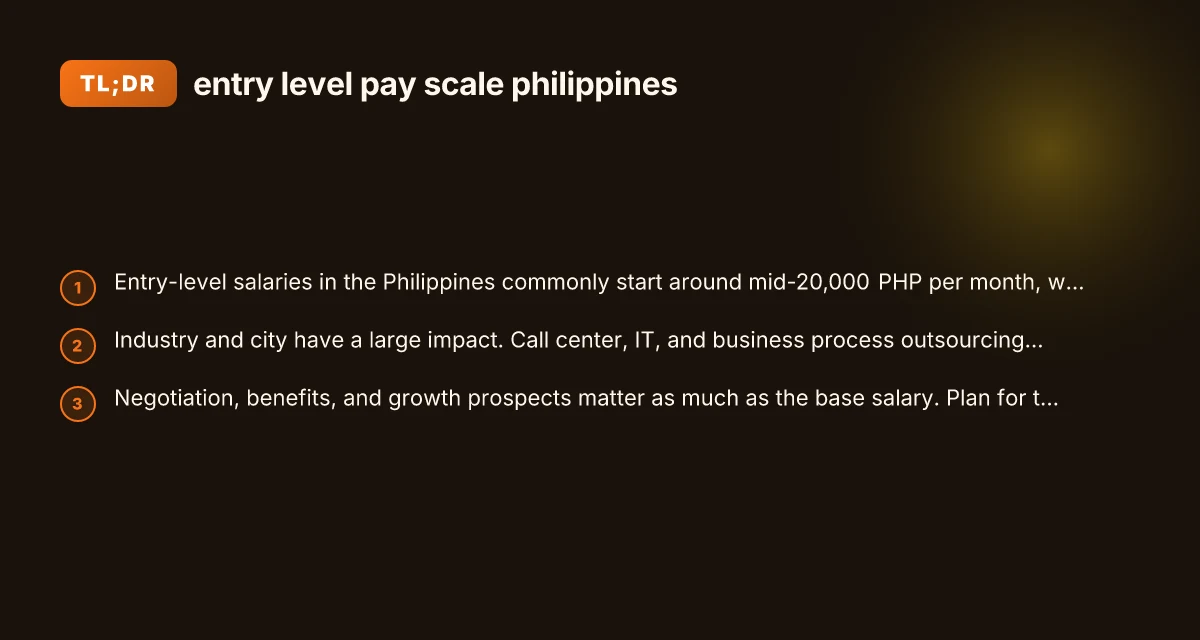
Introduction Starting pay for fresh graduates in the Philippines varies widely. Some roles offer salaries in the lower teens. Many entry-level positions cluster around the mid-20,000 PHP per month range. Location, industry, and company size matter as much as your degree, with competitive sectors like IT, BPO, and professional services often paying more at the entry level. This guide compiles typical ranges and practical considerations to help you gauge expectations and negotiate wisely.

What is considered “entry-level” in the Philippines?
- Entry-level generally means candidates with little to no professional experience beyond internships or part-time work.
- Fresh graduates entering the workforce may have their starting salaries influenced by:
- Industry norms
- Location and cost of living
- Educational background and certifications
- The role’s required skill set and complexity
- Some employers also tie starting pay to performance-based bonuses, training allowances, or signing bonuses.
Typical starting salary ranges by sector
- Business Process Outsourcing (BPO) / Call centers: commonly ₱15,000 to ₱25,000 per month, with higher ranges for technical or specialized support.
- IT and software-related roles: often ₱20,000 to ₱28,000 per month for entry-level positions, and higher for those with in-demand skills.
- Engineering and manufacturing: roughly ₱18,000 to ₱26,000 per month, depending on discipline and company.
- Finance and accounting (entry-level): about ₱18,000 to ₱25,000 per month.
- Marketing, sales, and customer service: typically ₱15,000 to ₱24,000 per month, with potential for commissions or bonuses.
- Public sector and government-related roles: often on a standardized pay scale, which can start around ₱20,000 to ₱26,000 depending on the position and region.

Regional differences
- Metro Manila and major urban centers (Cebu, Davao, etc.) often offer higher starting salaries due to higher living costs and concentrated demand for skilled labor.
- Rural or provincial areas may present lower starting pay, but some roles can offer valuable regional allowances or cost-of-living advantages.
- When weighing offers, consider commuting costs, housing, and personal financial goals.
Quick comparison table: typical entry-level monthly salaries by sector
| Sector | Typical range (PHP) | Notes |
|---|---|---|
| BPO / Call centers | 15,000 – 25,000 | Higher pay for technical or specialized support |
| IT / Software entry | 20,000 – 28,000 | Certifications and project-based skills raise value |
| Engineering | 18,000 – 26,000 | Depends on discipline and firm |
| Finance / Accounting | 18,000 – 25,000 | Often paired with training programs |
| Marketing / Sales | 15,000 – 24,000 | Potential commissions/bonuses vary |
| Public sector | 20,000 – 26,000 | Standardized scales; region matters |
What drives the starting salary
- Demand for specific skills: programming languages, data analysis, digital marketing, cybersecurity basics, or engineering know-how can push starting pay higher.
- Certifications and internships: relevant certifications (e.g., basic IT, accounting software, or industry-specific credentials) and solid internship experience can help you command a better first offer.
- Communication and soft skills: strong written and verbal communication, teamwork, and problem-solving can influence hiring decisions and initial compensation.
- Company size and prestige: multinational and large local firms commonly offer higher starting salaries, but smaller firms may provide rapid growth and learning opportunities.
How to assess an entry-level offer
- Compare base salary to market data: use salary portals, job postings, and recruiter insights for your target role and city.
- Consider total compensation: base pay, allowances (transport, meals, housing), signing bonuses, performance bonuses, and benefits (healthcare, retirement contributions, training budgets).
- Growth trajectory: ask about raises, performance reviews, promotion timelines, and the typical time-to-position for higher pay bands.
- Work-life balance and culture: overtime norms, remote work options, and career development opportunities can affect overall value.
Quick checklist when evaluating offers
- Is the base salary in the typical range for the role and city?
- Are there clear paths to salary increases within 12–24 months?
- What benefits are included (HMO, allowances, leave, training budgets)?
- Are there opportunities for certifications or training supported by the employer?
- How does the company support professional growth and promotion?
Negotiating your first salary
- Do your research: know the typical starting salary for the role and location, as well as the company’s size and industry norms.
- Articulate value: highlight relevant internships, projects, and skills that align with the job’s demands.
- Be flexible about the package: if the base salary is fixed, negotiate for a signing bonus, relocation allowance, or a structured plan for merit-based raises.
- Consider non-monetary wins: training opportunities, mentorship, remote-work options, and a longer probation period with a salary review.
- Practice your pitch: rehearse a concise case for your starting salary and be prepared to explain why you’re a solid investment for the employer.
Common questions about entry-level pay in the Philippines
- Q: How much is the entry-level salary in the Philippines? A: Common starting ranges are roughly ₱15,000 to ₱25,000 per month for many sectors, with higher starts in IT, specialized BPO, and some engineering or finance roles.
- Q: Is ₱30,000 a realistic entry-level salary? A: In some sectors and locations with high demand, ₱30,000 can be achievable, especially for roles requiring specific skills or certifications or in larger firms.
- Q: Is ₱25,000 a good entry-level salary? A: It can be respectable depending on the city and industry. Supplement with benefits, training, and growth prospects to maximize value.
- Q: How important is location for starting pay? A: Very important. Metro areas typically offer higher salaries but come with higher living costs. Balance pay with cost of living.
How to boost your entry-level earning potential
- Build in-demand skills: focus on tech basics (HTML/CSS, SQL, Python), data literacy, digital marketing analytics, or essential engineering software.
- Earn certifications: vendor-certified or university-affiliated certificates can differentiate you.
- Pursue internships strategically: projects and real-world experience often translate to higher starting offers.
- Leverage multiple offers: use competing offers to negotiate a better package or salary.
- Seek roles with clear career ladders: jobs with documented progression paths tend to offer faster raises.
Conclusion and recommendations Entry-level pay in the Philippines sits in a broad band, with many fresh graduates landing between ₱15,000 and ₱25,000 per month in common fields. However, strategic choices around industry, location, and skill-building can push this higher, particularly in IT, specialized BPO, and engineering-adjacent roles. When evaluating offers, look beyond base salary to total compensation, growth prospects, and development opportunities. If you’re early in your career, prioritize building marketable skills and seek roles with clear paths to advancement. These decisions often pay off more in the long run than a modest, immediate bump in starting pay.