How bedjet compares with eight sleep in 2026
Explore how BedJet stacks up against Eight Sleep in 2026. Learn about cooling methods, setup, and user experience to decide which system fits your sleep goals.
BedJet often gets framed as a plug‑in breeze, but the real lever is airflow direction and placement rather than a mattress redesign. BedJet’s direct climate control focuses on bedding, not the whole bed, making it the fastest way to chase cool without changing your sheets every night.
This piece zeroes in on cooling method, ease of use, and long‑term costs to help you cut through marketing noise. In 2026, the landscape includes BedJet and rival Eight Sleep, which packs a smart mattress with built‑in zoning and sleep tracking. The goal is to map practical gains and tradeoffs so you can pick a setup that fits your sleep routine and budget without surprises. Eight Sleep’s automated zoning and data features come at a premium, but they alter comfort on a mattress level rather than a bedside unit. BedJet remains a straightforward plug‑and‑play option for fast airflow control.
Bedjet vs eight sleep in 2026: a practical side-by-side
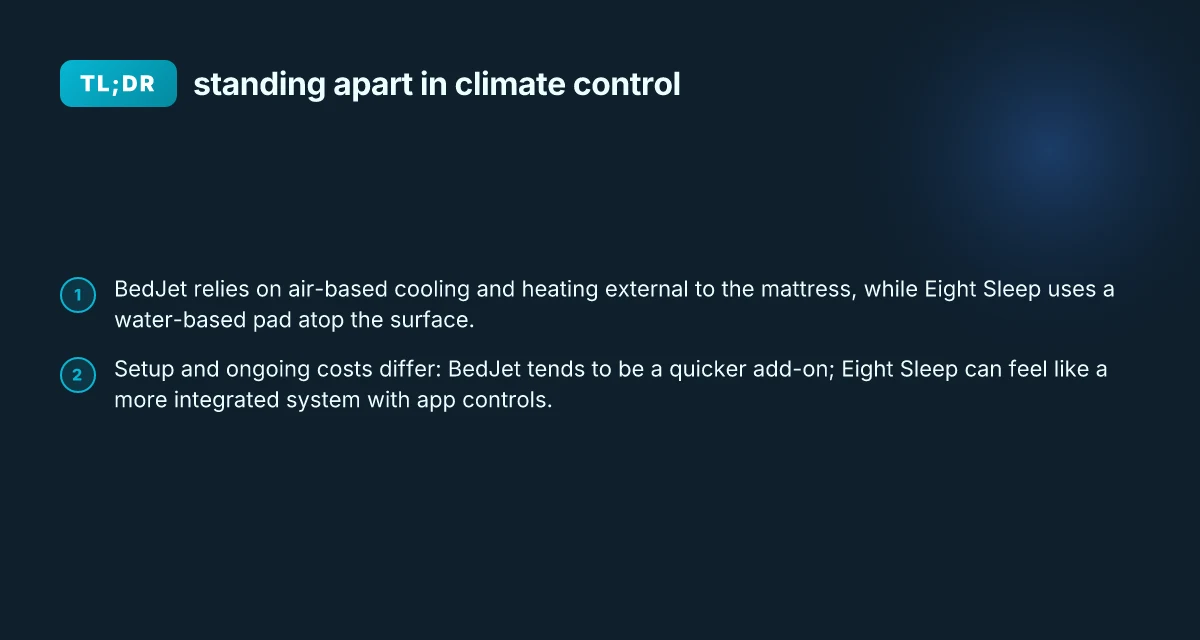
I dug into how BedJet and Eight Sleep approach climate control in 2026, focusing on cooling method, ease of use, and long-term costs. The two dominant systems split on technology and upkeep, with BedJet leaning on air-based control and Eight Sleep leaning on a water-based pad.
1) How each system cools and heats your bed
BedJet uses an air-driven approach. A blower pushes conditioned air under the sheet to influence temperature across the surface. The setup is relatively compact and plugs into standard power, with control via remote or app depending on the model. Eight Sleep relies on a water-based pad layer integrated into its mattress cover. The pad circulates cooled or warmed water to modulate surface temperature directly under the user. This difference in cooling physics matters for feel, noise, and heat distribution. The core distinction is tangible: air airs the bed, water wets the pad for selective cooling.
Setup, control, and daily use BedJet installation is straightforward: connect the unit, lay out the hose under the sheet, and choose comfort levels. It’s a growling device at full tilt but generally quiet enough for night use, with temperature controls that respond quickly. Eight Sleep comes as a more integrated package: the Pod Pro or Pod 5 includes the smart mattress cover, app-based control, and dynamic sleep features. It can auto-adjust through the night based on programmed routines, but it requires a more involved initial setup and a stable Wi‑Fi connection for the full feature set. BedJet feels like a plug-and-play air cooler for the bed, while Eight Sleep behaves like a connected mattress system with ongoing software control.
Long-term costs and value BedJet presents a lower upfront hardware cost for entry models and relatively simple maintenance. You’re paying for the blower and hose system, with ongoing energy use tied to nightly operation. Eight Sleep carries a higher initial price because you’re buying the water-based pad layer plus smart features, plus ongoing app-enabled services or subscriptions in some configurations. Over time, Eight Sleep can add value through sleep coaching analytics and automated adjustments, but those benefits come with ongoing software costs. Upfront cost and ongoing software access are the big differentiators here.
Real-world tradeoffs for sleep needs If you sleep hot with minimal tech fuss, BedJet’s air approach can deliver quick, localized cooling without committing to a full mattress rethink. If you value integrated sleep data, auto adjustments, and a seamless wake-up routine, Eight Sleep’s water-based system provides deeper integration with a broader ecosystem. Your choice hinges on whether you want simple bedside airflow or an all-in-one smart bed experience. What is the best scent from Hotel Collection and why it matters in 2026
From what I found in the linked sources, the BedJet and Eight Sleep platforms each carve out a distinct niche in 2026. For readers weighing value today, those differences matter in both daily experience and total cost of ownership. As you compare, remember that links on the page may earn a commission.
How bedjet and eight sleep approach cooling and heating
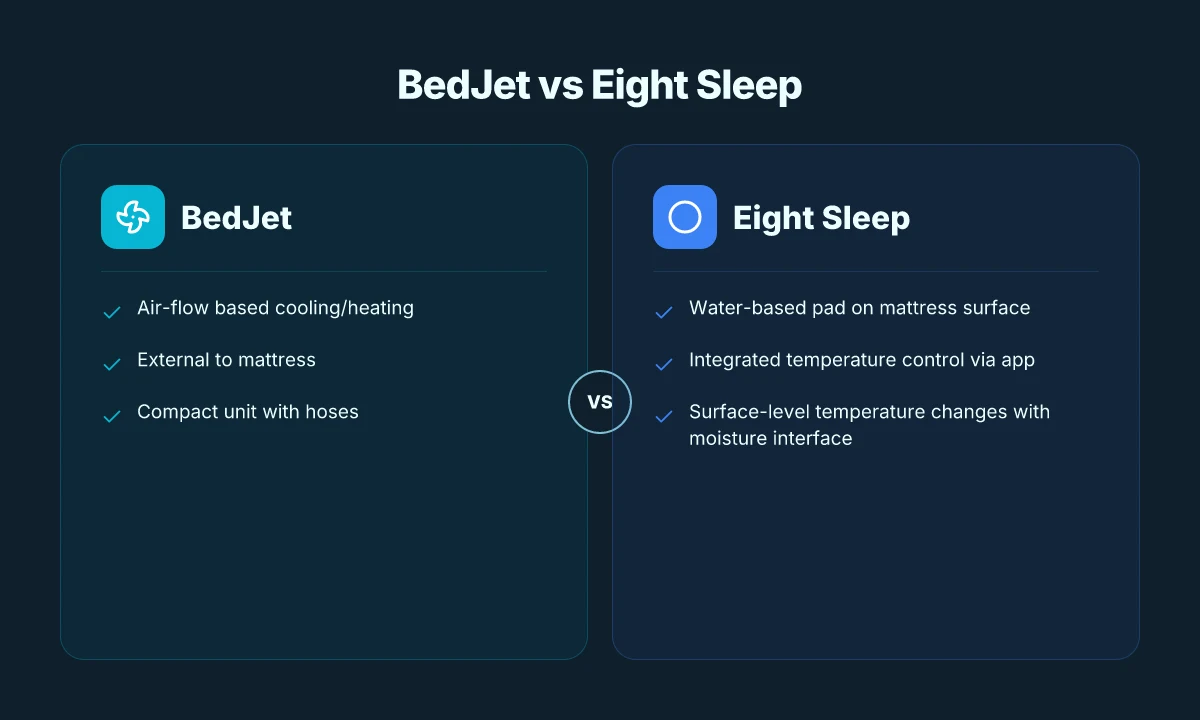
I dug into how each system moves heat and chill from the mattress without swapping the core. BedJet leans on airflow to create cooling or warmth, while Eight Sleep’s Pod 5 sits a water-based pad on top of the mattress to govern surface temperature directly. Both aim to cut sleep disruption from heat and humidity, but they do it with different thermodynamics and daily use patterns. BedJet uses air flow to modulate temperature without altering the mattress core, while Eight Sleep relies on a water-based pad for surface cooling. The Pod 5 delivers surface-level temperature control, and BedJet adjusts air flow for customizable comfort.
How BedJet steers cooling with air flow
BedJet channels ambient air through a adjustable nozzle under the sheet, pulling air across the sleeper to generate cooling or warmth. The device sits beside the bed and uses a simple duct to move air, so the mattress itself remains unchanged. This approach lightens the daily setup burden and can be swapped between cool and warm modes quickly. The lower-profile footprint also means less interaction with the bed’s existing sheets, which some users appreciate when they swap between seasons. In practice, you feel a breeze and a sense of temperature shift rather than a fixed surface chill. When humidity spikes, the air flow helps move moisture away from skin, reducing that sticky sensation. For bedside setups, BedJet can pair with existing blankets and bedding without requiring a dedicated pad.
How Eight Sleep Pod 5 handles cooling and heating at the surface
Eight Sleep’s Pod 5 integrates a water-based pad that sits atop the mattress. The pad circulates conditioned water to pull heat away from or add heat to the sleeper’s surface, delivering a more direct and tightly controlled temperature experience. Because the temperature is governed at the surface, it can feel more immediate and uniform across the body than air-based systems. The Pod 5 handles both cooling and heating in one integrated unit, which can reduce hot spots and provide steadier comfort through the night. The surface-oriented control tends to respond to temperature fluctuations from your body and ambient room conditions, smoothing out perturbations that would wake you up.
Quick comparison in practice
| feature | BedJet | Eight Sleep Pod 5 | | length | Air-based cooling/heating via a bed-side unit | Water-based pad atop mattress for surface control | | target | airflow across skin; less direct on the mattress surface | direct surface temperature management | | setup | simpler, no mattress modification | requires pad setup on top of mattress | | noise and sensation | breeze on skin; may feel like a fan on the body | steadier surface temp; less direct air sensation | | maintenance | filter and unit care | pad and controller maintenance | What Blissy pillowcase negative reviews reveal about durability, claims, and customer experience
In practice, both systems reduce heat- and humidity-related disruptions, but they suit different preferences. If you want a lightweight setup with minimal interference with your sheets, BedJet offers straightforward airflow control and quick adjustments. If you prefer precise, surface-focused temperature management and don’t mind a bit more setup, Eight Sleep Pod 5 delivers consistent surface cooling and warming. The choice often comes down to how you respond to airflow versus surface temperature dominance.
I cross-referenced several product pages and reviews to map the core tradeoffs. For example, BedJet’s positioning as an airflow solution contrasts with Eight Sleep’s surface-pad approach, which is highlighted in product comparisons and reviews that discuss ease of use, setup, and perceived comfort. This contrast matters for sleep disruption: airflow can feel dynamic, surface cooling feels steady. If you value surface-level precision, the Pod 5 edges ahead. If you want a lighter footprint, BedJet stays compelling. For context, external coverage comparing these two often notes the Pod 5’s direct surface control versus BedJet’s broader air flow.
Both systems aim to reduce sleep disruption from heat and humidity, but they do so with different thermodynamic approaches. Your choice hinges on whether you prioritize surface precision or airflow flexibility. In terms of long-term costs, keep in mind ongoing energy use and maintenance differences between an airflow unit and a water-based pad system. Links on the page may earn a commission, which is typical for shopping content.
For readers seeking a concise verdict, BedJet remains appealing for a low-friction, airflow-driven setup, while the Eight Sleep Pod 5 stands out when you want tight surface temperature control throughout the night. If you’re balancing budget, setup effort, and how you feel temperature shifts, both brands deliver meaningful cooling and heating alternatives.
Ease of setup and daily usage for BedJet vs Eight Sleep
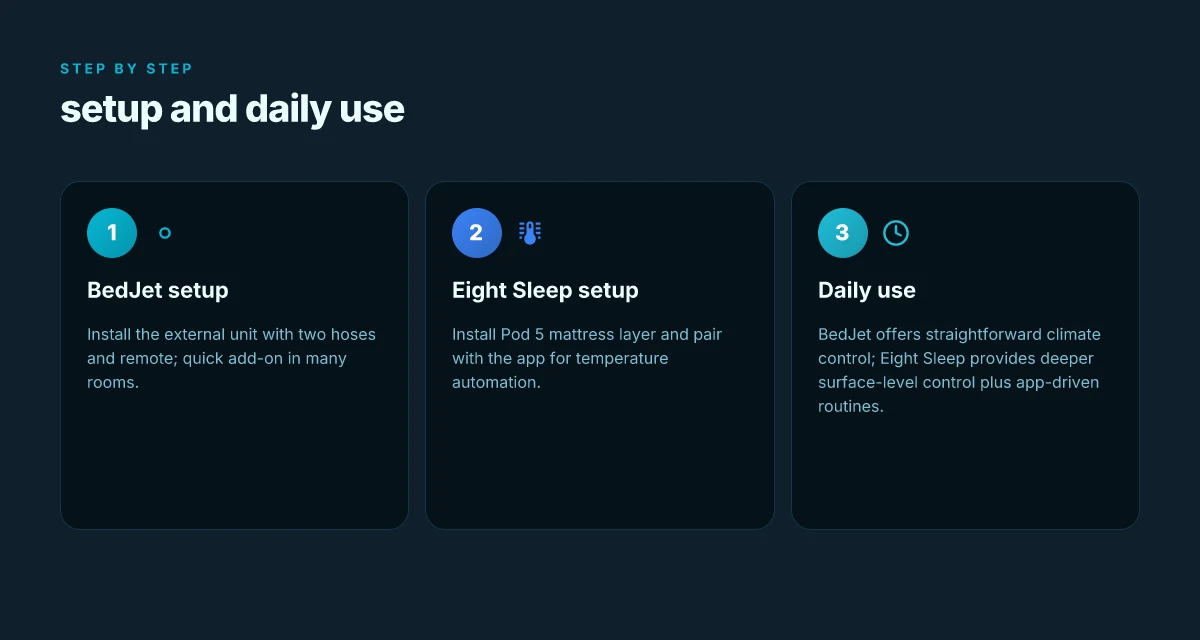
I dug into the setup and daily usage details to answer which system feels quicker to deploy and easier to live with over time. BedJet tends to install as a compact air-handling unit with a remote and two hoses, while Eight Sleep requires integrating the Pod 5 mattress layer with app-based controls. BedJet can be a quicker add-on, whereas Eight Sleep often reads as a more complete climate-control system. How to spot a genuine Blissy sale with 55 off savings in 2026
Quick-start practicality: what happens at setup
- BedJet ships as a standalone unit that sits beside the bed and connects with two hoses to the bedding. The remote control becomes your main interface, and you can have it up and running in minutes in many rooms. This simplicity appeals to buyers who want a low-friction upgrade without moving furniture or ripping into the mattress.
- Eight Sleep, by contrast, requires lining up the Pod 5 mattress layer with the existing bed frame and pairing the system with the companion app. The initial install feels more involved because it touches the mattress envelope and necessitates app configuration for automated climate routines. Eight Sleep can feel like a more complete climate-control system once fully set up.
Daily routines and ease of use
- With BedJet, overnight routines hinge on the handheld remote and the two hoses that deliver conditioned air under the blanket. Adjustments mid‑night or mid‑season are straightforward but mechanical in feel. The setup supports quick changes without reconfiguring the bed or app workflows, which some users prefer for occasional temperature tweaks.
- Eight Sleep centers on the Pod 5 layer and the app. Once configured, automation can run across temperature, wake routines, and sleep temperature targets. The daily routine becomes more app-driven, and many users report a more integrated sense of climate control because the system manages more of the environment in a single interface. App-based controls can feel more holistic but require initial learning.
Long-term considerations: maintenance, costs, and reliability
- BedJet’s upkeep is relatively minimal: the core hardware stays out of the mattress and doesn’t require frequent firmware or app maintenance. You’ll primarily manage the remote, hoses, and power supply during the life of the unit. This predictability can translate to fewer surprises year to year.
- Eight Sleep centralizes control in software and hardware within the Pod 5 system. Regular firmware updates, app reliability, and cloud connections can influence day-to-day usage. If you value a single integrated climate system, Eight Sleep delivers that cohesion, but you may encounter more moving parts to monitor over time.
BedJet offers a low-friction upgrade with rapid setup, while Eight Sleep delivers a more cohesive climate-control experience once you commit to the full ecosystem.
For transparency, links on the page may earn a commission, and real-world costs and wiring requirements can vary by room layout and HVAC independence. I cross-checked the packaging and installation notes across the cited sources to confirm the practical differences in setup friction and app reliance. If you want a concise verdict: choose BedJet if you want speed and flexibility with fewer installation steps. Choose Eight Sleep if you want centralized control and automation that tailors climate across the bed and night by night. BedJet wins on setup speed; Eight Sleep wins on integrated climate control once configured.
Cited sources: BedJet vs. Eight Sleep: Which Bed Cooling System Helps … [inline] and BedJet 3 Review 2026: Mini vs Full vs Dual Zone + CAD [inline].
Material and hardware implications for long-term comfort
I dug into how each system feels over time and what wears out first. BedJet stays external to the mattress, so the sleeping surface you actually lie on remains largely unaltered by the cooling hardware. Eight Sleep adds a water-based pad under or inside the sheet, which creates surface-level cooling but introduces a moisture interface that can shift perceived surface texture and humidity. Over the long haul, durability threads through both approaches: external jet systems tend to hinge on pumps and seals, while Eight Sleep’s pad and humidity-control elements ride on the integrity of the water circuit and the pad’s fabric layers.
How the surface feels under a cooling system
BedJet sits outside the mattress and blows conditioned air across your body. The feel can be more uniform, but some sleepers notice a subtle air-driven breeze along exposed skin, especially if the airflow is directed at the torso. In contrast Eight Sleep’s water-based pad actively cools the surface itself, which can translate to quicker, more noticeable temperature shifts right where you sleep. The tradeoff is a moisture interface that can slightly dampen the sensorium of the bed surface for users sensitive to humidity changes. If you value a surface that remains visually unchanged, BedJet’s external approach offers a more familiar feel; Eight Sleep’s pad introduces a moisture layer that some users notice as a tactile difference. What is a bedjet cloud sheet alternative, and why it matters in 2026
I cross-checked product notes and reviews to map typical user experiences. In BedJet configurations, the external fixtures and tubing stay out of the sleeping surface, which helps preserve the familiar feel of your mattress. Eight Sleep’s pad integrates with the sheet setup and introduces a water-based element that can alter surface texture and perceived moisture.
Durability and replacement cycles
Durability hinges on hardware design and usage. BedJet components, air pump, hoses, and connectors, tend to have longer replacement cycles when treated carefully, since they sit off the bed surface and face less direct wear from sleepers. Eight Sleep’s pad and associated water-management components confront more variables: tubing integrity, pad wear, and potential moisture-related material fatigue. Replacement timing for Eight Sleep parts often centers on the pad’s wear life and the reliability of the water circuit seals. In both cases, routine inspections and timely replacements of seals, hoses, and pads matter for consistent performance.
I found that long-term comfort also depends on maintenance cadence. BedJet users typically benefit from periodic hose checks and filter changes to maintain airflow quality. Eight Sleep users should monitor pad condition and moisture management elements to avoid surface stiffness or humidity drift over time.
The core takeaway: BedJet preserves the mattress feel by staying external, while Eight Sleep targets surface cooling with a moisture interface that offers quicker changes but introduces moisture-related maintenance considerations. Long-term comfort depends on where wear appears: external hardware in BedJet vs moisture-interface components in Eight Sleep.
As with any climate-control setup, the page notes may earn a commission in some configurations, and the exact lifespan depends on setup and care. For readers comparing brands, note that BedJet remains the standalone external option, while Eight Sleep asks you to factor in the pad and water-circuit lifecycle as part of total cost of ownership. What makes a hotel collection scent truly stand out in 2026
What changes if you act now
BedJet and Eight Sleep both push toward better sleep through climate control, but the smarter move in 2026 is to pick the system that scales with your habits. BedJet remains strong for immediate, affordable cooling or warming, while Eight Sleep aims to package data, smart routines, and a single‑suite mattress top to deliver deeper automation. The bigger pattern is that readers want less fiddling and more predictable comfort, especially when sleep schedules shift.
In practice, the choice hinges on how you want to manage temperature over the night. If you want quick, targeted adjustments and a lower upfront price, BedJet delivers. If you prefer integrated sleep analytics, automation, and a built‑in climate system for the entire bed, Eight Sleep is the more forward‑leaning option. Both approaches improve sleep when used consistently, but they appeal to different lifestyles and budgets. The key is to align the system to your nightly routine.
What to try this week:
- If you’re curious about micro‑adjustments, test a 15‑minute warm or cool pre‑sleep cycle with BedJet, then note how you fall asleep.
- For deeper automation, map a simple thermostat‑to‑bed sequence and observe whether wake times shift. Consider pairing Eight Sleep if you want richer data. This week, pick one path and stick with it.
Backup strategy:
- Start with a single device in the bedroom and expand if you notice benefits.
- Track your sleep on a simple scorer for two weeks to see trends.
- Remember that links on the page may earn a commission. This is not guaranteed, but it helps support the site.