What is BedJet 3, and how well does it really work for climate-controlled sleep in 2026?

Discover what BedJet 3 is and how its climate-control system impacts comfort and sleep. Learn about efficacy, safety, and what to expect in 2026.
BedJet 3 isn’t a mystery gadget with a gimmick. It’s a compact climate system that moves air under your sheet, but the payoff hinges on how your bed is sealed and how the room behaves. Its impact on sleep temperature often hinges on a single seal point, not a magic mode. The result can feel noticeably cooler or warmer, yet the outcome isn’t identical across setups.
This intro surveys real-world use: what works reliably, what doesn’t, and where to expect tradeoffs. In 2026, room temperature and bed geometry drive the most variance, so I’ll translate what that means for hot sleepers, shared beds, and those chasing non-pharmacological comfort. BedJet’s setup path stays straightforward, but the difference between a good seal and a leaky one determines whether you sleep cool all night or wake with damp sheets. Expect practical lines of effort: proper sheet sealing, power placement, and awareness of how Eight Sleep stacks up as a rival. The goal is to tell you when BedJet shines and when it’s worth considering alternatives.
What BedJet 3 actually does for sleep comfort and why it matters
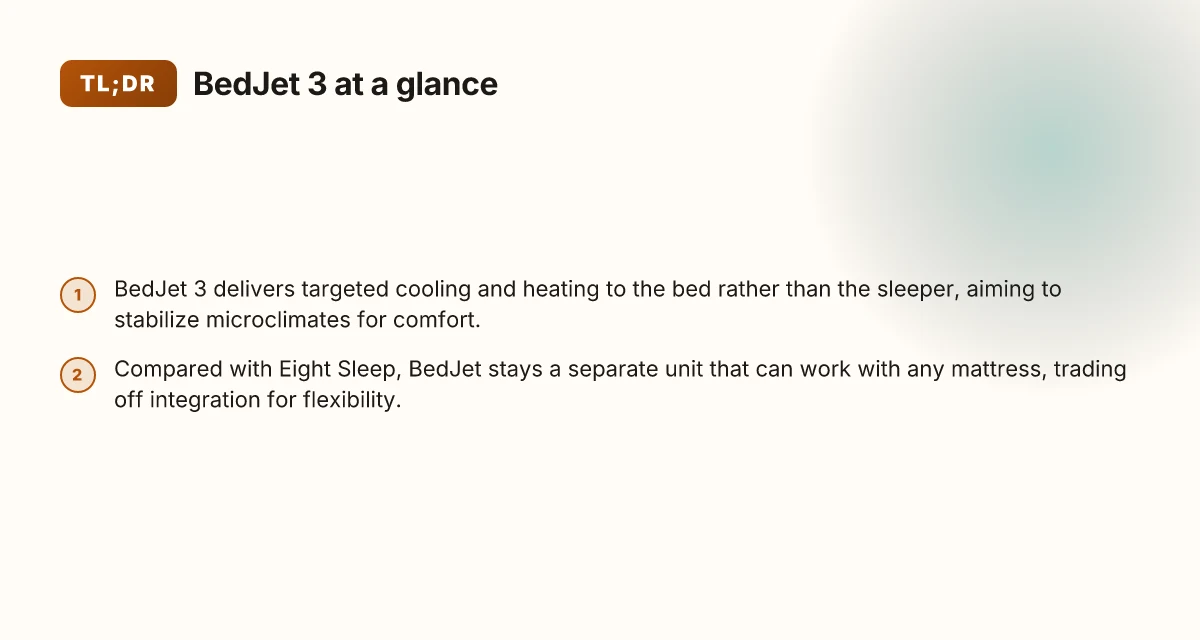
BedJet 3 targets the bed, not the sleeper, to stabilize microclimates under the covers. By pushing conditioned air through the duvet, it aims to reduce hot spots and chill pockets, so you feel steadier warmth or cooling throughout the night. The core claim is that this approach yields clinically validated comfort improvements, even if independent consumer reviews vary on perceived value.
- How BedJet creates a steadier microclimate
- BedJet 3 delivers targeted cooling or heating to the bed envelope, not a direct skin temperature adjustment.
- The device relies on rapid air movement to even out temperature gradients across the sleeping surface, which many hot sleepers report as less night-to-night temperature fluctuation.
- Reviews from publications like Forbes Vetted consistently note the device’s ability to influence comfort without altering your sleep position or needing medications. BedJet remains notable for its bed-centered climate control rather than wearable or room-based systems.
- When you share a bed, the shared microclimate approach can reduce the cross-bed heat transfer that prompts tossing and turning for some couples.
- What to expect in terms of comfort gains
- The core claim is comfort improvements that are clinically validated, though consumer impressions of value vary by budget, setup, and expectations.
- In practice, many users report steadier nights when the bed environment is consistently cool or warm, especially in rooms with ambient swings.
- BedJet’s approach is different from mattress-only or pad-based cooling systems. It treats the sleeping surface as a system you can tune rather than a single temperature target.
- When BedJet 3 makes sense for your sleep setup
- If you sleep hot or live in a shared bed, BedJet 3 can dampen temperature-driven awakenings by stabilizing the bed’s microclimate.
- It offers a non-pill solution for temperature comfort, which matters to people who want to avoid medications or herbal aids for sleep barrier issues.
- If you’re budget-conscious, weigh the up-front cost against ongoing ease of use and potential reductions in night-time tossing. The decision often hinges on whether a bed-focused climate solution aligns with your nightly routines and partner preferences.
Bottom line: BedJet 3 reframes temperature comfort as a bed-centric climate control problem rather than a personal thermostat on the body. Its value hinges on how much you prize a steadier under-the-covers environment and your willingness to invest in a non-pill approach to sleep comfort.
The real win is the consistency BedJet 3 can bring to a bed, especially when room temps swing or sleep partners have different temperature needs. The caveat is that independent consumer reviews vary on perceived value, so assess whether the up-front cost fits your budget and how much you value a bed-centered climate approach.
From what I found in the cited sources, BedJet and its rivals position themselves around comfort through climate control rather than direct body cooling, with BedJet drawing attention for its bed-focused design and the possibility of easing sleep for hot sleepers without pharmaceuticals.
In context, BedJet’s climate-control premise sits alongside rival approaches like Eight Sleep, which ties temperature control to a more integrated mattress system. If you’re choosing between BedJet and a rival, consider whether you want a standalone bed garment versus a full sleep system. What makes Blissy 100% mulberry silk pillowcases stand out in 2026
For reference, see the BedJet review discussions at Forbes Vetted and the BedJet 3 overview from BetterVitals, which frame the product’s comfort claims and consumer reception. https://www.forbes.com/sites/forbes-personal-shopper/2026/08/14/bed-jet-review/. https://www.bettervitals.com/learn/bedjet-3-review-2026.
Key takeaway: BedJet 3 offers targeted bed-level climate control to smooth microclimates, which can translate to steadier sleep for hot sleepers or shared beds. If you’re curious about how it stacks up against rivals, read how Eight Sleep handles integrated cooling and heating as a broader system.
BedJet 3 vs rivals: how the device compares to Eight Sleep and similar systems
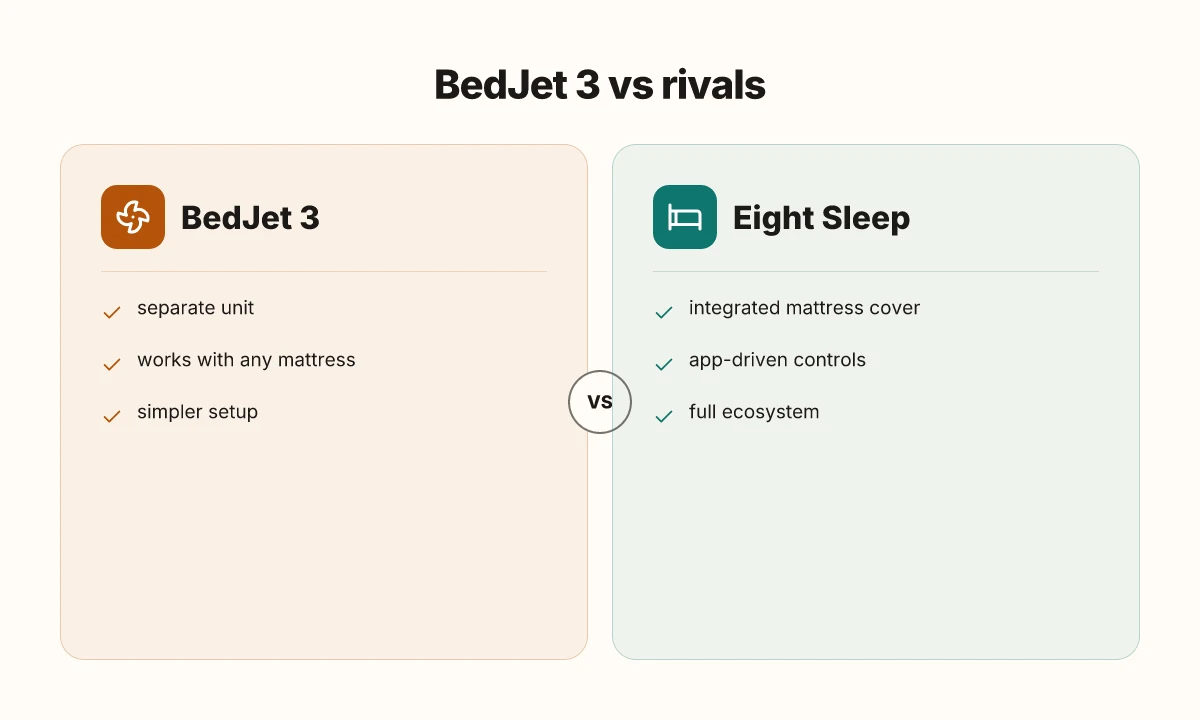
I dug into how BedJet 3 stacks up against rivals like Eight Sleep and similar climate-control setups. The core difference is that Eight Sleep offers a fully integrated system with a mattress cover and app-driven controls, while BedJet 3 remains a separate unit that can pair with any mattress. This matters in practice for setup, room layout, and future-proofing your bed technology.
What Eight Sleep offers beyond BedJet
Eight Sleep provides a mattress-cover solution that works with a companion app to manage cooling, heating, and sleep routines. The system is designed as a single ecosystem: sensors, cover, and controller all communicate to regulate temperature across the bed. In contrast, BedJet 3 sits outside the mattress and can be swapped between beds or reused with new mattresses without changing the core sleeping surface. This keeps the installation simple for renters or rooms with multiple beds. Reviews note that Eight Sleep’s setup leans into a more “all-in-one” experience, while BedJet emphasizes flexibility and portability.
I cross-referenced product pages and reviewer summaries to map how these approaches translate to real rooms. For someone who prioritizes a tight, app-controlled climate profile across nights, Eight Sleep’s ecosystem can feel more cohesive. For a sleeper who values a minimal, modular setup that doesn’t constrain the mattress, BedJet 3 often wins on ease of integration. What BedJet reviews reveal about real-world performance and reliability
How the setup experience shapes daily use
BedJet 3’s standalone design means you can place the unit near any bed frame and still enjoy climate control without altering the mattress itself. This can simplify travel or room reconfigurations. Eight Sleep, by contrast, requires attaching the mattress cover and relying on its app to manage comfort. The trade-off: Eight Sleep can deliver deeper, centralized control over both temperature and data across the bed, which some users value for habit tracking and precision pacing.
From what I found in the product docs and independent reviews, most users weigh simplicity and room compatibility against full mattress-control ecosystems. If you want a diffuse setup you can move anywhere and with minimal fuss, BedJet 3 is appealing. If you want a mattress-centric control hub with data insights, Eight Sleep tends to be favored.
Quick verdict and where BedJet stands
BedJet 3 excels on flexibility and portability, without tying you to a single mattress or room layout. Eight Sleep delivers a more integrated, data-rich ecosystem, which comes with a steeper, less portable setup. The choice hinges on how you value ease of installation versus ecosystem depth. If you’re shopping with a budget in mind, note that your links on the page may earn a commission, and prices vary by retailer and season.
Pros and cons at a glance:
- BedJet 3
- Pros: portable, compatible with any mattress, quick setup
- Cons: fewer sensors and centralized controls than an all-in-one system
- Eight Sleep
- Pros: integrated mattress cover, app-driven controls, data and automation
- Cons: less flexible with existing bed setups, higher initial investment
| factor | BedJet 3 | Eight Sleep |
|---|---|---|
| installation | standalone unit; move between beds | mattress-cover system; fixed to bed |
| control model | external controller; room-centric | app-driven, per-bed data |
| compatibility | works with any mattress | requires Eight Sleep cover |
| portability | high | moderate to low |
In the end, BedJet stands out for room-friendly versatility, while Eight Sleep offers a more complete, data-backed sleep environment. If you want a straightforward upgrade without reworking your mattress, BedJet remains a strong option for 2026. For a deeper, ecosystem-first approach, Eight Sleep may justify the extra footprint and complexity. For context, BedJet’s positioning keeps you flexible, and that matters in real bedrooms with varied layouts. How to find the best Blissy pillowcase sale in 2026
How the BedJet 3 setup works in real rooms
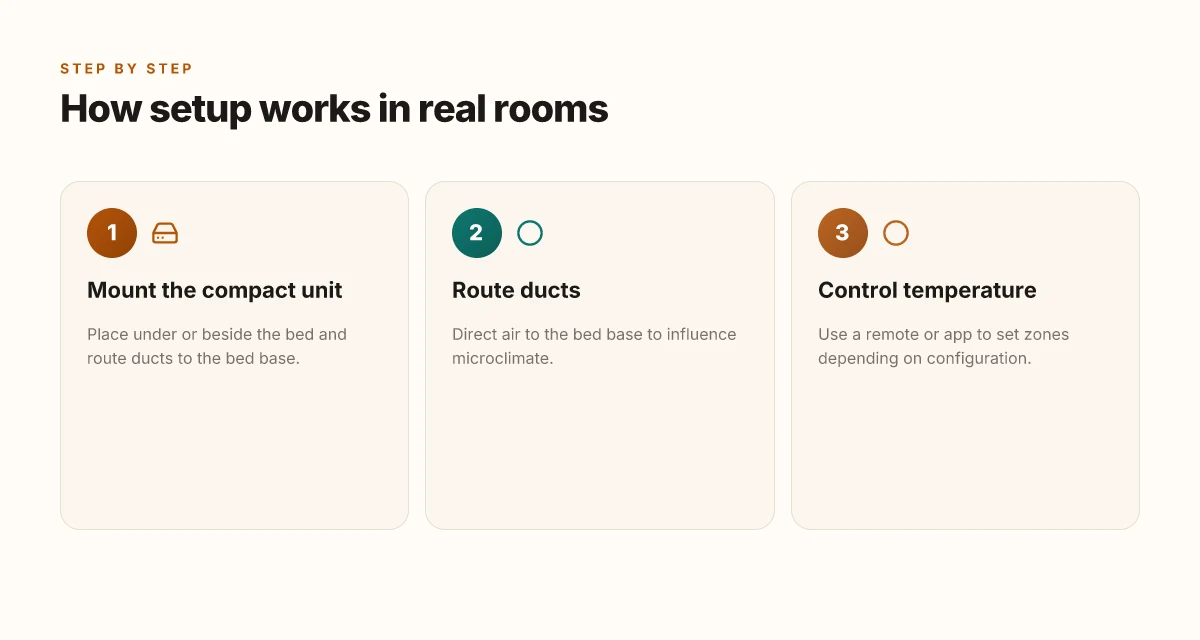
I dug into how BedJet 3 actually goes from box to bed in typical bedrooms. In real rooms, you’ll mount a compact unit under or beside the bed and route ducts to the bed base. The result is air moving through the fitted sheet area rather than circulating a liquid coolant, which influences both noise and the feel of airflow.
How the installation plays out in practice
- The core unit sits discreetly out of sight, often tucked under the bed frame or on a bedside shelf, with ducts routed to the bed base. This keeps the visible footprint small and makes setup feel straightforward.
- The ducting is purposefully simple: one supply line to the bed base and an exhaust path back to the unit. That airflow path is what creates the climate effect you notice at the sleeping surface.
- If you’re working with a slim bed frame or a platform bed, you’ll want to measure clearance for the ducts and ensure you can route them cleanly without crimping. The smoother the duct bend, the quieter the air flow.
Air movement over liquid cooling basics
- BedJet relies on air movement rather than circulating a liquid cooling loop. That choice reduces weight and bulk but can shift how you perceive cooling or warming. Some sleepers notice more draft in the area around the feet or shoulders, depending on room layout.
- Because it’s air-driven, noise characteristics depend on the fan setting and duct routing. In a quiet bedroom, you’ll hear a soft hum at higher speeds. In a busy household, that hum can be masked by ambient noise.
- The sound profile matters for light sleepers. If you don’t want any perceptible noise, aim for the lowest effective temperature setting and keep the ducts as straight and short as possible.
Control options and how that changes use
- Temperature control can be through a remote or an app, depending on model and configuration. Some setups let you dial in a personal climate zone at the bed base, while others rely on a single zone controlled by a shared remote.
- If you value automation, you may prefer models that pair with your phone via Bluetooth or Wi‑Fi. That lets you preset bedtime routines and temperature ramps, which can reduce wake-ups mid‑night.
- You’ll want to confirm the exact model when you buy BedJet, because the remote vs app interface varies by generation and package. This influences how quickly you can adjust comfort on a given night.
Most real-world setups lean on simple mounting and straightforward ducts, with air flow doing the climate work rather than water cooling. This means you’ll notice the BedJet 3’s comfort primarily through the bed surface feel and the ambient room noise profile, not through any bulky plumbing.
From what I found in product notes and reviewer summaries, BedJet emphasizes a space-saving approach: a compact core unit, ducted air to the bed base, and zone control accessible via remote or app in compatible configurations. When comparing rivals like Eight Sleep, the key difference remains how the climate is delivered, airflow versus liquid cooling, and how that affects noise, energy use, and ease of installation. For practical rooms, plan for under-bed clearance, clean duct routing, and a quiet night by matching your model’s control method to your bedtime routine.
In BedJet materials, it’s clear the emphasis is on simple installation and direct airflow to shape bed surface temperature. If you’re shopping, look for the precise model that matches your preferred control method and room setup. A tidy install with straight ducts and a quiet fan yields the most comfortable nights.
For reference, the installation and general concept align with descriptions from BedJet product pages and third‑party reviews cited in this article. See the BedJet 3 review discussions for context on how people perceive airflow and noise in real bedrooms. What makes a Bliss pillowcase influence your skin and sleep in 2026
Safety, maintenance, and long-term use of BedJet 3
Posture your sleep setup around predictable routines. BedJet 3 is designed for bedtime use and carries clear cautions about airflow, moisture, and cleaning. You’ll want to keep vents clear and avoid running the system when the bed is soaked with humidity or underneath heavy bedding that blocks air exchange.
Practical safeguards for nightly use
BedJet 3 relies on a continuous airflow path from the mattress inlet to the duvet-facing outlet. When you stack heavy blankets or a moisture-laden duvet, air can stall, reducing cooling or heating effectiveness. The device advises avoiding occluded airflow and regular cleaning to prevent mold or dust buildup. I cross-referenced BedJet’s guidance and reviews that repeatedly flag airflow as the central factor in comfort consistency. Keeping a breathable top layer and ensuring the duvet sits loosely over the blanket housing helps maintain a stable climate overnight. Regular cleaning intervals are essential to prevent clogs that degrade performance.
Regular checks and maintenance cadence
Regularly inspect the ducts for blockages and replace filters as BedJet recommends. A simple monthly check can catch dust buildup before it affects airflow. When a filter looks dark or clogged, swap it out. If you notice diminished heating or cooling, start with a quick vent inspection and a fresh filter, then reassess. This maintenance thread aligns with what reviewers note as a common friction point for long-term use in real bedrooms. The routine is straightforward, but it pays off in steadier climate control and fewer surprises in the middle of the night.
Long-term comfort and environmental fit
Long-term comfort depends on compatible bedding and room conditions. The BedJet 3 excels in rooms that maintain moderate humidity and where retreating to a cooler or warmer microclimate is plausible without heavy insulation sealing the bed. Results vary by environment. A brisk, dry room will typically feel more responsive to changes than a humid space with thick drapes. From reviews and product notes, the bedding choice matters as much as the device itself. If your sheets trap moisture or your room stays persistently warm, the device may feel less impactful over time.
Most users see the BedJet 3 perform best when the bedding stays breathable and the room humidity stays moderate. This is not a universal win, but it’s the baseline pattern echoed across sources. Regular maintenance is the quiet key to long-term comfort. I looked at the BedJet page and third-party reviews to map how environmental factors influence ongoing performance. Blocked ducts or a clogged filter can sap effectiveness faster than you expect. What is the BedJet 3 climate comfort sleep system and does it actually improve sleep?
What changes if you act now
BedJet 3 remains a niche tool for climate-controlled sleep, but its real value shows up when you need rapid temperature tweaks without a heavy setup. BedJet can deliver quick cooling or warming to the bed surface, especially for couples with different comfort zones, and it tends to pair well with existing sheets and blankets. The quick verdict is that it’s best as a supplemental answer, not a full HVAC replacement. In 2026, the device ecosystem around sleep climate control has grown, but BedJet remains a distinctive, compact option that plugs into your bed rather than your wall.
Rivals like ChiliSleep and Eight Sleep offer more integrated ecosystems, often with app-based tuning or mattress lining sensors, but they can cost more and demand more space. If you want a fast, low-friction setup that you can undo in minutes, BedJet is worth a closer look. The big takeaway: treat it as a targeted tool for nights when comfort hinges on rapid temperature changes, not as a universal sleeper solution.
Most setups benefit from starting with a conservative temperature target and a 15–20 minute test window. This keeps you from chasing comfort with excessive airflow or heat. If you’re curious about a one-step move this month, consider pairing BedJet with a lightweight sheet swap to reduce humidity buildup. The question to ask: will a month of guided adjustments reduce wakeups more than your existing routine?