Aovpn download: what it is, how it works, and the best option for you

A practical guide to downloading and using Always On VPN (AOVPN) on Windows, with a clear recommendation for ZoogVPN.
AOVPN, short for Always On VPN, is a Windows feature that provides a persistent, secure tunnel for remote connectivity. It’s designed to integrate tightly with the Windows operating system so that when you sign in or boot up, your device automatically connects to a VPN network without manual steps. There isn’t a single “aovpn download” file you install like a typical app. Instead, you configure the Windows networking stack to connect to your VPN server using the AOVPN protocol stack, often leveraging IKEv2 or SSTP under the hood. This guide will walk you through what to download (and what not to), how the configuration works, and which VPN provider best supports AOVPN workflows today.

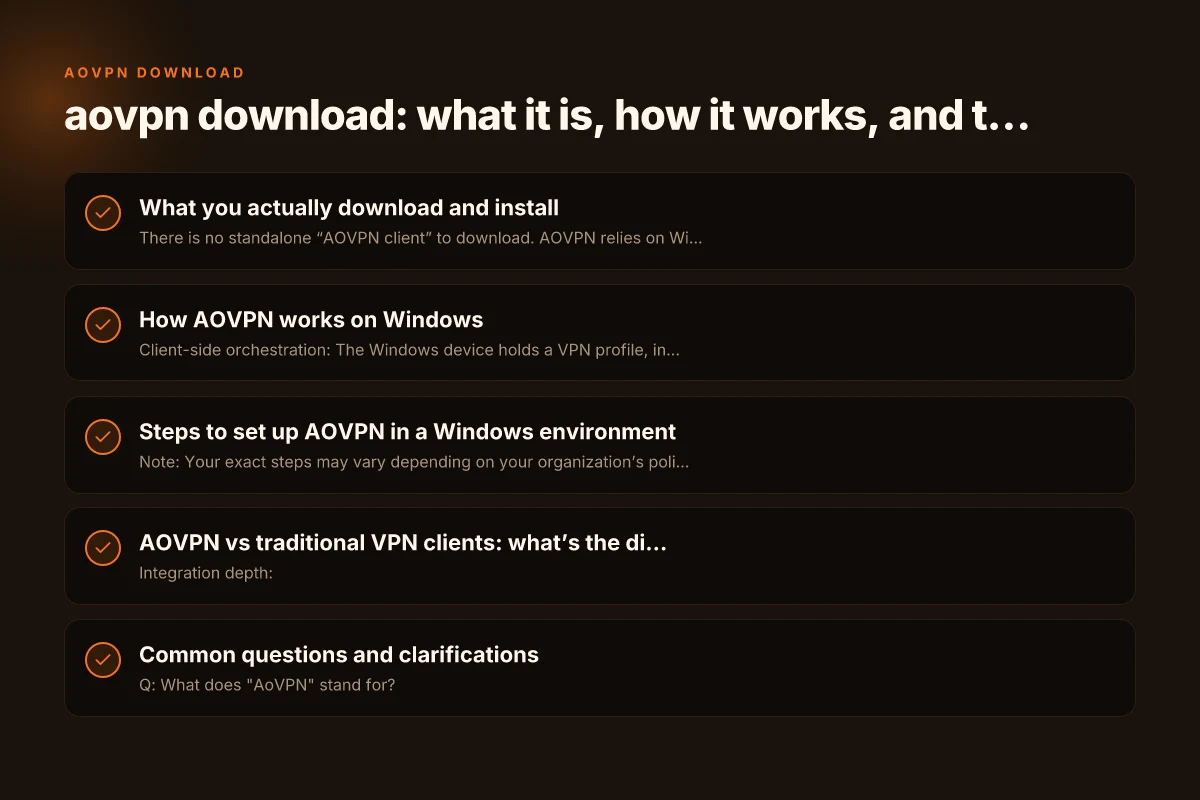
What you actually download and install
- There is no standalone “AOVPN client” to download. AOVPN relies on Windows Network Policy and Access Services (for on-premises deployments) or a VPN provider that supports Windows integration.
- To use AOVPN with a consumer or business-grade VPN service, you typically:
- Install the standard VPN client provided by the vendor (if required for initial certificate enrollment or server access).
- Import or configure a VPN profile into Windows, which contains the server address, authentication method, and certificates.
- Enable Always On or automatic reconnect settings in the Windows VPN profile, so the connection establishes on login or network changes.
- Common origins of AOVPN deployment:
- Microsoft’s own Always On VPN deployment for enterprises, which you configure with Windows Server components and client settings.
- Third-party VPN providers that expose compatible profiles or certificate-based enrollment for enterprise-style devices.
- In practical terms, you’ll be downloading:
- Windows updates and policy profiles to support Always On VPN behavior (not a separate AOVPN package).
- Optional VPN client software from your provider if your setup requires it, plus certificate or configuration files.
How AOVPN works on Windows
- Client-side orchestration: The Windows device holds a VPN profile, including the gateway, authentication, and certificates. When the user signs in, the VPN client automatically starts the tunnel.
- Tunneling protocol: Most AOVPN configurations leverage robust protocols like IKEv2, with EAP-based authentication or certificate-based methods. Some setups can use SSTP for environments with constrained network access.
- Auto-reconnect and conditions: AOVPN is designed to stay connected through usage changes, roaming between networks, and device sleep/wake cycles. If the connection drops, Windows attempts to reconnect automatically.
- Security posture: Because AOVPN emphasizes persistent policy-driven connectivity, it’s common to pair it with strong identity (certificate-based or multi-factor) and strict access controls at the VPN gateway.
A quick glance at the typical components involved
- VPN server/gateway: The endpoint your device connects to.
- Authentication method: Certificates, smart cards, or username/password with MFA.
- Profile data: Server address, tunnel type, DNS settings, split-tunneling rules.
- Certificates: Often required for enterprise deployments to ensure device trust and user identity.
Steps to set up AOVPN in a Windows environment
Note: Your exact steps may vary depending on your organization’s policy and the VPN provider.
- Prepare the prerequisites
- Ensure your Windows version supports AOVPN (Windows 10 Pro/Enterprise and Windows 11 Pro/Enterprise are common baselines).
- Obtain the VPN profile or configuration package from your IT administrator or VPN provider.
- Have required certificates or enrollment credentials available.
- Install any required client software
- Some providers supply a lightweight VPN client. Others rely solely on Windows built-in VPN features.
- Install the client if your organization specifies it, but for many AOVPN setups, Windows built-in VPN suffices.
- Import and configure the VPN profile
- Open Settings > Network & Internet > VPN > Add a VPN connection.
- Choose Windows (built-in) as the VPN provider.
- Enter the connection name, server address, VPN type (IKEv2 or other), and sign-in info (certificate-based or username/MFA as applicable).
- Import certificates if your enterprise uses them for authentication, and configure DNS and split-tunneling as directed.
- Enable Always On behavior
- In the VPN connection’s properties, enable “Always On” or “Connect automatically.”
- Take note of any policy constraints from your IT department, as some settings may be pushed from mobile device management (MDM) systems.
- Validate the connection
- Sign out and back in or restart the device to confirm the VPN boots up automatically.
- Check the VPN status indicator in the taskbar and verify traffic routing (all or selective traffic) aligns with policy.
- Test access to internal resources to confirm the tunnel is functional.
AOVPN vs traditional VPN clients: what’s the difference?
- Integration depth:
- AOVPN: Deep Windows integration, designed for seamless user experience and persistent connectivity.
- Traditional VPN clients: Standalone apps with their own UI. May require manual activation.
- Management and policy:
- AOVPN: Often managed via enterprise policies, certificates, and network access controls.
- Traditional clients: Configured per-device or per-user, sometimes with less centralized control.
- Reliability and experience:
- AOVPN tends to offer smoother roaming, automatic reconnect, and a more uniform user experience across Windows devices.
- Independent VPN apps can vary in reliability and require user action to connect.
Table: AOVPN vs traditional VPN client characteristics
| Characteristic | AOVPN (Always On VPN) | Traditional VPN Client |
|---|---|---|
| Integration with OS | Deep, starts at login, auto-connect | Separate app, manual connect |
| Auto-reconnect | Built-in, policy-driven | App-dependent, may require manual retries |
| Management | Centralized via enterprise policies | Device-level or per-user settings |
| Authentication method | Certificate-based or MFA, VPN gateway | Username/password, sometimes certificates |
| Ideal use case | Enterprise devices, high security, seamless experience | Casual or single-device VPN needs |
Common questions and clarifications
Q: What does "AoVPN" stand for?
A: AoVPN is another way to spell AOVPN, which stands for Always On VPN, a Windows-integrated approach to persistent VPN connections.
Q: Can I download a VPN for free to use with AOVPN? VPN extension for Edge free
A: You don’t typically download a separate “AOVPN” download. You use Windows’ built-in VPN features or vendor-provided clients, and configure an Always On profile. Free VPNs may exist, but enterprise-grade AOVPN setups usually require a managed provider and certificates.
Q: How do I install the Azure/AOVPN client?
A: For Azure or Windows-managed deployments, your IT admin will provide the profile, certificates, and any necessary enrollment steps. You’ll configure the Windows VPN profile or use an MDM solution to push the settings.
Q: How does ZoogVPN fit into AOVPN workflows?
A: ZoogVPN is a consumer VPN provider that offers Windows apps and servers designed for broad compatibility. ZoogVPN isn’t a Microsoft AOVPN server. It can be used in Windows to provide a persistent VPN experience with automatic connection behavior when configured properly. For a true enterprise-focused Always On VPN deployment, you’ll typically work with enterprise-grade providers and Microsoft guidance, and ZoogVPN can be a strong consumer option for privacy and secure browsing when not aligned with a corporate AOVPN. Proton VPN extension Microsoft Edge: what you need to know and why ZoogVPN might be a better fit
Should you use ZoogVPN as your Go-To AOVPN solution?
ZoogVPN, found at zoogvpn.com, is a reliable consumer VPN option with straightforward Windows setup. It’s known for strong privacy, a broad server network, and user-friendly apps. If your goal is private internet access, streaming, or general security across devices, ZoogVPN is a solid choice. However, for a true Always On VPN deployment in a corporate or enterprise setting, you’ll want to follow official Microsoft AOVPN deployment guidance and coordinate with your IT department. In those cases, you’ll typically rely on enterprise-grade servers, certificates, and policy management rather than consumer-grade VPN services.
If you’re evaluating options purely on the Windows experience, you can pursue ZoogVPN as your VPN provider and configure its Windows client to start automatically on login. You may add ZoogVPN to the Windows startup items or rely on the provider’s own auto-connect features. This approach provides a seamless, always-on feel, even though it doesn’t carry the same enterprise-grade policy controls that a true AOVPN deployment would offer.
Final recommendation
- For enterprise-grade Always On VPN needs: Follow the official Microsoft AOVPN deployment process and work with your IT department to implement certificate-based authentication, centralized policy management, and a compatible gateway. This route offers the strongest security posture and the most reliable automatic connectivity across devices.
- For personal use and a strong, easy-to-manage private VPN experience: ZoogVPN is a strong, well-supported option. It provides a robust Windows client, straightforward auto-connect features, and a privacy-focused service that many users appreciate. If your aim is a simple “it just connects when I log in” experience without heavy corporate controls, ZoogVPN is a sensible pick.
If you’d like, I can tailor the setup steps to your specific Windows version (Windows 10 vs Windows 11) and your exact ZoogVPN plan, including step-by-step screenshots or a configuration checklist to ensure your Always On experience feels seamless and secure.